

















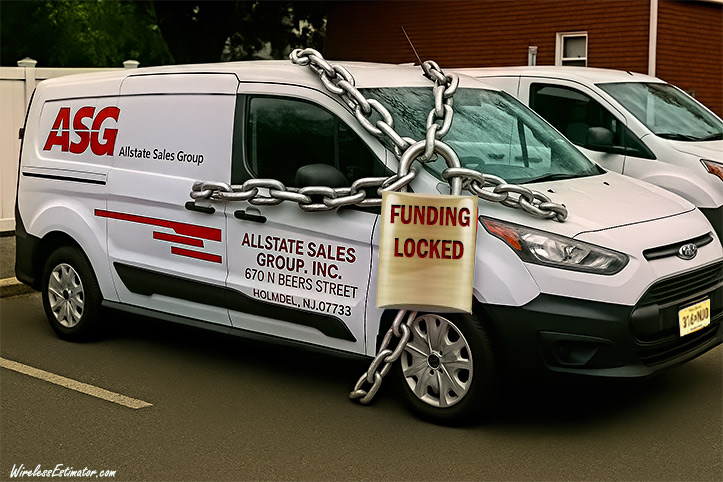
ASG’s lender has put a funding lock on its bank account that paused work, delayed payroll, and will end health coverage for roughly 500 laid-off workers.
UPDATE, Sept. 9, 2025 – A class action WARN Act lawsuit has been filed against Allstate Sales Group and two of its executives.
Telecom infrastructure contractor Allstate Sales Group (ASG) has laid off roughly 500 employees who say they haven’t been paid and will soon lose health insurance, according to multiple individuals who shared internal emails with Wireless Estimator and confirmed the details. As of press time, ASG executives and other company contacts had not responded to repeated requests for comment.
What ASG told its workforce
In an initial companywide message, employees were told, “Effective immediately, we must ask all employees to pause work until further notice,” and, “We are doing everything in our power to get payroll processed as soon as possible, but at this time we have no definitive date.”
The memo added that leadership was “working tirelessly with our banking institution and partners” and that “all options…are on the table, including organizational restructuring,” a red-flag phrase that doesn’t automatically mean bankruptcy. It also advised that Outlook accounts would be temporarily disabled and directed questions to the HR and Payroll inboxes.
A subsequent email to staff offered sharper detail: “At this time, we do not have access to the account that is used for funding,” noting there was still no update on outstanding payroll. It said the group health plan will be canceled within the next 1–2 weeks for non-payment and “COBRA will not be available,” directing workers to the federal marketplace instead.
Employees were informed that they are eligible to apply for unemployment, that their ADP profiles will be updated to “Terminated,” and to use August 29, 2025, as the termination date for their claims.
Company background
ASG is a Holmdel, New Jersey–based contractor that provides telecom and electric-infrastructure engineering, design, and construction services across multiple states. The company’s website said ASG was founded in 2008 as a site acquisition company. ASG has approximately 8 U.S. locations. Their employment page only has one opening for a construction technician in Las Vegas that was posted over two weeks ago.
In 2019, ASG announced an Ireland expansion with back-office hubs in Waterford and Sligo and a plan to create about 200 jobs to support its U.S. telecom work; however, there’s no current indication the target was fulfilled—recent public sources don’t show active hiring there, and ASG’s website today lists only its Holmdel, New Jersey headquarters with no Ireland offices or contacts.
The funding squeeze and why accounts can get locked
In July 2022, bank BHI announced that it had provided $18.35 million in financing to ASG—a package that included a senior secured revolving credit facility, a term loan, and mortgage financing for three properties, as well as a purchase card line.
Facilities of this type commonly include lender control rights over operating bank accounts in the event that a borrower breaches covenants or misses agreed-upon payments. When control is exercised, a company can temporarily lose access to the very account used to fund payroll and premiums—language that mirrors the internal emails seen by Wireless Estimator.
Would a single customer bankruptcy sink a firm this size?
ASG is listed as a contract counterparty in the Everstream Chapter 11 case; sale documents and related filings show proposed cure amounts and vendor entries associated with ASG for $332,000. That exposure is material—but on its own, unlikely to be the pivotal cause of a shutdown at a company employing around 500 people, which would have a bi-weekly payroll of approximately $1.76 million.
According to one project manager, the company owed payments to suppliers and vendors.
Based on employee accounts and internal emails, New Jersey’s mini-WARN law may be implicated if a sufficient number of affected ASG employees worked in or reported to New Jersey.
According to the statute, covered employers (generally 100+ workers) must be given 90 days’ written notice and pay severance of one week per year of service to each impacted employee—plus four additional weeks if the full notice wasn’t provided—and, unlike federal WARN, New Jersey does not recognize an “unforeseeable business circumstances” exception, so a sudden lender funding lock would not necessarily relieve those obligations. Whether the law applies here ultimately depends on employee counts, sites of employment, timing, and the content of any notices.