














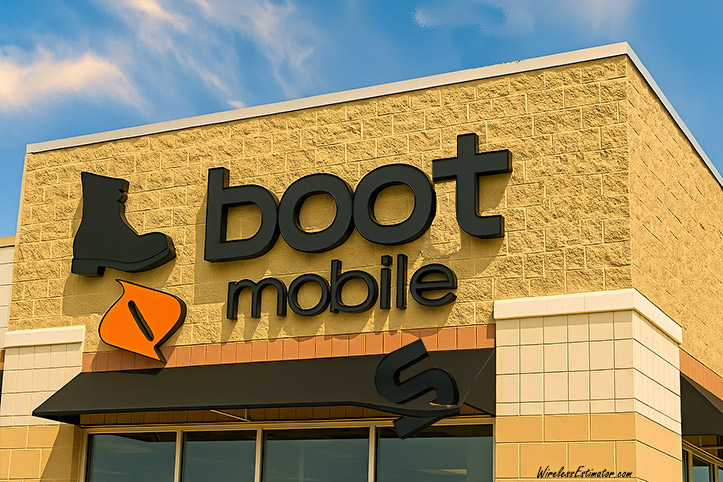
Contractors who once relied on Boost’s 5G buildout are now getting the boot, as EchoStar halts new site construction.
The prospect of Boost Mobile emerging as an actual “fourth national carrier” has collapsed following EchoStar’s multi-billion-dollar spectrum sales to AT&T and SpaceX. Together, the transactions dismantle Dish/EchoStar’s original 5G greenfield buildout and confirm that the U.S. market will remain dominated by the Big Three—AT&T, Verizon, and T-Mobile—for the foreseeable future.
AT&T deal: Spectrum sale and RAN takeover
In late August, EchoStar announced a $23 billion transaction with AT&T to sell its 600 MHz and 3.45 GHz licenses. Just as consequential, AT&T will assume control of the RAN (radio access network) portion of Boost Mobile’s 5G Open RAN build, encompassing thousands of newly constructed cell sites.
Boost will retain its cloud-native core for managing subscriber traffic and billing. Still, without direct control of its RAN, the company shifts to a “hybrid MNO” model: effectively a core-based operator relying on another carrier’s radios for national coverage. For contractors, the signal is clear—greenfield Boost tower builds are coming to an end, while AT&T integration and spectrum deployment projects are poised to expand.
SpaceX deal: Exit from direct-to-device
Days later, EchoStar unveiled a $17 billion agreement with SpaceX for its AWS-4 and PCS H-Block spectrum. The deal delivers cash, equity in SpaceX, and a commitment by SpaceX to cover roughly $2 billion in EchoStar’s interest payments through 2027.
This transaction canceled EchoStar’s recently announced partnership with MDA Space to deliver a proprietary Aurora direct-to-device (D2D) broadband network. Instead, Boost subscribers will be tied into SpaceX’s Starlink Direct-to-Cell platform, with traffic routed through the Boost core. While this ensures satellite coverage extensions for Boost customers, it confirms that EchoStar will not field its own D2D network—ceding ground to Starlink, AST SpaceMobile, Lynk Global, and Amazon’s Project Kuiper.
Billions spent, now handed off
The reversal is stark. As a remedy for the 2019 T-Mobile/Sprint merger, the DOJ and FCC required Boost to be spun off to Dish, which pledged $10 billion to stand up a new facilities-based competitor. Between 2020 and mid-2025, Dish/EchoStar spent about $7.7 billion, constructing roughly 24,000 Open RAN cell sites and covering ~75% of the U.S. population. More than 30 vendors—from radio and microwave suppliers, in addition to tower crews and fiber providers—were enlisted to deliver the build.
EchoStar trumpeted the network as proof of Open RAN’s viability. But with the RAN now transferring to AT&T, those sites will likely be decommissioned or repurposed, and the vendor ecosystem disbanded.
Subscribers: Too little, too late
Marketing was another stumbling block. Boost inherited ~9.3 million prepaid subscribers from Sprint but struggled to shift them onto its facilities. Despite recent net-add momentum, by the end of Q2 2025, Boost had only ~7.3 million total subs, with fewer than one million on its own RAN postpaid plans. By contrast, each of the Big Three supports well over 100 million lines.
The scale gap underscored why EchoStar couldn’t sustain a parallel nationwide buildout. Analysts note that EchoStar’s precarious finances, a declining Pay-TV base, and looming debt maturities forced a retreat.
What remains of Boost
Today, Boost Mobile is positioned as: A prepaid/hybrid operator anchored by its long-term MVNO agreement with AT&T; A cloud-core company, retaining subscriber management but outsourcing radios; A satellite adjunct, offering Boost subs access to Starlink Direct-to-Cell in remote areas.
This hybrid model keeps Boost in the market, but not as a facilities-based 4th carrier. EchoStar has also begun cutting ~500 Boost network jobs, consistent with its lighter-infrastructure posture.
Contractors left hanging
For contractors, the fallout is immediate. The promise of a sustained fourth nationwide buildout meant many hundreds of crews could count on steady new-site construction for years. With AT&T inheriting Boost’s spectrum and RAN, most of that demand is gone.
One contractor told Wireless Estimator that they had already seen work grind to a halt. “We were just doing small maintenance jobs on the remaining sites,” the contractor explained. “We tried to make contact and learned that their office was closed and no one was answering. We’ve reached out to more corporate contacts, like accounting, to see what the status is and haven’t gotten any update.”
That uncertainty is likely to ripple across the vendor ecosystem. Tower owners, subcontractors, fiber installers, and Open RAN suppliers—many of whom had bet heavily on Dish/EchoStar’s $10 billion pledge—may find themselves chasing fewer contracts in a market once again dominated by the Big Three.
What began as a bold $10 billion bet on Open RAN and a fourth national carrier has ended with AT&T and SpaceX absorbing Dish/EchoStar’s spectrum and infrastructure. Boost Mobile survives—but only as a hybrid MVNO with a Starlink partnership, not the market-making competitor regulators once envisioned.
Tower owners and market reaction
For towercos like American Tower, Crown Castle, SBA Communications, and Vertical Bridge, the direct financial hit from Boost’s retreat appears limited, but the industry is watching closely. Analysts note that some Boost equipment will be decommissioned, creating site churn, though contracts provide buffers.
American Tower has a long-term lease agreement with EchoStar running through 2036, which cushions near-term revenue even if sites are retired. SBA estimates about $55 million in annualized EchoStar revenue, warning of elevated churn after 2027–2028 as more sites roll off.
Morningstar labeled the stock-market reaction “overdone,” suggesting the broader demand environment—driven by AT&T, Verizon, and T-Mobile densification—will still fuel steady growth. But the loss of a fourth facilities-based carrier means fewer new tower builds and a heavier reliance on amendments and collocations from the Big Three.
Financial markets have noticed. EchoStar’s stock surged after announcing the sales, while AT&T shares reflected both the cost of the acquisition and the value of added spectrum. Tower REITs didn’t collapse but are being re-rated by investors as expectations shift from greenfield growth to incremental densification.

