















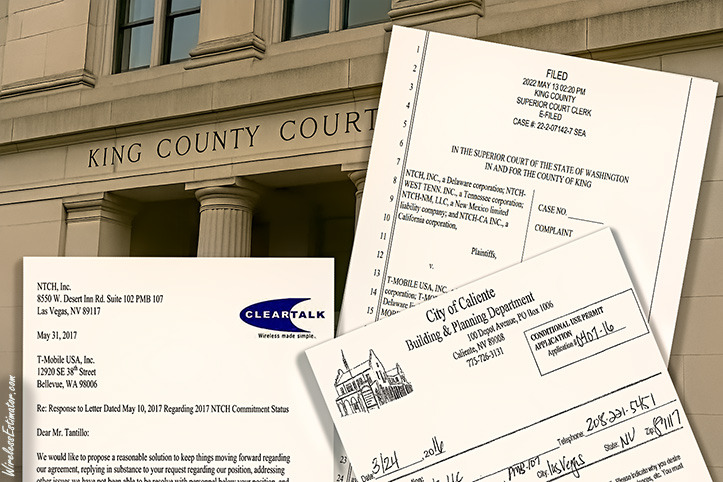
The NTCH v. T-Mobile lawsuit is being heard in King County Superior Court in Seattle, WA, where a jury trial commenced on September 8, 2025, over allegations that T-Mobile failed to honor its commitments regarding tower development. In its experience, NTCH reasonably expected to build at least 100 towers. Had that occurred as expected, NTCH’s return on investment would have exceeded $20 million based on its tower sale deal with Vertical Bridge, the company said.
NTCH, Inc. and several of its affiliates are pursuing a high-stakes lawsuit against T-Mobile USA, Inc. in King County Superior Court in Washington, accusing the wireless carrier of breaching a contractual commitment that was supposed to provide the tower builder with at least 100 new development opportunities under a Build to Suit Master Services Agreement (MSA) signed in 2015.
NTCH claims stem from the T-Mobile spectrum deal
The dispute traces back to a 2014 spectrum deal in which T-Mobile purchased licenses from wireless entrepreneur David Miller at a significant discount. As part of that transaction, T-Mobile pledged to give NTCH the first right of refusal to construct 100 new towers over a four-year period.
The promise was memorialized in the MSA, which anticipated that NTCH would finance and construct the sites, then lease them back to T-Mobile as the anchor tenant. NTCH asserts that the arrangement was worth roughly $20 million in expected revenue, aided by a parallel agreement with Vertical Bridge to purchase the completed towers once T-Mobile leases were in place.
NTCH stresses that it was not merely a contractor. Still, a third-party beneficiary of the spectrum purchase agreement, Miller would not have sold his licenses at a discount had T-Mobile not agreed to create business opportunities for NTCH.
Search ring dispute at the heart of the case
According to the complaint, T-Mobile systematically undermined the deal. NTCH contends that in late 2015, the carrier overwhelmed the company by sending more than 500 search rings in a matter of days, then refused to sign site agreements for any of them.
The lawsuit further alleges that many of the search rings provided were never viable in the first place, located in areas burdened with zoning restrictions, on tribal lands with heavy regulatory barriers, or in markets that had already been offered to competing tower developers.
NTCH maintains that only 32 legitimate opportunities were ever provided. At the same time, T-Mobile has argued that the initial large batches of rings satisfied its contractual commitments despite being later withdrawn or reassigned. For NTCH, those offers were meaningless because the company was denied the ability to advance projects into signed site agreements, leaving the required 100 new search rings unmet.
Costly tower projects left abandoned
The complaint also accuses T-Mobile of stringing NTCH along even after it invested heavily in sites. At the Brewer site near Nashville, NTCH says it spent more than $630,000 on land acquisition and construction, only to have T-Mobile abruptly refuse to sign a lease. Similar situations, where NTCH incurred expenses between $150,000 and $350,000 per site, allegedly left the company with stranded assets and no anchor tenant. NTCH argues that the imbalance of power was stark: the company bore all upfront risks, with per-tower costs ranging from $125,000 to $600,000, while T-Mobile exercised its discretion to rescind commitments without consequence.
T-Mobile merger with Sprint cited as motive
A central theme of NTCH’s case is that T-Mobile’s actions coincided with its merger with Sprint. As those talks advanced, NTCH claims, T-Mobile deliberately slowed or sabotaged new tower builds because Sprint’s existing network assets made additional builds unnecessary. The complaint cites T-Mobile’s own statements to investors that the merger would allow it to avoid building 16,000 new macro sites, boasting of billions in cost savings. NTCH frames this as proof that breaching its commitments was not an accident but part of T-Mobile’s corporate strategy to reduce expenses at the expense of its contractual partner.
NTCH argues public lost out on coverage
Beyond the financial harm, NTCH argues that T-Mobile’s conduct damaged the public interest. The company maintains that by failing to build towers in rural and underserved areas, T-Mobile denied communities access to expanded broadband and more reliable 911 service. NTCH portrays the dispute as not only a broken contract but also a missed opportunity for consumers in markets where wireless coverage remains critical to public safety and economic growth.
NTCH seeks $20 million, treble damages, and costs
NTCH’s legal claims include breach of contract, breach of the implied covenant of good faith and fair dealing, and violations of Washington’s Consumer Protection Act. The company is seeking damages of no less than $20 million, treble damages, and recovery of all litigation costs. The complaint specifically asks the court to require T-Mobile to pay NTCH’s expenses and attorneys’ fees if the plaintiffs prevail, significantly raising the potential liability beyond the alleged lost profits. NTCH has gone so far as to request specific performance, asking the court to compel T-Mobile to provide 68 new search rings and lease space on towers, an unusually aggressive remedy in telecom disputes.
Judge O’Donnell rebukes NTCH at trial
The case, filed in May 2022 under Case No. 22-2-07142-7 SEA, is still pending in King County Superior Court. At the September 2025 bench trial, Judge Sean O’Donnell offered a sharp rebuke to NTCH, chastising the company for attempting to introduce new testimony after earlier representations. “You want tens of millions of dollars from T-Mobile because you think they did you wrong by this lease,” O’Donnell told NTCH’s counsel, warning against shifting theories and stressing the importance of adhering to evidentiary boundaries and trial efficiency. The judge’s remarks underscored the court’s concern with how NTCH has framed its claims as it presses forward with a case that could have implications for both tower developers and carriers navigating similar build-to-suit arrangements.
Damages dispute: Site costs off the table
Another flashpoint in the courtroom yesterday was T-Mobile’s request to limit what damages NTCH can pursue. In a motion in limine filed on September 15, 2025, the carrier asked Judge O’Donnell to exclude all testimony and evidence related to NTCH’s costs of developing sites where T-Mobile never signed a lease, including the high-profile Brewer and Roofing sites .
T-Mobile argued that the Master Services Agreement expressly made NTCH responsible for its own site development costs unless particular reimbursement procedures were followed—such as submitting requests and documentation within 90 days of termination. Because NTCH never filed those reimbursement requests, T-Mobile maintains that the company waived any right to recoup those expenses. The carrier also pointed out that the court had already restricted NTCH’s damages claims to lost profits and lease rents, and that allowing testimony about sunk development costs would confuse jurors and run afoul of evidentiary rules on hearsay and best evidence.
T-Mobile denies breach, outcome uncertain
T-Mobile has denied wrongdoing, maintaining that it met its commitments under the MSA. The outcome of the trial will determine whether NTCH secures the damages and cost recovery it seeks or whether the carrier’s position that its obligations were satisfied prevails.

