















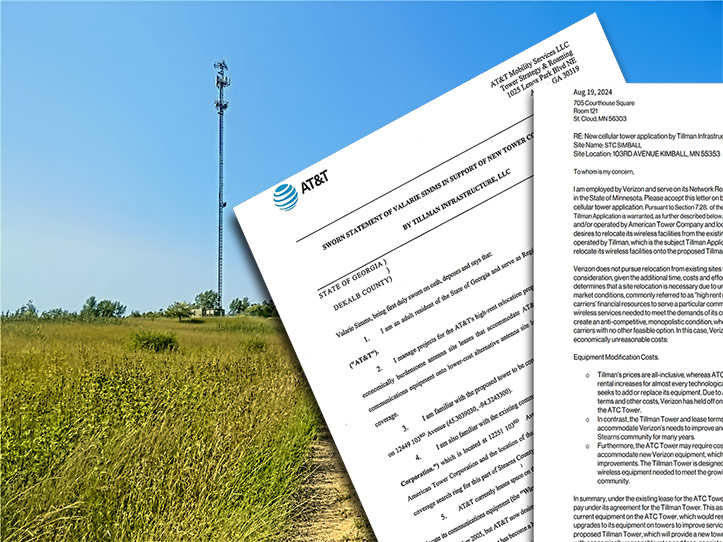
AT&T and Verizon have pledged to relocate from American Tower’s 300-foot Kimball site (shown above) to Tillman’s proposed 325-foot tower nearby, leaving contractors with new build and decommissioning work while stranding the incumbent site.
Tillman Infrastructure has sued Stearns County in Minnesota after the Planning Commission turned down its bid to construct a 325-foot tower in rural Kimball. Tillman says the denial violates the Telecommunications Act of 1996, which requires that local governments’ refusals be backed by written decisions and “substantial evidence.”
But the real story is not the lawsuit itself — siting disputes are common when zoning boards reject tower applications. What makes this case unusual is why the tower is needed.
Not coverage — But cost
Most lawsuits like this argue that new towers are essential to fix coverage gaps or address capacity strain. In Kimball, coverage isn’t the issue. Instead, two of the nation’s biggest carriers — AT&T and Verizon — say they need the Tillman tower, about a mile away, because the existing American Tower site at 2251 103rd Ave., which they utilize for coverage, has become economically unsustainable.
Both carriers submitted letters of support, making clear they plan to relocate to the Tillman site once it is approved.
Verizon: A “high-rent relocation”
Verizon’s letter described its move as a textbook “high-rent relocation.” The company said American Tower’s lease terms are triple the cost of Tillman’s and pile on additional charges for nearly every equipment upgrade. Those “economically unreasonable” costs, Verizon argued, have even delayed technology upgrades in the Kimball area.
By contrast, Tillman’s proposal offers all-inclusive pricing at a significantly lower rent, dedicated space for Verizon’s growth, and structural headroom to accommodate future equipment without triggering new costs. Verizon also warned that a single incumbent tower can create an anti-competitive monopoly, leaving carriers with no choice but to pay inflated rates.
AT&T: Two decades of high rent is enough
AT&T echoed those concerns in its own letter to the county. Its real estate director wrote that AT&T intends to colocate on the Tillman tower because the existing American Tower lease that they have had since 2005 has become an obstacle to serving customers effectively.
AT&T’s engineers determined that the new Tillman facility is necessary to maintain reliable service and to meet future demand for advanced wireless technologies. The carrier pointed to the limitations and escalating costs of its current lease as a barrier to upgrades, saying only a new, reasonably priced tower would allow it to expand capacity in the Kimball area.
AT&T acknowledged that decommissioning an existing wireless facility in favor of moving to an alternate tower is something the carrier will only do in limited circumstances, since the capital cost of also relocating to another structure is not feasible, but the Tillman offer would compensate for those expenses
Manager of “burdensome antenna site leases,” Valarie Simms, said that at the current rate of rent increases, over the next 20 years, the difference in rent paid by AT&T to remain on the American Tower guyed tower versus relocating to the Tillman tower is $2,286,960. She said, “Unlike other tower companies, American Tower has resisted any economically sustainable cost structure with its existing AT&T colocation leases, such that many of these leases have become economically burdensome for AT&T.”
Tillman’s playbook
The Kimball case is a prime example of Tillman’s side-by-side strategy. The company identifies incumbent towers with high rents, then builds new structures nearby. Before breaking ground, it secures anchor tenants — in this case, both AT&T and Verizon — ensuring immediate cash flow. By offering predictable, all-inclusive pricing, Tillman can undercut the incumbent’s lease terms and make relocation attractive.
The outcome is clear: the incumbent tower in Kimball, stripped of its only two tenants, becomes a stranded asset. Also, the rural setting makes it unlikely that American Tower can recruit replacements.
The Kimball project highlights multiple revenue streams for the contracting community. The 325-foot guyed tower will require a full site buildout, from foundations to fencing. With AT&T and Verizon committed to moving in, colocation installation work is guaranteed. At the same time, the American Tower site could see antenna removals and eventual mothballing, creating decommissioning opportunities.

