















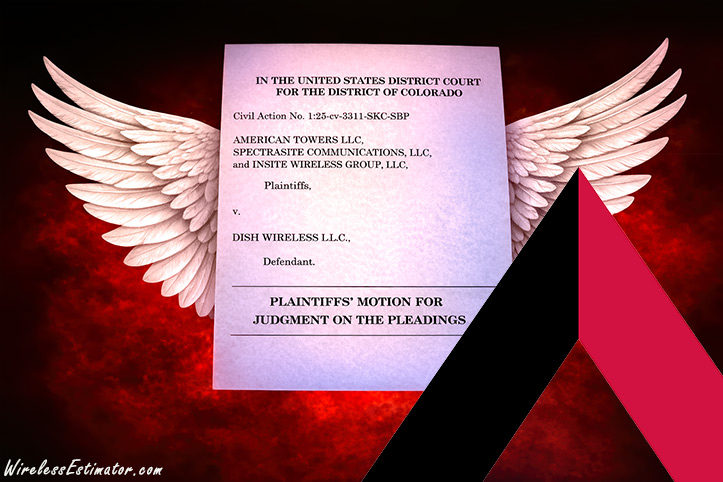
American Tower is asking the court to let its case take flight procedurally, moving for judgment on the pleadings without extended litigation and discovery.
American Tower has escalated its legal battle with DISH Wireless, asking a federal judge to rule as a matter of law that DISH cannot walk away from billions of dollars in tower lease obligations by claiming its business strategy collapsed.
In a Motion for Judgment on the Pleadings filed December 12, American Tower and its affiliates—SpectraSite Communications and InSite Wireless Group—argue that DISH’s attempt to invoke the legal doctrine of “frustration of purpose” fails on its face and should be rejected without discovery or trial.
The filing marks the most aggressive procedural move yet in a dispute that could have sweeping implications across the U.S. tower industry, where operators are watching closely to see whether carriers can retroactively unwind long-term master lease commitments tied to now-abandoned network strategies.
American Tower: DISH made a business choice and must live with it
At the center of the dispute is DISH’s Strategic Collocation Agreement (SCA) with American Tower, which governs thousands of sites supporting Boost Mobile’s 5G buildout. After EchoStar—DISH’s parent—agreed in late summer 2025 to sell approximately $40 billion worth of spectrum licenses to AT&T ($23 billion) and SpaceX ($17 billion), DISH notified American Tower that it believed those transactions “frustrated” the purpose of the SCA.
American Tower’s filing dismantles that argument, asserting that no FCC order or court mandate forced the spectrum sales, and EchoStar repeatedly characterized the transactions as voluntary, strategic, and lucrative.
DISH acknowledged that it intends to continue operating on some American Tower sites, undermining any claim that the agreement’s purpose has been destroyed.
“Frustration of purpose,” American Tower argues, is a narrow doctrine reserved for truly unforeseeable, catastrophic events—not for a carrier that chose to monetize spectrum and pivot its business model.
Foreseeable risks, disclosed years earlier
The motion also highlights DISH’s own public disclosures, including SEC filings dating back to 2019, in which the company warned investors that the FCC buildout milestones might not be met; that spectrum licenses were subject to modification or revocation; and that regulatory actions could materially harm the business.
Because those risks were explicitly acknowledged before the SCA was signed, American Tower contends that DISH cannot now claim surprise or impossibility when those risks materialized—or were voluntarily avoided through a spectrum sale.
“Cash-rich” after spectrum sales — but rent-free?
Perhaps most damaging to DISH’s position, American Tower points to EchoStar’s own statements to regulators and investors, which describe the transactions as leaving the company “cash-rich” and enabling Boost Mobile to become “way more competitive.”
Courts applying New York law—the governing law under the SCA—have consistently ruled that a party cannot invoke frustration of purpose when it has made a conscious business decision that renders a contract less attractive or more expensive to perform, the filing argues.
WIA registers its concerns with the FCC
In a letter filed with the FCC, WIA – The Wireless Infrastructure Association warned that EchoStar must not be permitted to use the spectrum assignment process as a means to unjustly enrich itself at the expense of the infrastructure companies and partners that helped make its spectrum transactions possible.
WIA said EchoStar, through written communications from its wholly owned subsidiary DISH Wireless, has made clear it does not intend to use proceeds from its substantial spectrum sales to meet existing contractual obligations. The association urged the Commission to clarify that it provided no such performance excuse. It cautioned that allowing EchoStar to proceed in this manner would undermine the wireless infrastructure ecosystem, disrupt current 5G and future 6G deployment, and erode the integrity of the FCC’s spectrum assignment process.
Consistent with prior Commission precedent and the public interest, WIA said EchoStar must honor its agreements and ensure DISH Wireless has sufficient funds to pay obligations owed to the companies that supported license buildout requirements, noting that decisive FCC action could help prevent unnecessary litigation and what it described as corporate “shell games.”
A bellwether case for the tower industry
As Wireless Estimator previously reported, tower companies collectively face potential exposure approaching $9 billion if DISH were allowed to shed its lease obligations en masse. The Colorado case mirrors concerns raised across the industry, including earlier actions by other tower owners seeking to enforce master lease agreements despite DISH’s retreat from its nationwide facilities-based wireless ambitions.
By seeking judgment on the pleadings, American Tower is effectively asking the court to shut the door early on what it characterizes as a legally defective defense—before discovery, expert testimony, or protracted litigation.
If granted, the ruling would not only secure American Tower’s position but also set a powerful precedent limiting carriers’ ability to rewrite infrastructure contracts when strategic bets fail retroactively.
For now, the case puts a sharp legal spotlight on a question reverberating throughout the wireless ecosystem: Can a carrier abandon its network vision and still walk away from the towers that made it possible?
