














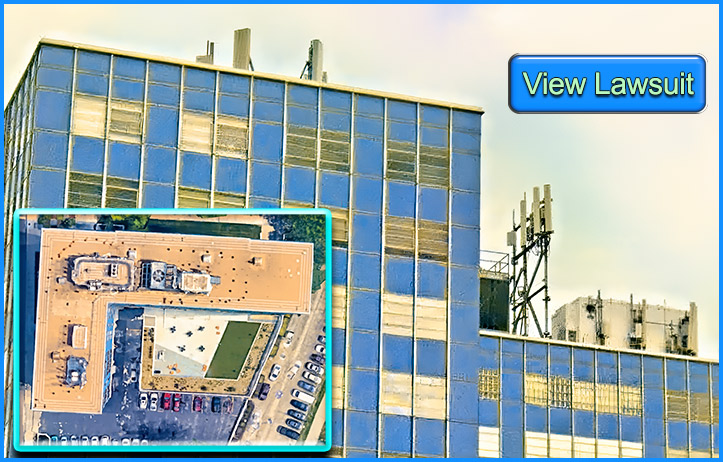
Verizon has asked a federal court to block rooftop construction at the Brookside condominium building, arguing that planned HVAC and boiler work would interfere with a long-standing cell site serving thousands of Kansas City customers. The condominium association claims Verizon’s antennas caused roof damage, a charge the carrier disputes. A judge has temporarily paused the case after ruling Verizon must amend its complaint before emergency relief can be considered. (Google Earth images)
Verizon Wireless has filed a federal lawsuit seeking emergency injunctive relief against a Kansas City, MO condominium association, arguing that planned rooftop construction could interfere with a long-standing cell site and disrupt wireless service for thousands of customers across the city.
In a complaint filed in the U.S. District Court for the Western District of Missouri, available here, Cellco Partnership, doing business as Verizon Wireless, alleges that the 333 Meyer West Condominium Association intends to proceed with rooftop construction and equipment installation that would obstruct or require removal of Verizon’s antenna equipment, actions Verizon says violate a Rooftop Lease Agreement that dates back more than three decades.
The 12-story mid-century building, widely known in the Brookside neighborhood as the Blue Goose, was built in 1955 and has hosted Verizon antennas since the early 1990s. At the site, Verizon serves more than three square miles and provides wireless service to thousands of users, including residents, businesses, schools, healthcare providers, municipalities, and first responders.
Verizon argues that any interruption to the site would cause immediate and irreparable harm that cannot be remedied through monetary damages alone.
Dispute over alleged damage and planned construction
The dispute escalated in August 2025, when the condo association informed Verizon that the weight of its antenna equipment had allegedly caused damage to exterior masonry walls on a rooftop penthouse and that repairs costing approximately $120,000 would be required.
Verizon disputes the claim, stating the association has failed to provide engineering analyses or other evidence linking the alleged damage to Verizon’s equipment. According to the complaint, Verizon construction engineer Bryan Widman inspected the site in November and observed no structural damage attributable to the antennas.
During that visit, Widman also observed that the association had already installed steel framing for new HVAC and boiler equipment immediately adjacent to Verizon’s antennas and indicated that additional rooftop construction was scheduled to begin in January 2026. In an affidavit, Widman stated that if the proposed HVAC and boiler equipment were installed as planned, Verizon’s antennas would be blocked and rendered inoperable, causing service outages across the coverage area.
“If that equipment were installed, Verizon’s antenna would not be able to operate,” Widman wrote, warning that the signal obstruction would disrupt service for customers who rely on the site.
Lease rights and failed negotiations
Verizon’s complaint emphasizes that the rooftop lease agreement, originally executed in 1993 and amended five times, most recently in November 2025, grants Verizon the right to install, operate, and maintain its equipment and guarantees quiet enjoyment of the premises. Verizon contends the lease does not permit the association to move or remove its antennas or otherwise interfere with network operations.
Emails included in the filing show the parties discussed the possibility of temporarily relocating Verizon’s antennas while masonry repairs were performed. Verizon estimated such a relocation would cost between $80,000 and $100,000 and maintained that any move would need to be approved through a lease amendment and performed at the association’s expense.
The association countered that it would cover the masonry repair costs if Verizon paid for relocating its equipment, and warned it would seek court intervention if no agreement was reached. Correspondence also shows the association declined to engage in lease renegotiations, including Verizon’s separate request to reduce its monthly rent, until the rooftop dispute was resolved.
Negotiations continued through the fall but ultimately broke down. In late December, Verizon requested written confirmation that no rooftop work would proceed while discussions continued. The association responded that its volunteer board was unavailable during the holidays and could not provide formal assurances. Verizon filed suit six days later, on the final day of 2025.
Association responds; court pauses emergency request
The case was temporarily delayed when U.S. District Judge Beth Phillips ruled that Verizon’s initial complaint did not sufficiently establish federal jurisdiction and ordered the carrier to file an amended complaint within 14 days. Until that occurs and the court rules on Verizon’s request for emergency relief, no injunction is in place preventing the association from proceeding with rooftop construction that Verizon says could disrupt wireless service.
For now, Verizon’s antennas remain in place, and the dispute over lease rights, alleged damage, and rooftop construction remains unresolved.
Editor’s Note: For over 21 years, Wireless Estimator, without pay walls, has gone beyond surface-level press releases and generic reports skinned from other media. To stay informed with exclusive news, industry updates, and in-depth investigative articles you won’t find anywhere else, subscribe to our news releases on our home page today. And if you’re a supplier, service provider, or contractor, you’ll need to be listed at no charge in the industry’s most successful buyer’s guide, the BLUE BOOK, with almost 1.3 million ad views and the only industry platform offering Quick Connect to ensure your company’s success. Other time-honored, successful advertising opportunities are available here.

