












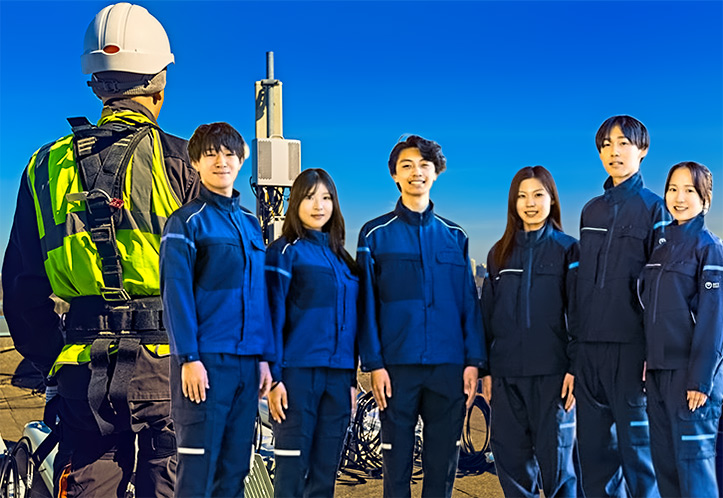
Mobile carrier NTT East Japan’s redesigned field uniforms—set to roll out in autumn 2026—emphasize heat mitigation, cold and wet weather performance, mobility, and inclusive sizing for technicians working in increasingly extreme conditions, reflecting a growing recognition that modern network construction demands workwear designed for safety, comfort, and full-harness use rather than appearance alone.
What may appear to be a routine wardrobe update in Japan is, in practice, a recognition of the same environmental and jobsite pressures already confronting U.S. tower technicians.
Japan’s largest mobile carrier, NTT East Japan, has announced it will roll out redesigned, eco-friendly uniforms for its field engineering workforce, which includes tower technicians, beginning in autumn 2026, citing rising temperatures, heavier rainfall, evolving safety requirements, and changes in workforce composition.
Those drivers are hardly unique to Japan.
Climate extremes are a shared reality
Japan’s summers regularly reach the 90s°F with high humidity, while winters in northern regions fall well below freezing amid snow, ice, and wind. American tower crews face equal—and often harsher—conditions.
In the Dakotas, winter temperatures routinely drop to –10°F to –20°F, with wind chills far lower on exposed structures. Summer temperatures across the Midwest frequently exceed 95°F, while Nevada crews often work in temperatures of 105°F to 115°F.
Add Florida, Texas, and Arizona, and U.S. technicians regularly work in heat indices that rival or exceed those in Japan.
Earlier this week, the lowest reported temperature in the contiguous United States was approximately −43 °F in northern Minnesota, with temperatures outside NATE’s Watertown, SD office dropping to −10 °F today.
The environmental stressors driving NTT East’s redesign are already daily realities for American tower workers.
Designed for the harness, not the brochure
What sets NTT East’s initiative apart is its emphasis on field functionality for both sexes, particularly for technicians working in full-body fall-protection harnesses.
The redesigned uniforms include:
- Chest pockeare ts are accessible while harnessed
- Heat-stress and high-ventilation materials
- Reflective elements for low-light and roadside work
- Recycled stretch fabrics for mobility and durability
- Ambidextrous pocket layouts and inclusive sizing
- An emergency whistle is integrated into the zipper pull
NTT East credits a field-driven improvement program, including input from women working in telecom construction roles, for shaping the design. This approach contrasts with the procurement-driven decisions common in the U.S.
A familiar contrast for U.S. contractors
While U.S. carriers routinely emphasize safety in messaging, uniforms and workwear are typically treated as a cost center, pushed downstream to contractors already squeezed by pricing pressure and rigid MSAs. Heat mitigation, ergonomic design, and harness-compatible clothing are often left to individuals
While NTT East has not said whether the redesigned uniforms will extend to subcontractors, the carrier already tightly controls outside construction work through a pre-qualified outsourcing framework, limiting work in common or high-risk areas to licensed firms with proven experience on NTT facilities—raising the question of whether workwear standards could eventually follow the same path.
NTT’s uniforms are also geared towards women
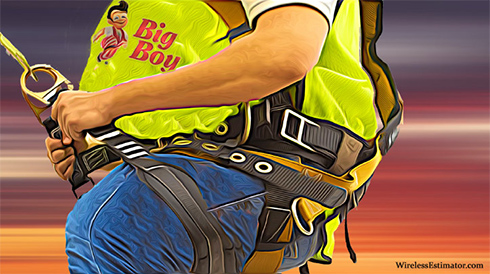
OSHA HAD PREVIOUSLY ESTIMATED that construction employees who may require non-standard sizes of PPE are 114,369 men above 300 pounds, 11,113 women above 300 pounds, and 57,498 women under 5 feet tall. OSHA had not identified how many men met the 5-foot threshold or how many women were tower technicians.
Although NTT East says the redesigned uniforms feature inclusive sizing—an emphasis that, in Japan, may be informed by a construction labor pipeline where women accounted for about 6% of newly hired “skilled workers” in 2024, there’s no telecom-tower dataset that allows a clean comparison to the U.S. In the U.S. tower segment, the available evidence is mostly observational: Wireless Estimator’s resume board activity, contractor team imagery, and two decades of field reporting suggest that female tower technicians likely represent between 1% and 2% of the climbing workforce.
OSHA took a meaningful step last year with its properly fitting PPE rule for construction harnesses, effective January 13, 2025, to ensure PPE is selected and sized to fit each worker, including women’s sizes and smaller-framed workers.
OSHA’s proposed federal heat standard remains unfinalized and under agency review, with the rule now in the post-hearing phase after public comments and hearings concluded in 2025, leaving employers, for now, subject to guidance and enforcement under the General Duty Clause rather than a binding national heat-specific regulation. NATE: The Communications Infrastructure Contractors Association advocated for industry-specific adjustments to the safety proposal.
More than a wardrobe change
NTT East says the uniforms will begin rolling out in autumn 2026, with wear expected to start on October 1. While modest in scope, the initiative signals that at least one major carrier views heat stress, mobility, and on-structure practicality as operational risks worth addressing directly.
For U.S. tower crews climbing through sub-zero winters and triple-digit summers, the takeaway is clear: the conditions driving change overseas already exist here, ere and tower techs have adapted to what works best in the field.