

















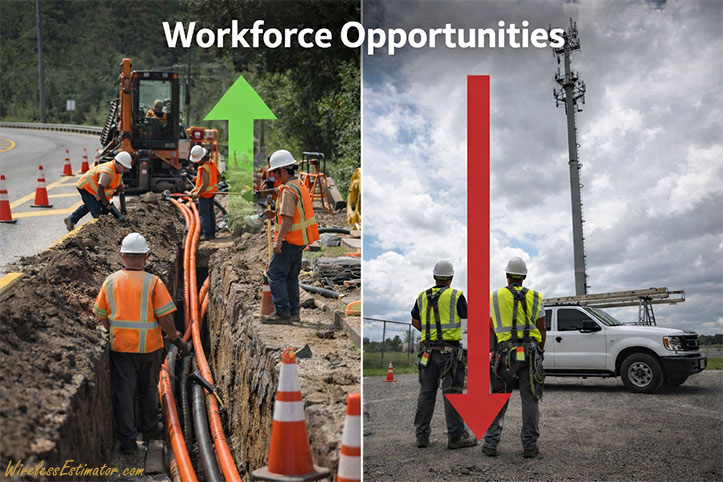
Industry observers warn that even as demand for fiber-optic installers accelerates and billions in BEAD funding flow into broadband builds, major providers may ultimately mirror the wireless sector’s playbook—driving down installation pricing, compressing contractor margins, and creating what some are already calling “Wireless Construction 2.0.”
A Wall Street Journal report this week highlights a stark labor imbalance in the broadband construction sector; while demand for high-speed fiber deployment is surging nationwide, contractors are struggling to recruit sufficient qualified workers to build the networks.
Record federal broadband funding, expanding data-center connectivity needs, and the push for universal high-speed internet have driven intense hiring for drillers, linemen, and fiber splicers—roles that now command rapidly rising wages.
Experienced directional drill operators can earn from the high-$20s to mid-$40s per hour, roughly double some state median wages. At the same time, telecommunications line installers earned a median annual salary of approximately $70,500 in 2024, well above the $49,500 median for all U.S. occupations.
Entry-level fiber workers can earn approximately $60,000 with overtime, according to the Wall Street Journal, with pay often rising 25% to 30% within a few years; site superintendents can earn six-figure incomes. Industry forecasts suggest demand could create 58,000 new jobs by 2032, yet retirements and attrition may leave a shortfall approaching 178,000 workers, threatening timelines for nationwide broadband and AI-driven infrastructure.
It’s in sharp contrast to the wireless contracting workforce
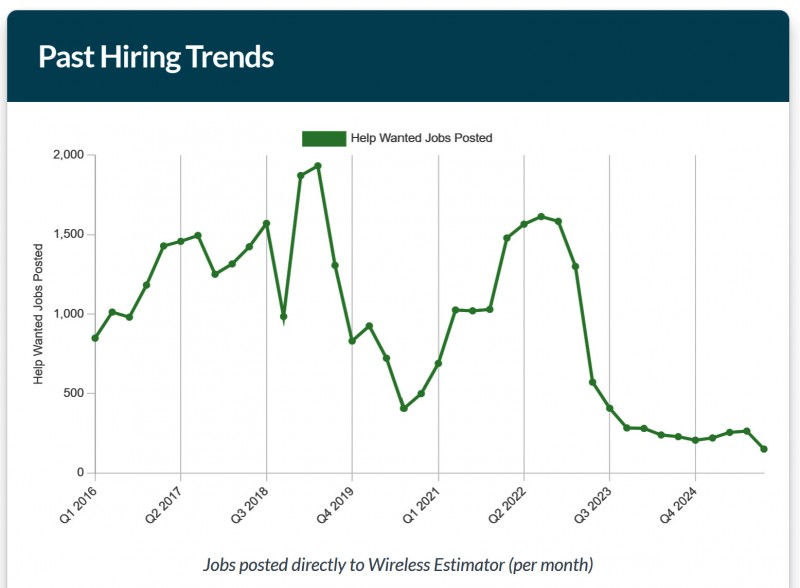
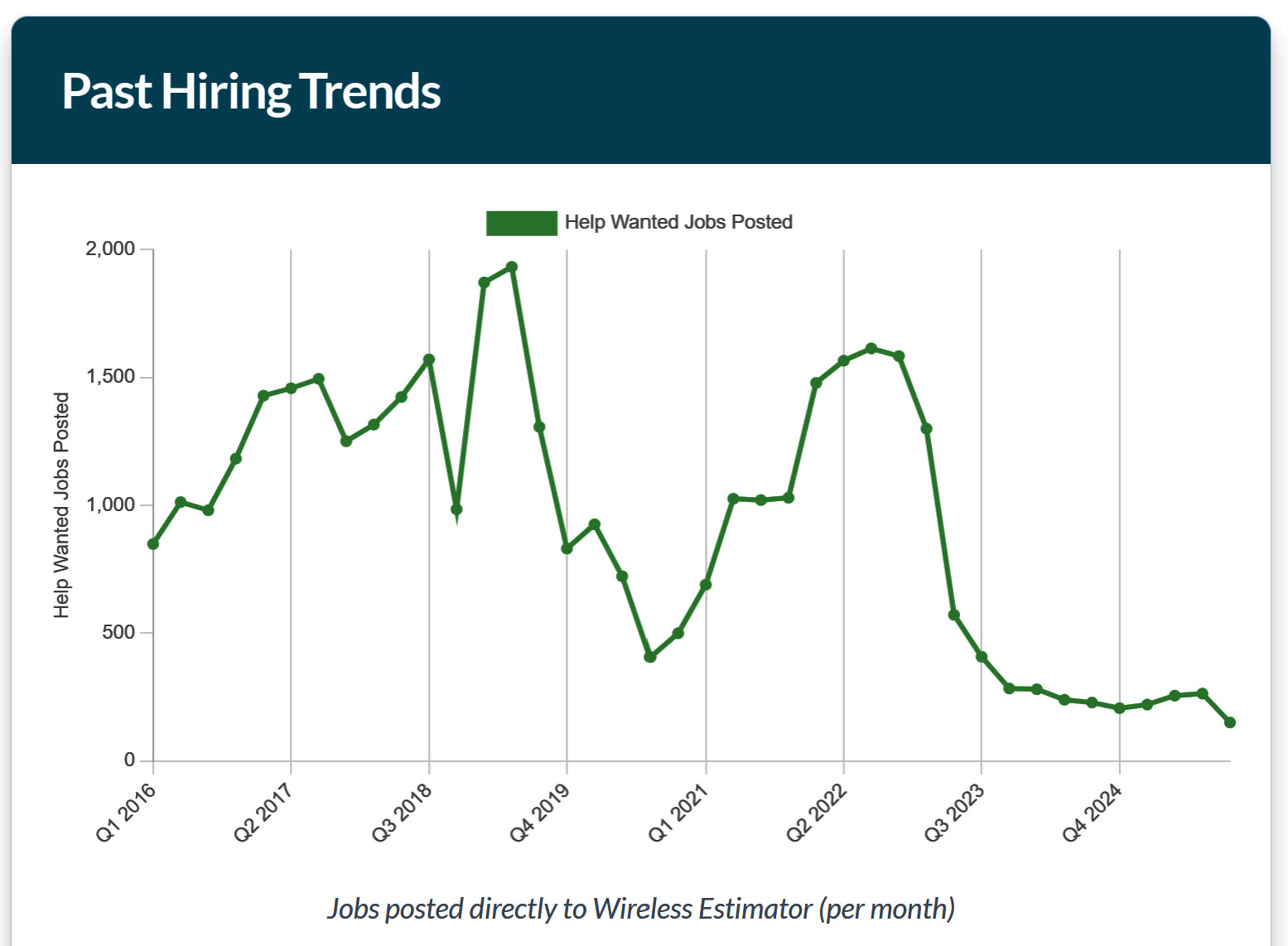
That tightening labor market stands in sharp contrast to conditions in the wireless tower construction workforce, which in the fourth quarter of 2025 hit a 20-year low.
 Rather than a shortage, many tower technicians and construction professionals are facing layoffs as contractors struggle to survive under matrix pricing, compressed margins, and reduced carrier spending. Numerous firms have downsized or exited the market entirely, leaving experienced climbers and project personnel seeking employment even as fiber construction wages rise.
Data from Wireless Estimator’s long-running employment barometers underscores the divergence. The industry’s Help Wanted job board—tracked for 20 years as a proxy for tower-sector health—shows available positions down roughly 60% compared with recent years, while the site’s résumé board indicates workers seeking employment have surged more than 300%.
Taken together, the two trends reveal a widening split within the communications infrastructure: fiber broadband construction is constrained by insufficient labor. At the same time, the tower sector is increasingly characterized by insufficiently sustainable practices.
Five years ago, industry associations and community colleges promoted the largely unsubstantiated claim that tens of thousands of additional tower technicians were urgently needed. At the time, the Wall Street Journal similarly reported strong demand for tower workers, citing competitive pay that could push entry-level climbers above $50,000 annually, including bonuses. In contrast, experienced foremen were reported to earn more than $90,000 per year.


