















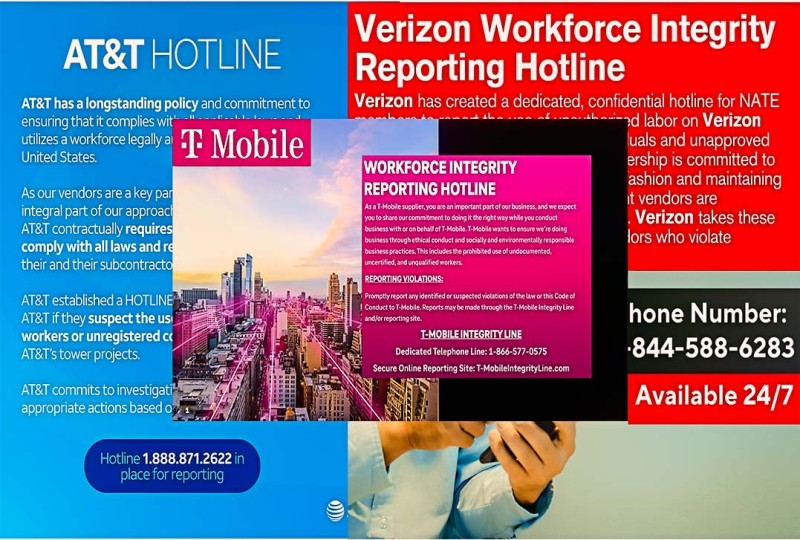
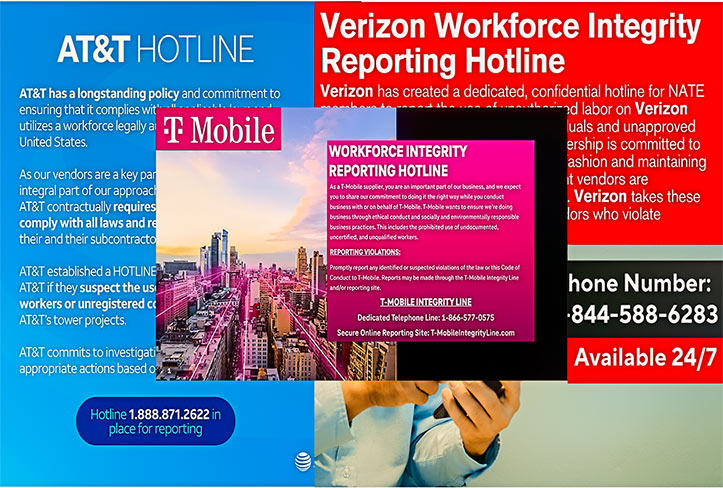
Due to NATE: The Communications Infrastructure Contractors Association’s advocacy, carriers have established reporting hotlines for unsafe and uncertified crews and companies, but using them comes with risks, and not all hotlines are created equal.

A CATHEAD ON the back of an SUV signals exactly the kind of safety and compliance red flags that carrier hotlines are designed to capture and investigate.
It would be foolish to think that the three major carriers — at the infrastructure build management level — are unaware of the flagrant workforce abuses occurring on many of their projects. The evidence is too widespread, the patterns too consistent, and the competitive pricing too implausible to attribute to ignorance.
A troubling practice is the misuse of H-1B employer-sponsored visas to fill tower technician positions. The H-1B program was designed for foreign professionals in specialty occupations that require at least a bachelor’s degree or its equivalent — such as software engineers, architects, and scientists.
It was not designed to bring Eastern European or other foreign nationals to American tower sites to perform physical infrastructure work. Yet contractors across the industry have reported encountering crews whose presence on job sites appears tied to exactly that kind of visa misuse.
More alarming still is the documented use of undocumented immigrants, shifted deliberately from market to market to minimize their visibility and reduce the likelihood of detection.
In some cases, these workers are paid at or near minimum wage for some of the most dangerous work in American industry.
When they raise concerns, they are reportedly told they will be left on their own — and exposed to immigration authorities. The threat is effective. Workers who came to this country seeking a way to send money home to impoverished families in El Salvador, Mexico, and other countries are not in a position to file complaints. They go quiet, return to the job, and the cycle continues.
The carriers know, or should know, this is happening beneath them in their supply chains. That is what makes establishing contractor reporting hotlines both necessary and, for skeptics, insufficient on its own.
The question is not whether the infrastructure exists to report abuses — it is whether the carriers have the will to act on what is reported, and whether the contractors who witness these violations can do so without risking their own livelihoods.
For years, legitimate wireless infrastructure contractors have watched helplessly as improperly classified 1099 workers and uncertified crews undercut them on price — winning jobs that legal, fully compliant businesses cannot afford to take. The reason is straightforward: a contractor running a real operation carries real overhead.
Taxes, workers’ compensation, liability insurance, licensing fees, 401(k) contributions, and safety compliance costs are not optional. For a crew assembled through a Facebook post promising daily cash pay, they effectively don’t exist.
Some turfing contractors and carriers have turned a blind eye to the problem for years, content to meet their build projections and stay within capital expense targets regardless of how the work was actually getting done.
The human and competitive cost of that indifference has been severe. Legitimate contractors have been forced to shutter businesses they spent decades building. And because many of these impromptu crews lack the structure, training, and discipline that safety requires, the people performing the work, often undocumented, often unqualified, have paid for it with their safety and, hopefully, not their lives.
It is precisely why all three major carriers have now established compliance hotlines allowing contractors to report unsafe, uncertified, or improperly classified workers on wireless sites. And that is why those hotlines were among the most-discussed topics at NATE UNITE 2026 in Las Vegas this week.
AT&T Comes on Board With Its “Speak Up” Line
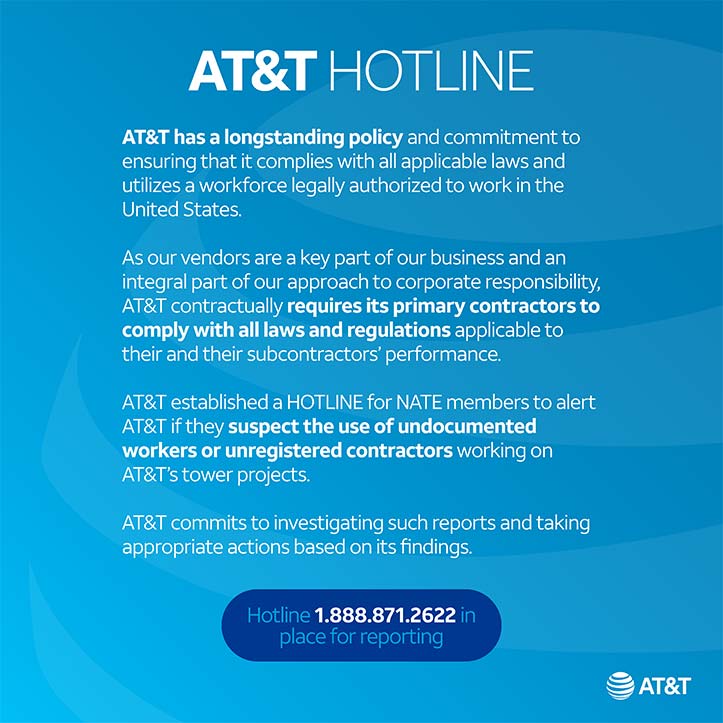
The latest of the three carriers to formalize a reporting mechanism is AT&T, which has activated its Speak Up Line for contractor-related concerns. The number — 1-888-871-2622 — is now live, answered quickly by a third-party operator, and structured around two prompts:
Prompt 1: Imminent Safety Threat (violence, active danger)
Prompt 2: Contractor Concerns (all other matters)
The types of violations that contractors would logically report include undocumented workers, crews in which no one speaks English, companies not registered or licensed in the state where the work is being performed, and blatant disregard for OSHA safety standards — such as free climbing, improper use of hoisting equipment, and similar hazards.
While those last-mentioned items could technically qualify as imminent safety threats under Prompt 1, in practice, by the time an investigation begins, the crew will likely have completed the work and moved on. AT&T is nonetheless interested in learning about those violations and routing them through Prompt 2, as general contractor concerns may ultimately lead to more thorough follow-ups.
Notably, this hotline number has been in place for many years and is not NATE-specific — any contractor can call it.
Details Matter
For AT&T to take meaningful action on a report, callers need to come prepared. That means time-stamped photos or other documentation, the tower owner’s site ID, the date and time of the observed violation, and, if possible, research confirming whether the company in question is actually licensed in the state where the complaint originates. AT&T is expected to provide a mechanism for uploading photos. The more specific and documented the report, the greater the likelihood of a real response.
Callers who wish to remain anonymous should state that preference clearly when the third-party operator answers.
T-Mobile: Third-Party Platform, But a Broken Link
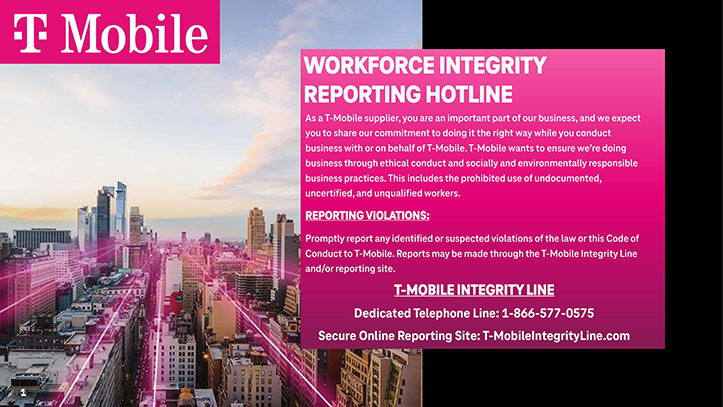
T-Mobile’s hotline, prominently promoted by NATE in a T-Mobile-provided graphic, is technically described as for NATE members—but a call to the reporting line confirmed that the third-party handling of complaints does not verify NATE membership, does not disclose caller information to T-Mobile, and will accept reports from any contractor.
The platform T-Mobile uses is Convercent, now owned by EQS Group — a well-regarded, purpose-built anonymous reporting system. Convercent allows users to file under a fictitious name, monitor their case status, and submit additional documentation through a secure, anonymous portal. Response times are typically measured in days. For NATE members and contractors with legitimate, documented complaints, the platform is worth using — and worth monitoring after submission.
There is, however, a significant operational problem: the website referenced while callers are on hold, https://T-MobileIntegrityLine.com, does not work and takes too long to respond. Most people would give up at that point and never file a report. The correct URL is https://www.t-mobile.com/responsibility/legal/integrity-line, which routes to the Convercent platform.
Verizon: The Least Transparent — and the Least Compliant
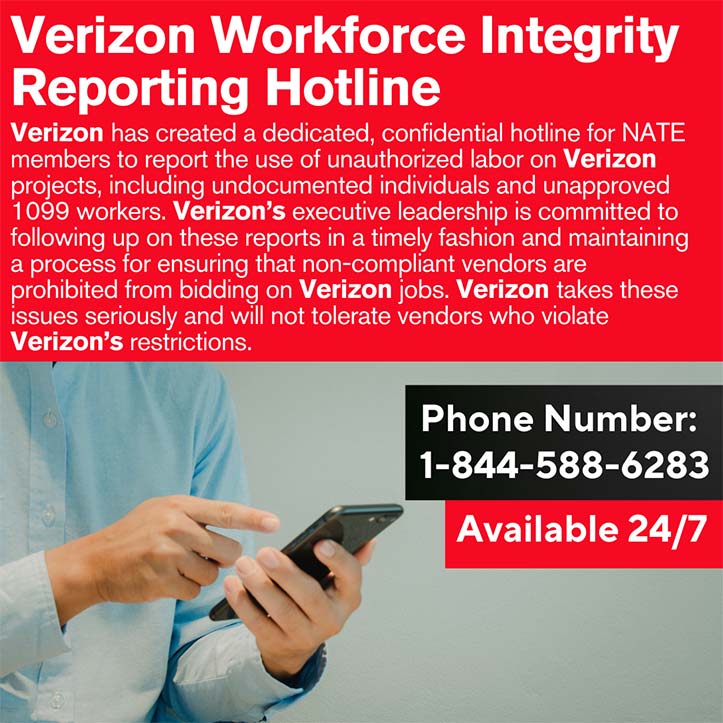
Verizon’s reporting line, 844-588-6283, identifies itself in a recording as a NATE hotline but stands apart from the other two in a troubling way: it requires callers to provide their name, contact information, and company details.
Unlike T-Mobile’s Convercent platform or AT&T’s clearly identified third-party operator, Verizon’s system does not clearly establish itself as an independent, anonymous platform. For a contractor worried about retaliation, that distinction is not a minor procedural detail; it is the difference between filing a report and staying silent.
That lack of transparency fits a broader pattern. Of the ten commitments Verizon made to the FCC as part of its framework agreement with NATE, reportedly only three have been delivered to date: reimbursement of third-party onboarding platform fees, establishment of the toll-free hotline, and 30-day payment terms.
And even that last item is now in question. As reported by Wireless Estimator, Verizon informed contractors earlier this month that it was moving payment terms to net 90 days, effective February 2026, a direct contradiction of the commitment made in its May 2025 FCC filing. Following public exposure of the discrepancy, Verizon recommitted to the original 30-day terms. The carrier has not responded to requests for additional information on its broader compliance status.
Speak Up — But Understand the Risk
At NATE UNITE’s Monday session, NATE President and CEO Todd Schlekeway made a direct appeal to contractors to put their names behind the reports they file. “Anonymous reports carry half the weight of a named report,” he told the room. “When you put your name on it, it creates accountability on both sides.”
It is the right instinct. It is also, for many contractors, easier said than done.
Wireless Estimator has documented multiple instances in which contractors who raised concerns, whether with carriers, state agencies, or through formal complaint channels, faced professional consequences.
Some were told their work would be redirected. Others watched their job flow diminish without explanation. Filing a named complaint against a crew working for the same GC that controls your access to a carrier’s work is not an abstract risk. For contractors whose entire business depends on a single carrier relationship, it can be an existential one.
The same dynamic applies to reporting through government channels. Contractors have filed complaints about 1099 misclassification with Secretaries of State, Departments of Revenue, unemployment tax offices, and workers’ compensation boards — and received little or no meaningful response.
The carriers, by contrast, have both the access and the contractual authority to investigate and disqualify companies that are not operating legally on their projects. That is precisely why these hotlines matter, and why their integrity, anonymity, and follow-through are not optional features.
What Should Be Reported — and How
Regardless of which carrier’s hotline you are using, the following violations are some of the most appropriate to report:
- Workers who appear undocumented or do not speak English on a safety-critical job site
- Companies not registered or licensed in the state where work is being performed
- Free climbing, improper hoisting practices, or other OSHA safety violations
- Crews assembled through social media, soliciting daily cash pay
- Companies pay workers as 1099 contractors to avoid taxes, insurance, and workers’ compensation obligations
Document everything. Time-stamped photos, site IDs, dates, company names, and any licensing information you can verify in advance will all strengthen the report and increase the likelihood of a real investigation.
The carriers have the tools to act on this information. Whether they consistently choose to use them, and whether the hotlines they have established represent genuine commitment or compliance window dressing, are questions the industry will be watching closely in the months ahead.
A Confidential Record for Those Who Report
Contractors who file a complaint through any of the three carrier hotlines are encouraged to submit a brief, confidential overview of what they reported to Wireless Estimator at info@wirelessestimator.com. Wireless Estimator will use the information solely to track the volume and nature of complaints filed and to follow up with carriers at a general level on their compliance with the framework commitments.
No personal or company information will be shared, and Wireless Estimator will not adjudicate individual contract disputes or complaints. The goal is simple: to build an independent, documented record that shows whether these hotlines are generating real carrier responses or exist primarily on paper.
