














For wireless infrastructure contractors who have spent the past three years watching carrier capex decline and work slow, this week’s FirstNet announcement deserves a close read.
AT&T and the U.S. Department of Commerce announced a $2 billion agreement in principle to expand and upgrade FirstNet, America’s dedicated nationwide public safety broadband network, though only $1 billion represents new money from AT&T, with the remainder coming from a reduction in fees AT&T had been collecting under the original contract terms.
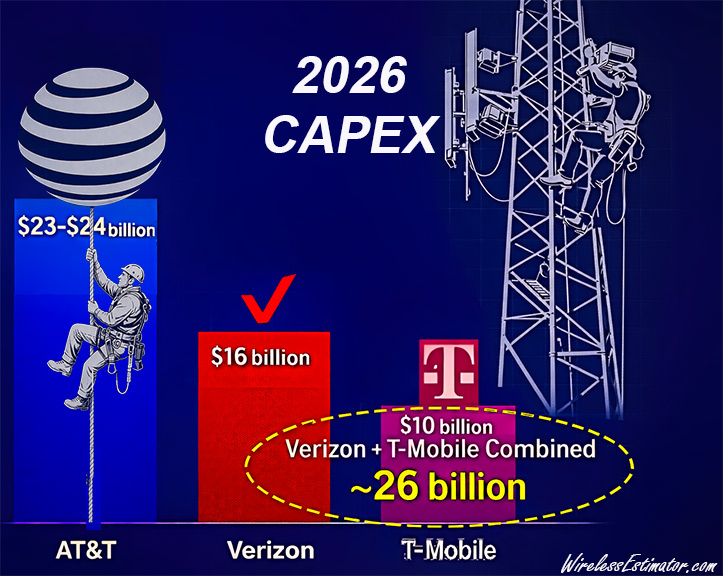
More importantly, it comes at a moment when AT&T’s two major competitors are cutting spending. Verizon’s 2026 capex guidance is $16 to $16.5 billion, down from $17 billion in 2025. T-Mobile’s 2026 capital expenditure guidance is $10 billion. AT&T is guiding to $23 to $24 billion in capex for 2026 alone, almost as much as Verizon and T-Mobile combined, with a five-year commitment recently announced that analysts estimate at roughly $50 billion annually.
The contractor community hasn’t seen a spending gap this lopsided among the Big Three in years.
The FirstNet Deal — Two Separate Billion-Dollar Streams
The $2 billion breaks into two distinct parts. The first $1 billion comes from AT&T reducing what it charges the federal government to operate FirstNet Government Technology, a renegotiation triggered by the Trump administration’s contract review initiative that effectively found AT&T had been overcharging.
That money stays in the FirstNet program, directed by the FirstNet Authority Board. It could be used for public safety to enhance the network with site builds, in-building coverage, additional deployables, and other benefits to the program.
The second $1 billion is a direct new investment from AT&T itself, targeted at closing coverage gaps, adding 5G capabilities, and beefing up mobile deployable units that restore service during disasters. Hoodline: Both streams ultimately flow to contractors on the ground.
The deal also builds on a 10-year, $8 billion initiative launched in 2024, as part of which AT&T has already rolled out 1,000 new cell sites across 46 states and Washington, D.C., many in rural, tribal, and critical public safety locations such as hospitals, fire stations, and law enforcement facilities.
The New Sites Pipeline — Where Contractors Will Work
Those 1,000 sites were not a ceiling. They were a starting point. AT&T completed the launch of the required FirstNet cell sites nine months ahead of schedule and is already working on the next round of purpose-built sites targeting tribal, territorial, and rural areas.
FirstNet Authority is directing AT&T to deploy more than 135 additional new, purpose-built cell sites across the country as the next wave of expansion.
More than two-thirds of the sites are focused on rural and tribal areas, with the vast majority enhancing coverage at key public safety locations such as fire stations, police departments, courthouses, and hospitals.
When AT&T puts up a Band 14 cell tower, and it has spare capacity, the general public can take advantage of that spectrum, and when AT&T hangs a Band 14 radio, they often also hang an additional radio for commercial users.
So even though FirstNet is not a rural broadband program, it has provided significant coverage to communities that were previously unserved. For contractors, this means each FirstNet build in an underserved area is effectively a dual-purpose project — and that dual purpose is part of what makes the work pipeline durable.
AT&T’s $250 Billion Commitment — and How It Compares
The FirstNet deal sits within a dramatically larger investment context. AT&T announced more than $250 billion in investment and spending over five years to build the best and largest network, with the capabilities and resilience required for the next era of innovation and economic growth, including accelerating the deployment of fiber, 5G home internet, wireless, and satellite across urban, suburban, and rural America.
At roughly $50 billion per year, AT&T’s commitment dwarfs its competitors’. Verizon’s capex guidance for 2026 is between $16 billion and $16.5 billion, down from $17 billion in 2025, as new CEO Dan Schulman aggressively rationalizes initiatives that fall outside investing in mobile and broadband networks.
T-Mobile’s 2026 capital expenditure guidance is $10 billion. Combined, Verizon and T-Mobile will spend approximately $26 billion in 2026 — roughly half of what AT&T is projecting on an annualized basis under its five-year commitment. As one analyst noted, the $250 billion figure is well above the $113.6 billion in capex analysts had projected for the same period, and AT&T’s 2026 capex guidance alone is already $23 billion to $24 billion.
It is worth noting, however, that analysts have raised legitimate questions about the composition of the $250 billion figure.
AT&T did not state how much of the $250 billion would be spent on network infrastructure buildouts, on deals with other companies, or on new hires, and the announcement contains significant gaps in how those funds are actually allocated.
The $23 billion EchoStar spectrum deal, operating expenses, and lease obligations are all likely folded into that headline number. What is verifiable is AT&T’s actual capex guidance: $23 to $24 billion for 2026 — still approximately 45% more than Verizon and more than double T-Mobile’s planned spend.
The “Thousands of Technicians” Announcement — Read Carefully
Alongside the $250 billion commitment, AT&T announced it would be hiring thousands of technicians in 2026 alone, noting that only 5% of its jobs require a four-year degree, and investing in training, upskilling, and career pathways to keep roles current as tools and technology change.
The announcement generated significant coverage, but contractors should read it carefully. AT&T did not specify the number, the types, or the ratio of direct employees to contractor-sourced field workers.
The description was broad — technicians needed to “build and maintain infrastructure” — covering fiber splicers, customer installation techs, network integration specialists, IT roles, and wireless tower workers.
Tower technicians represent just one slice of a wide spectrum of roles AT&T categorizes under that umbrella. At a time when the wireless tower construction workforce has seen fewer opportunities over the past year as 5G coverage builds wound down across all three carriers, it would be premature to read the announcement as a direct signal of a hiring surge for climbing crews specifically.
What the announcement more accurately reflects is AT&T’s recognition that a multi-year infrastructure buildout of this scope requires a sustained, qualified workforce — and that the industry’s current workforce pipeline is not sufficient to meet that demand.
In that sense, the FirstNet investment, the 5G core buildout, and the fiber expansion may not immediately create a surge in new positions for wireless tower technicians.
Still, they represent something arguably more important in the current environment: the sustained workload needed to keep the existing contractor workforce employed, viable, and growing. In an industry that has watched work slow and companies shrink over the past 18 months, sustainability is not a consolation prize. It is a lifeline.
AT&T’s Investment in the Field Workforce — NWSA Foreman Certifications
AT&T has backed its workforce commitment with a concrete action that matters specifically to the tower construction community. Recognizing that qualified supervisors are the foundation of any effective construction program, AT&T donated $75,000 to the National Wireless Safety Alliance to cover the one-time cost of the NWSA Foreman Certification exam for all TTT-2 certified technicians taking it for the first time, available on a first-come, first-served basis, according to Wireless Estimator.
This isn’t just goodwill — it reflects AT&T’s clear-eyed understanding that the construction pipeline it is now funding requires certified leadership on the ground to execute safely and effectively. Details are available at nws-a.org/foreman-sponsorship.
The Bottom Line
AT&T’s $1 billion FirstNet commitment, layered on top of its $23 to $24 billion 2026 capex guidance and the broader five-year infrastructure pledge, makes it by far the most aggressive investor in wireless infrastructure among the big three carriers at a moment when Verizon is cutting spending, and T-Mobile is holding steady.
For wireless infrastructure contractors, the FirstNet work pipeline — hundreds of new purpose-built sites in rural, tribal, and remote locations, Band 14 radio upgrades at thousands of existing sites, and a 5G core infrastructure buildout — represents years of sustained, real construction activity.
The question for the contractor community is the same one it always is: when AT&T’s construction program accelerates, will your company be positioned — and properly certified — to be on the list to receive it?

