













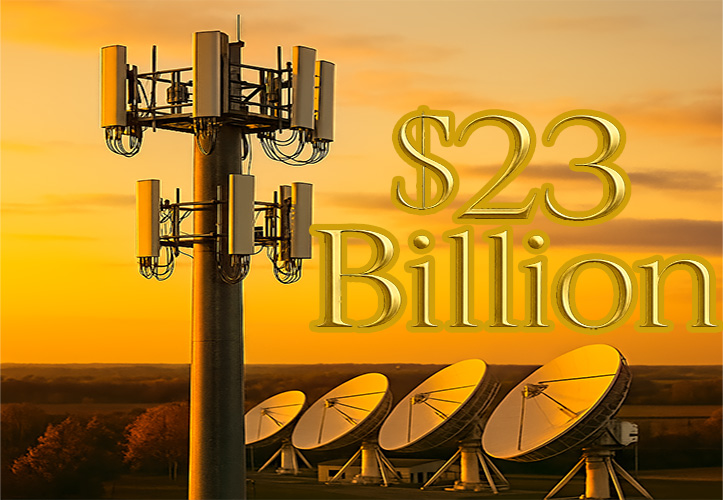
AT&T said it will acquire a nationwide bundle of wireless spectrum from EchoStar for about $23 billion in cash, a move the company says will bolster its 5G coverage and capacity and accelerate growth in both wireless and home-internet services. The deal, which is subject to regulatory approvals, is expected to close in mid-2026.
Under a related agreement, AT&T and EchoStar will expand their long-term wholesale network relationship, enabling EchoStar to continue operating Boost Mobile as a hybrid mobile network operator on AT&T’s network. AT&T will be EchoStar’s primary network services partner.
“This acquisition bolsters and expands our spectrum portfolio while enhancing customers’ 5G wireless and home internet experience in even more markets,” said John Stankey, AT&T’s chairman and CEO. “We’re adding fuel to our strategy of investing in valuable wireless and broadband assets to become America’s best connectivity provider.”
What AT&T Is Buying
-
Mid-band: ~30 MHz of 3.45 GHz spectrum (compatible with AT&T’s current 5G network).
-
Low-band: ~20 MHz of 600 MHz spectrum.
-
Coverage: Licenses span virtually every U.S. market—more than 400 in total.
-
Average uplift: AT&T says the package adds an average of ~50 MHz of low- and mid-band spectrum to its holdings nationwide.
AT&T said it intends to begin deploying the mid-band licenses “as soon as possible,” while supporting both mid- and low-band rollouts within its existing multi-year capital investment plans. The company reiterated previously stated fiber build targets.
Strategy: Converged Growth and Capacity
AT&T framed the purchase as a way to maintain long-term leadership in advanced connectivity across 5G and fiber, citing expected gains in coverage, reliability, and speeds. The company said the added spectrum should help it:
-
Expand fixed wireless availability for AT&T Internet Air, including in areas slated for future fiber builds, with the ability to migrate customers to fiber over time.
-
Transition legacy copper phone and internet customers to next-generation products (Internet Air and AT&T Phone – Advanced) in locations not reached by fiber.
-
Prepare for data-intensive use cases tied to AI-native devices, autonomous systems, and robotics by adding network capacity without relying as heavily on new cell-site construction.
AT&T also pointed to its previously announced plans to lead in commercial-scale Open RAN deployment, saying the additional spectrum supports that broader network roadmap.
Financing, Leverage, and Capital Returns
AT&T plans to fund the transaction with cash on hand and incremental borrowings. After closing, it expects net debt to adjusted EBITDA to rise to the ~3x range and then trend back toward its ~2.5x target in about three years. The company reaffirmed full-year 2025 guidance and its capital-return framework, including $20 billion of share repurchase capacity during 2025–2027, with a “consistent” approach envisioned for 2028–2029 as leverage declines.
AT&T does not expect a material impact on adjusted EPS or free cash flow during the first 24 months following the deal’s closure.
