















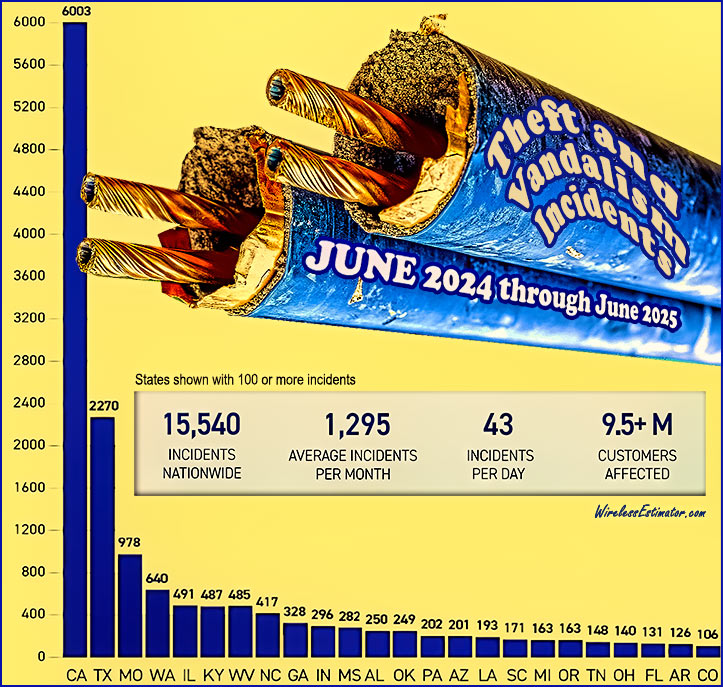
LOWBALLED LOSSES? Although the number of theft and vandalism incidents from June 2024 through June 2025 has increased sharply, it’s likely the count is considerably higher.
Two new reports, “Protecting Critical Communications Infrastructure” and “The Real Costs of Communications Outages Due to Infrastructure Theft or Vandalism,” released at the Third Telecom Industry Summit last week, reveal alarming data on the surge in attacks on telecom infrastructure.
Between June 2024 and June 2025, the reports document 15,540 incidents, disrupting service for more than 9.5 million customers nationwide. The incidents are attributed primarily to copper theft and sabotage targeting critical broadband and wireless infrastructure.
Actual attacks may be more shocking than detailed
However, these numbers might only be scratching the surface. The trade groups behind the reports, NCTA, CTIA, USTELECOM, NTA, WIA, and NCA, have relied primarily on data from a survey of “large and small internet service providers across the country reporting incidents” to compile their statistics.
This approach overlooks a significant portion of the problem, as the four mobile carriers — AT&T, Verizon, Dish, and T-Mobile — though they provide internet services, are not classified as traditional ISPs.
Additionally, broadcast towers and government sites, often targeted for copper theft or vandalism, are not included in the report. In fact, there are almost weekly reports of cell towers being stripped of copper and transmission lines, a growing issue that likely goes unaccounted for in these studies.
The report’s case list highlights cable and utility thefts. Still, it appears to include no recent incidents at broadcast and cell towers, even though tower sites have suffered some of the most disruptive, high-dollar copper crimes in the period it covers. In January 2024, thieves in Hugo, Oklahoma, brought down a 500-foot tower to strip copper, taking a broadcaster off the air and causing roughly $500,000 in losses—yet that event is absent from the report’s examples. Subsequent court filings and the 2025 sentencing confirm the scale and motive, and what appears to be a slap on the wrist.
And it wasn’t an outlier. In Memphis, copper thieves at WGSF’s AM facility caused about $170,000 in damage and service loss in May of 2025. At the same time, Oklahoma authorities arrested suspects for cutting copper coax at a cellular antenna site in July 2025. When you juxtapose these tower cases with the report’s focus on lower-value incidents, the takeaway is clear: the problem is more serious than understood, both in cost and in public impact—knocking out over-the-air radio and cell coverage, not merely stripping idle metal. Any comprehensive threat assessment of “critical communications infrastructure” needs to explicitly account for wireless tower thefts and sabotage to avoid underestimating risk and misdirecting mitigation resources.
None of the many links to news articles in the report are related to thefts at communications structures; some are years old, such as an FBI report from 2008, yet there are multiple thefts reported by industry media during the latest incident reporting period.
While CTIA and WIA, representing mobile carriers and their infrastructure, may have access to this data, the reports are clear that only ISPs are being included in the statistics, potentially leaving out an entire sector of telecom infrastructure.
These gaps in data collection highlight that the actual scale of the problem is considerably worse than the trade groups have reported, underscoring the need for a broader, more inclusive approach to tracking these attacks across all sectors that rely on critical communications infrastructure.
California and Texas Lead the League
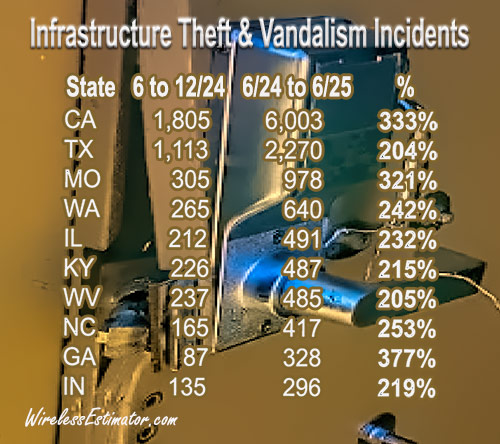 California and Texas are consistently at the top of the list for telecom infrastructure attacks. According to the reports, California alone accounted for 6,003 incidents, or about 38.7% of all recorded attacks nationwide. This is a staggering figure, especially given the scale of infrastructure in both states. California’s extensive network of telecom infrastructure, coupled with its high population density and thriving scrap-metal markets, makes it a prime target for copper theft and vandalism. Likewise, Texas, with its vast and diverse telecom network, saw significant disruptions, accounting for another 12% of all incidents.
These states’ vulnerability is compounded by the sheer volume of infrastructure that spans dense urban areas and rural corridors, making both targets for theft and vandalism. As noted in the reports, incidents in rural areas often go unnoticed until the damage escalates, while urban disruptions tend to have immediate, widespread impacts. The 9,770 incidents in just the first half of 2025, which marks an alarming uptick, have led to increasing concerns about the long-term sustainability of communication networks in these high-risk states.
Key Findings from the Reports
The reports highlight a significant rise in attacks on telecom infrastructure, with California standing out as the hardest-hit state. 6,003 incidents occurred in California alone, accounting for nearly 40% of all documented attacks, a striking statistic that underscores the vulnerability of communications networks in high-density regions. The data also show that the total number of incidents has been accelerating, with 9,770 incidents in the first half of 2025, suggesting that the threat is worsening over time.
Economic Impact of Telecom Infrastructure Attacks
The economic toll from these attacks is significant, with California alone incurring an estimated $29.3 million in damages from these disruptions, while Texas faced an additional $18.1 million in losses. The total estimated economic impact of these attacks is projected to be between $38 million and $188 million nationwide in just the last six months alone. The costs include not only the direct damages to physical infrastructure but also the lost productivity, service interruptions, and public safety risks caused by the downtime of emergency services and critical communication networks.
The broader societal impact cannot be overstated. As the reports highlight, the rise in attacks jeopardizes vital services — from 911 call centers to broadband internet access for rural communities. The disruptions caused by these attacks can have cascading effects across multiple sectors, including healthcare, education, and government operations, as many of these entities rely heavily on secure, uninterrupted communications.
In addition, small businesses and households that depend on reliable broadband services are also affected, adding another layer to the economic burden. The theft and sabotage of critical communications infrastructure have thus created a situation where the costs extend far beyond the telecom industry itself, affecting communities nationwide.
Industry’s Response: Calls for Stronger Protection and Data Collection
The alarming rise in attacks has sparked a unified response from the telecom industry. Leading trade associations, such as NCTA, CTIA, and WIA, along with major ISPs and carriers, are calling for stronger law enforcement coordination and more stringent penalties for individuals caught vandalizing or stealing telecom infrastructure. In particular, there is a push to enhance penalties for copper theft, which continues to be a major motivator for these attacks.
The reports also recommend improving data-sharing between telecom providers, local law enforcement, and federal agencies to better track incidents and respond more quickly. By enhancing coordination, the industry hopes to build a more robust defense against the ongoing threat and reduce the frequency of these attacks.
Furthermore, the industry is calling for increased investment in physical security for telecom sites, including better surveillance, hardened facilities, and real-time monitoring systems to detect and prevent attacks before they escalate. Tower climbers and other field technicians are being urged to follow enhanced safety protocols, as some of the attacks have put lives at risk.
Policy Proposals and National Security Concerns
As the reports indicate, the scope of these attacks goes beyond the telecom industry, affecting national security and public safety. FCC Commissioner Olivia Trusty has called for a more comprehensive approach to protecting telecom infrastructure, labeling the theft and vandalism crisis as a national security issue. With increasing attacks on broadband networks, emergency services, and government sites, there is growing concern that the nation’s communications backbone is not being adequately protected from these rising threats.
One of the key proposals discussed during the summit was the need for a federal task force dedicated to addressing telecom infrastructure attacks. The task force would focus on developing stronger regulatory frameworks, improving coordination between state and federal agencies, and creating incentives for telecom companies to bolster their security measures.
Additionally, experts are urging policymakers to introduce more stringent controls on the resale of stolen copper, a key driver of many of these attacks. By limiting the ability of criminals to sell stolen materials, it would reduce the financial incentive to target vulnerable infrastructure.
Looking Forward: Bridging Data Gaps and Strengthening Protection
While the reports provide valuable insights into the rising threat of telecom infrastructure attacks, the industry acknowledges that the full scale of the issue may not be fully captured. Mobile carriers and broadcast towers, which are frequently targeted, were not included in the data from USTelecom and ProtectCCI, as their data primarily came from ISPs. However, with growing awareness of the severity of these attacks, there is hope that future studies will provide a more comprehensive picture of the problem.
The industry’s response, including the push for stronger laws, enforcement, and collaboration, signals a recognition that the telecom sector needs to work together to protect its infrastructure and ensure the continued reliability of critical communications. As the threat landscape evolves, telecom providers, policymakers, and stakeholders must remain vigilant and responsive to keep the nation’s communications networks secure, advocates advise.
