















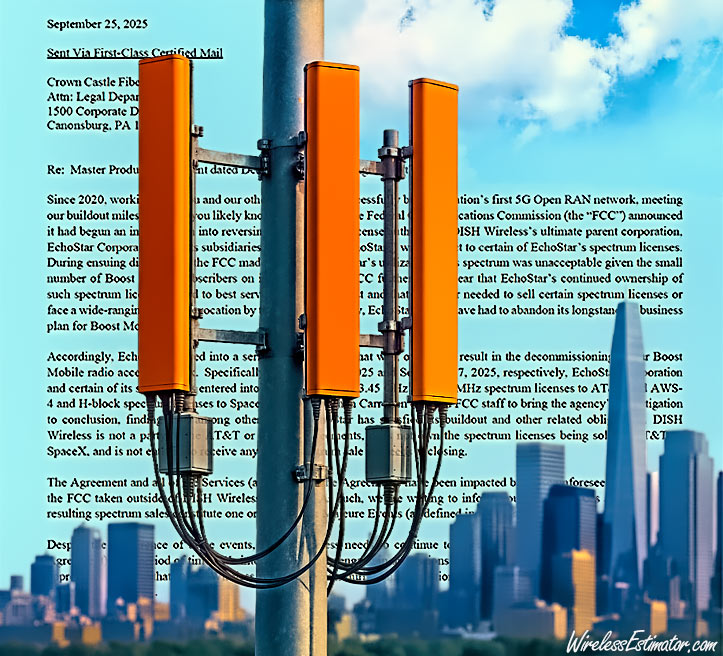
DISH’s September 25 letter to Crown Castle, sent while the carrier remains on thousands of the company’s towers nationwide, asserts that its spectrum sale relieved it of long-standing MSA obligations—a claim now challenged in a lawsuit filed on November 20 by Crown Castle in federal court.
Crown Castle has become the second major tower operator to sue DISH Wireless after the carrier notified infrastructure partners of its intent to shed large portions of its wireless business through spectrum-sale transactions.
Just weeks after American Tower filed suit demanding that DISH honor its long-term lease commitments despite the pending spectrum sale, Crown Castle has taken the same position, filing a federal lawsuit asserting that DISH cannot simply “turn off” its contractual duties under the parties’ Master Services Agreement (MSA).
The case, filed in the U.S. District Court for the District of Colorado on November 20, 2025, argues that DISH is attempting to use its planned divestitures to avoid long-standing contractual obligations that remain fully enforceable, including rent, site commitments, and termination procedures defined in the MSA.
Crown Castle Says the MSA Still Controls — Regardless of DISH’s Spectrum Sale
At the heart of Crown Castle’s lawsuit is the assertion that DISH’s MSA with the tower company remains binding and unaffected by any corporate restructuring, spectrum sale, or post-transaction operational changes. Crown Castle alleges that DISH, after announcing its intention to sell significant 5G spectrum assets, has taken the position that it is no longer required to comply with the MSA’s payment schedule, cancellation rules, and site-commitment terms.
According to the complaint, DISH informed Crown Castle that its obligations were “frustrated in purpose” or otherwise extinguished due to its shifting network strategy. Crown Castle flatly rejects that argument, asserting that nothing in the MSA allows DISH to walk away from leases, decommission sites at will, or convert long-term obligations into short-term liabilities simply because of a spectrum transaction.
Complaint References Prior Industry Reporting
In outlining its claims, Crown Castle cites an online article from Wireless Estimator that examined DISH’s handling of contractor obligations, stating that DISH embarked upon a campaign to avoid paying its vendors and other partners who supported the buildout of its wireless network.
An Escalating Industry Pattern
Crown Castle’s lawsuit mirrors the themes of the recent American Tower complaint, where ATC argued that DISH’s spectrum sale did not nullify the MSA or its associated rental obligations. American Tower emphasized that DISH remained contractually bound regardless of operational pivots or asset dispositions — a position Crown Castle now echoes almost verbatim.
Together, the lawsuits represent a unified front by the two largest U.S. tower operators: a carrier cannot avoid or rewrite long-term tower agreements by restructuring its business or selling spectrum.
Are Other Tower Owners Taking Action?
While Crown Castle and American Tower are currently the only tower operators with public federal lawsuits tied to DISH’s MSA abandonment strategy, industry sources suggest that other tower owners—particularly midsize and regional towercos—are actively reviewing their contracts. Some have reportedly received similar notices or ambiguous communications regarding DISH’s intent to reduce, withdraw from, or alter existing site obligations.
Suppose DISH applies the same strategy across all its tower partners. In that case, additional filings may be forthcoming, mainly as carriers typically rely on standardized MSA templates that could lead to similar claims by other landlords.
Billions in Contractual Value at Risk
Crown Castle’s suit highlights what may become the central legal issue surrounding DISH’s restructuring: whether long-term tower MSAs are truly immutable in the face of a carrier’s business-model reversal, or whether carriers can limit their exposure through a post-hoc spectrum sale.
For tower companies, this is not a technicality — long-term MSAs underpin multi-billion-dollar revenue streams, tower valuations, and debt-market confidence. Crown Castle argues that allowing DISH to escape its obligations would destabilize the tower-leasing ecosystem and undermine the contractual certainty tower operators rely upon.
What Happens Next?
The Crown Castle case is expected to proceed on similar tracks as American Tower’s action, with early motions focusing on:
- Whether DISH can invoke frustration-of-purpose or similar doctrines to avoid MSA terms
- Whether a spectrum sale or network-exit strategy alters contractual commitments
- How quickly DISH must continue paying rent or providing formal decommissioning notices
- Whether the MSA requires strict adherence regardless of corporate restructuring
With two of the largest tower operators now pursuing nearly identical claims, DISH faces a mounting legal battle that could determine how wireless carriers unwind large-scale infrastructure commitments—and whether tower companies can rely on long-term MSAs when carriers’ business strategies shift.
