















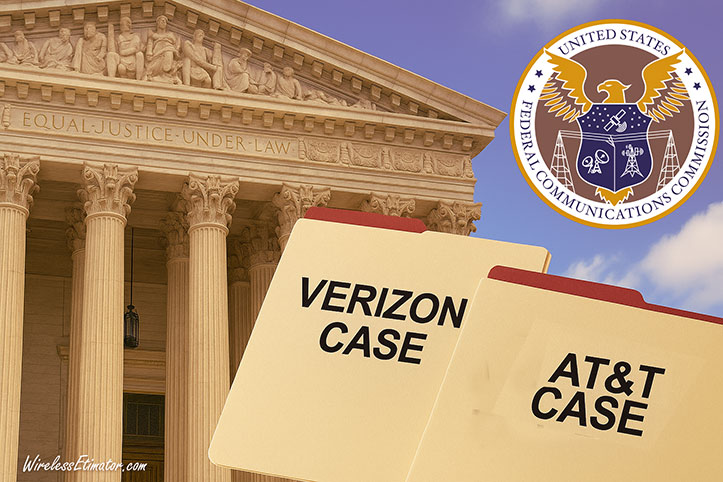
The Federal Communications Commission is urging the U.S. Supreme Court to hear Verizon’s challenge to a $46.9 million location-privacy fine together with a parallel case involving AT&T’s vacated $57 million penalty, saying the Court should resolve—once and for all—whether the agency may impose large monetary forfeitures without offering companies a jury trial.
The government told the justices that the two high-stakes appeals present the same fundamental constitutional question and should be decided in a single ruling to settle the rapidly widening split between the Second and Fifth Circuits.
Two Carriers, Same Issue: Can the FCC Issue Penalties Without a Jury?
The FCC fined Verizon, AT&T, T-Mobile, and Sprint nearly $200 million for improperly sharing real-time customer location data with third-party aggregators. Verizon and AT&T each paid their penalties and went to court—but landed in very different places.
- The Second Circuit upheld Verizon’s $46.9 million fine, rejecting arguments that the Seventh Amendment required a jury trial before the FCC could impose the penalty.
- The Fifth Circuit vacated AT&T’s $57 million forfeiture, holding that the agency’s in-house process violates both the Seventh Amendment and Article III because it deprives companies of a jury trial before they face binding liability and reputational consequences.
The conflicting rulings have created a direct constitutional clash over the FCC’s “penalty-now, maybe-jury-later” system, making Supreme Court intervention increasingly likely.
Verizon and AT&T Agree: Put the Cases Together
Despite opposite outcomes, both Verizon and AT&T have told the Supreme Court they want the cases consolidated.
- Verizon argues the Second Circuit was wrong and that Jarkesy entitles it to a jury before paying any civil penalty.
- AT&T wants the Court to affirm the Fifth Circuit’s decision striking down the FCC’s forfeiture regime but says nationwide clarity is urgently needed.
The FCC, in an unusual alignment, now agrees that the Court should hear both matters together and resolve the future of its enforcement system in one decision.
The Stakes for the FCC — and Every Regulated Industry
At the heart of the fight is Section 503 of the Communications Act, which allows the FCC to impose fines after an internal adjudication. Companies can then:
- Pay the fine and appeal directly to a federal appellate court—without a jury, or
- Refuse to pay and hope DOJ sues to collect, which would finally trigger a jury trial.
The Fifth Circuit said that choice is unconstitutional because the agency’s final order already imposes real-world consequences, leaving the jury right as an afterthought. The Second Circuit, by contrast, said the process is lawful because a jury becomes available if DOJ sues.
A Supreme Court ruling in favor of Verizon and AT&T could force the FCC—and potentially other federal agencies—to move many enforcement actions into district court jury trials, slowing enforcement and increasing DOJ’s workload. A ruling for the FCC would largely preserve its existing forfeiture system and the speed with which it can penalize carriers.
A Looming Supreme Court Showdown
With nearly $200 million in privacy fines in limbo and a sharp circuit split now cemented, the FCC is pushing for one consolidated Supreme Court review. Verizon, AT&T, and the FCC all agree the justices should take the cases—the only disagreement is over whose victory gets preserved.
If the Court steps in, its decision will not only determine the fate of Verizon’s and AT&T’s penalties but will also reshape how federal agencies enforce rules across the communications industry and beyond.
