














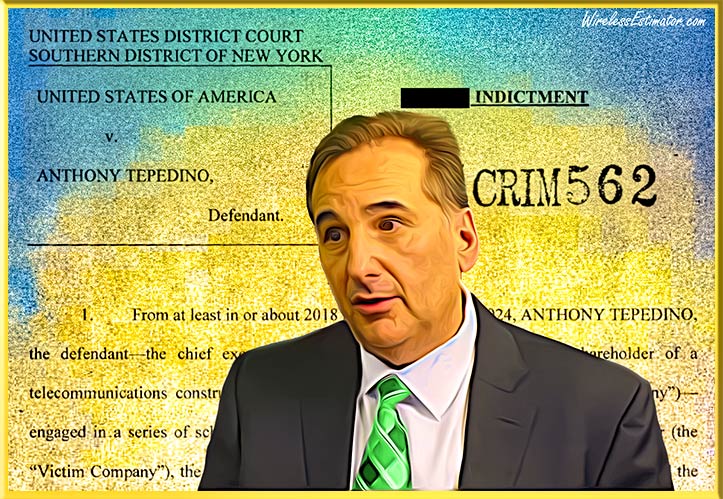
Anthony Tepedino, CEO of Allstate Sales Group (ASG), is accused of orchestrating a six-year scheme involving shell companies, fake invoices, and commercial bribery that helped steer more than $300 million in work to his wireless infrastructure contracting firm. The federal indictment describes conduct consistent with major U.S. carrier contracting models. The ‘Victim Company’ might be Verizon, a key contractor for ASG. In addition, Tepedino set up a software and CAD company in Ireland to serve as a hub for expansion and oversight of its U.S. contracting. Although he said it would provide a gateway to Europe, it is also in the country where Verizon operates, managing all U.S. infrastructure contracts.
Indictment reveals years of bribery, forged invoices, shell companies, and concealed payments inside a telecom contracting giant
When the U.S. Attorney’s Office for the Southern District of New York unsealed an indictment against Allstate Sales Group’s (ASG) CEO Anthony Tepedino last week, the wireless infrastructure industry received its clearest—and most troubling—view yet into the corruption that led to the company’s dramatic collapse in 2025. For years, ASG portrayed itself as a fast-scaling engineering and construction partner serving major carriers, boasting hundreds of millions of dollars in annual revenue, over 700 employees at its peak, and multimarket telecom construction capabilities.

According to prosecutors, the corruption ran on two tracks: inside the Victim Company, high-level manager CC-2 allegedly pocketed more than $1 million in secret payments while steering contracts and green-lighting invoices worth hundreds of millions. Outside its walls, CC-1—not employed by the Victim Company helped Tepedino drain ASG through a shell-company pipeline. Together, the schemes created a flow of illicit cash that fueled one of the industry’s most brazen breaches of trust.
But the indictment tells a very different story: one in which the company’s founder allegedly turned ASG into a personal withdrawal machine, siphoning off millions, bribing a senior manager at the company’s largest client, and then attempting to orchestrate a coordinated cover-up when investigators closed in.
Public records indicate that ASG has worked for Verizon, AT&T, Frontier, Everstream, Tilson/Boundless, and MTA Bridges & Tunnels. Multiple former ASG employees informed Wireless Estimator that Verizon was their primary client.
The federal case now underway reveals an operation more sprawling, calculated, and deceptive than previously understood. While its impact was felt immediately by 500 laid-off employees and unpaid vendors in late August, the government’s allegations make clear that ASG’s internal collapse was not a sudden liquidity crisis; it was the inevitable unraveling of a scheme that had metastasized over more than half a decade.
Tepedino, 61, faces multiple charges, including one count of conspiracy to commit wire fraud and honest services wire fraud, bank fraud, and witness tampering, carrying potential maximum sentences ranging from 20 to 30 years, not to mention a mandatory two years for aggravated identity theft.
A Company Built on a Fault Line
ASG was, on paper, a story of rapid success. More than 500 employees, major carrier clients, and a reputation as one of the busiest construction and engineering vendors in the Northeast. The company expanded into fiber, enterprise construction, and wireless deployments, frequently appearing on public bidding lists and job postings for AT&T and Verizon.
However, according to prosecutors, the company’s internal reality was far more fragile. Tepedino, who founded the company in 2008 and remained its sole owner, allegedly exercised personal control over all financial operations, creating the perfect environment for fraud. The indictment describes a culture in which invoices were approved rapidly, signatures were rarely questioned, and a small circle of insiders, Tepedino, and two other individuals identified as CC-1 and CC-2 held near-total control over approval pathways and contract flows.
This concentration of authority, prosecutors say, became the mechanism through which shell companies flourished, fraudulent documents were processed, and bribes were delivered.
The Shell Company That Opened the Floodgates
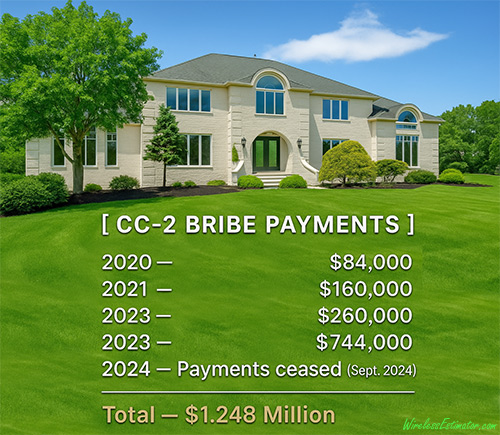
Federal prosecutors allege that while Tepedino paid more than $1 million in bribes to CC-2 to secure lucrative contracts, he also siphoned ASG funds through a shell company to bankroll an array of personal expenses — including $730,000 for home construction, landscaping, and a pool installation at his Manalapan, New Jersey residence. The indictment further details $1.6 million routed into his own accounts, luxury-event spending, payments to companies he controlled, transfers to a relative’s business, and money paid to his spouse and adult child. He also used hundreds of thousands of dollars in credit card payments to fund further transfers to other companies he owned and to fund cash withdrawals.
Beginning in 2018, Tepedino and a subordinate, identified only as CC-1, created Shell Company-1, a non-operational entity with no employees, no equipment, and no capacity to perform real work. It existed solely to receive fraudulent payments generated through falsified invoices that Tepedino approved inside ASG’s accounting system.
To keep the scheme hidden, CC-1 impersonated another individual—referred to in the indictment as Individual-1—whenever Shell Company-1 communicated with ASG. At various times, Tepedino allegedly forged the signatures of ASG executives on internal documentation to make the payments appear legitimate.
By the time this portion of the scheme ended in 2024, Shell Company-1 had received more than $5 million. Those funds, according to prosecutors, were split among the co-conspirators and used to pay personal debts, luxury expenses, and—perhaps most tellingly—to upgrade Tepedino’s own residence in Manalapan, New Jersey. The indictment references tens of thousands of dollars in home improvements, suggesting that the stolen funds blended seamlessly into the personal lifestyle of the man at the top.
The $1 Million Bribery Scheme That Brought in $300 Million of Work
If the shell-company fraud was the fuel of ASG’s collapse, the commercial bribery scheme was its economic engine. Beginning in 2020, Tepedino used the money he stole from his own company to make more than $1 million in bribe payments to a senior manager at the company’s largest customer. That individual—identified as CC-2—held responsibility for steering contracts, assigning work, and approving vendor invoices.
In exchange for those payments, federal prosecutors say CC-2 provided the company with millions of dollars in new projects and ensured invoices were approved, even when internal ethics protocols explicitly prohibited such arrangements. More strikingly, the relationship did not falter when CC-2’s employer identified concerning irregularities and placed him under restrictions barring him from accepting gifts or outside compensation. Despite being under scrutiny, CC-2 allegedly continued to approve inflated or unsupported ASG invoices.
The results of the arrangement were staggering: during the four-year bribery period, ASG received more than $300 million in payments from the Victim Company.
This volume of revenue, paired with the contracting influence CC-2 possessed, strongly reflects the operational footprint of a primary carrier. ASG’s known client list includes both AT&T and Verizon, and prosecutors stated that more than 90 percent of the fraudulent shell-company funds originated from a single New York-based client—geographically consistent with major wireless operator management centers.
Public records already tie ASG to extensive Verizon FiOS engineering and build work in New York. A Verizon spokesperson informed Wireless Estimator that they are “aware of the situation” but declined substantive comment, referring questions to prosecutors. The representative would not confirm whether Verizon is the unnamed ‘Victim Company’ referenced in the federal indictment.
AT&T did not respond to a request for information.
However, the U.S. Attorney’s Office has not identified the “Victim Company” by name, and there is no public confirmation that Verizon—or any other specific operator—is the entity described in the indictment.
The Ireland Connection and Carrier Oversight

In 2019, ASG announced an Ireland expansion backed by IDA Ireland, reportedly supported by a grant and additional state-backed incentives tied to a pledge to create 200 jobs across two regional offices. However, no evidence suggests the operation ever approached those employment levels, and any remaining presence appears to have folded alongside ASG’s collapse. Although ASG initially promoted its Irish subsidiaries as a strategic international foothold, references to the Irish offices disappeared from the company’s website by 2023.
The indictment became even more intriguing in light of ASG’s publicly announced expansion into Ireland in 2019. The company received support from IDA Ireland to open two facilities—one in Waterford and one in Sligo—purportedly to serve as CAD support and software development centers.
Descriptions of these offices suggest that ASG intended them to function as “back-office” operational hubs for U.S. carrier work. That model aligns with Verizon’s international operational structure, where U.S. contractor oversight is managed through its Irish administrative unit. Although publicly available records show no evidence that ASG’s Ireland offices ever fully opened or grew beyond the startup announcements that the company would employ 200 professionals, the alignment of geography and contracting roles has raised further questions.
Taken together—the Ireland expansion, the scale of the contract awards, the New York origins of the payment streams, and the functions performed by CC-2—it is increasingly clear that the Victim Company fits the profile of a primary carrier.
Industry reports suggest that some of the nation’s largest contracting and management companies’ executives, including Tilson Technology, have made trips to Ireland in recent years to renegotiate major contracts.
During negotiations with NATE: The Communications Infrastructure Contractors Association, the association engaged with representatives based in Ireland to discuss the need for a revised contracting framework that would provide greater stability for its member companies.
The Bank Fraud That Kept the Scheme Alive
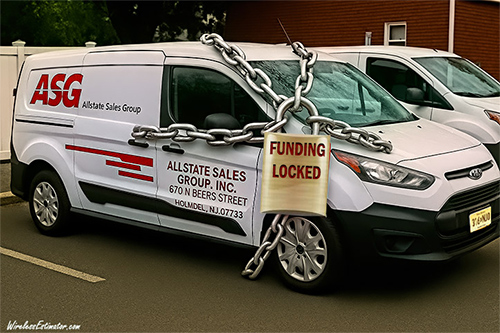
The indictment alleges Tepedino defrauded the “Victim Bank” while seeking more than $18 million in credit; Wireless Estimator has identified that lender as BHI, which financed ASG in 2022. When BHI froze ASG’s accounts during the federal investigation, the company abruptly shut down its operations, stranding workers, parking its fleet, and triggering the class-action WARN Act lawsuit by employees that is now pending in federal court.
By 2021, ASG needed additional capital and applied to a federally insured bank for more than $18 million in commercial credit. Tepedino, according to the indictment, concealed the existence of the shell-company fraud and the ongoing bribery scheme. He withheld the company’s authentic financial relationships and failed to disclose that the inflated invoices padding ASG’s apparent revenue were the byproduct of criminal activity.
The bank, identified in the indictment as ‘Victim Bank,’ extended the credit line, believing ASG’s receivables were genuine. This misrepresentation not only harmed the lender but also allowed the company to continue operating—effectively prolonging the fraud and deepening the eventual financial harm to employees, vendors, and creditors.
In September, Wireless Estimator identified that in July 2022, bank BHI announced it had provided $18.35 million in financing to ASG—a package that included a senior secured revolving credit facility, a term loan, mortgage financing for three properties, and a purchase card line.
The Secret Meeting: Phones Off, Background Noise On
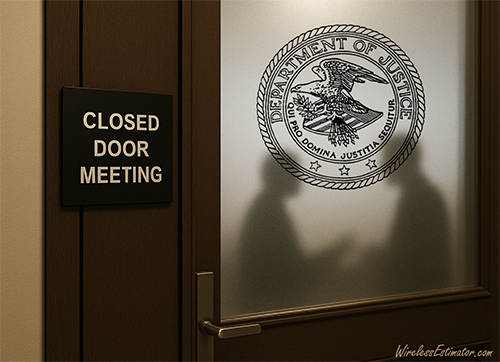
Perhaps the most vivid detail in the indictment comes from prosecutors’ description of a clandestine meeting in September 2024. Knowing investigators were closing in, Tepedino allegedly gathered CC-1, CC-2, and another individual in a closed room. He directed everyone to turn off their phones and introduced background noise—an action prosecutors believe was intended to thwart electronic surveillance. He then instructed the individuals to adopt a false narrative that would portray the bribe payments as legitimate consulting fees.
The meeting underscores the level of sophistication and intent prosecutors attribute to Tepedino. It wasn’t simply a matter of concealing the origins of funds; it was a conscious effort to manipulate potential witnesses and impede a federal investigation—a decision that now appears prominently in the obstruction section of the indictment.
Why CC-1 and CC-2 Have Not Been Charged
 The absence of criminal charges against CC-1 and CC-2 may seem surprising, given that both individuals clearly participated in schemes that would ordinarily expose them to significant legal risk. However, prosecutors often prioritize securing convictions against the central figure—especially when that individual orchestrated the scheme’s architecture and controlled the flow of funds.
The level of detail provided in the indictment about CC-1’s communications, bank accounts, and impersonations, along with CC-2’s invoice approvals and contract steering, strongly suggests that both individuals have been cooperating. Their testimony may be crucial to establishing the chronology of events, financial flows, and the decision-making framework behind the fraud. In many corruption cases, prosecutors either defer or decline to file charges for cooperating witnesses or pursue separate filings after a primary conviction is secured.
Whether CC-1 or CC-2 ultimately face civil or criminal liability remains unknown; however, if their employers—or the Victim Company—seek restitution, the government may recoup some of the benefits they received. Carriers routinely pursue civil recovery in cases of vendor fraud, although such actions typically occur after criminal proceedings conclude.
The Collapse and the Industry Fallout
By late 2024, ASG was rapidly destabilizing. federal agents seized documents and personal devices. Cash flow dried up. Contracts remained in flux as carriers reevaluated their vendor relationships. Employees received no warning before mass layoffs in 2025. Vendors reported unpaid invoices and, in some cases, significant outstanding receivables. Workforce reductions triggered federal WARN Act claims, and employees began filing lawsuits describing sudden job loss and shuttered offices.
Internally, the company appears to have been fraying long before the workforce realized the trouble—financial distortions created by fraudulent invoices masked deteriorating balance sheets. Credit obtained under false pretenses kept operations afloat far longer than the company’s actual financial condition allowed. By the time authorities intervened, the collapse was all but irreversible.
The indictment reveals that the fraud did not merely drain ASG’s assets; it compromised the company’s governance, exposed carriers to inflated invoices, jeopardized employees’ livelihoods, and undermined the integrity of vendor ecosystems that rely on transparent contracting frameworks.
A Scheme of Scale and Precision
Taken together, the allegations describe a CEO who exploited every layer of ASG’s operations to fuel a system of fraud and bribery. Prosecutors allege that Tepedino hand-picked co-conspirators, manufactured fictitious vendors, approved invoices for work that never occurred, bribed a high-level manager at a major client, deceived a federally insured bank, and then attempted to script witness testimony as investigators closed in. The government contends that these actions were not impulsive or opportunistic—they were planned, rehearsed, and sustained over six years.
As the case proceeds, the industry will likely learn more about the contracting pathways, approval mechanisms, and oversight gaps that allowed the fraud to persist. For now, the indictment stands as one of the most significant corruption cases ever to emerge from a telecom construction company—one with consequences that continue to ripple across the workforce, the vendor community, and the nation’s wireless infrastructure sector.
Editor’s Note: For over 21 years, Wireless Estimator, without pay walls, has gone beyond surface-level press releases and generic reports skinned from other media. To stay informed with exclusive news, industry updates, and in-depth investigative articles you won’t find anywhere else, subscribe to our news releases on our home page today. And if you’re a supplier, service provider, or contractor, you’ll need to be listed at no charge in the industry’s most successful buyer’s guide, the BLUE BOOK, with almost 1.3 million ad views and the only industry platform offering Quick Connect to ensure your company’s success. Other time-honored, successful advertising opportunities are available here.
