
















AT&T’s new contracting framework will eliminate by June 2026 the long-criticized turf model by hiring a single general contractor and allowing only one approved subcontractor tier, cutting out layers of 1099 crews that many say have destabilized the industry. The shift is expected to accelerate demand for National Wireless Safety Alliance–certified technicians, with AT&T now requiring that at least 50% of workers on its sites hold NWSA credentials. However, AT&T has observed that percentage for at least three years; its entry into the agreement appears to signal enhanced enforcement.
In a move that could rewrite the business model for how America’s wireless infrastructure gets built and maintained, NATE: The Communications Infrastructure Contractors Association and AT&T recently reached an agreement to overhaul longstanding contracting practices. According to NATE, the deal includes fundamental changes the association expects will “advance material aspects of the tower construction ecosystem,” including phasing out the “turf vendor” model in favor of a more transparent, sustainable general contractor framework.
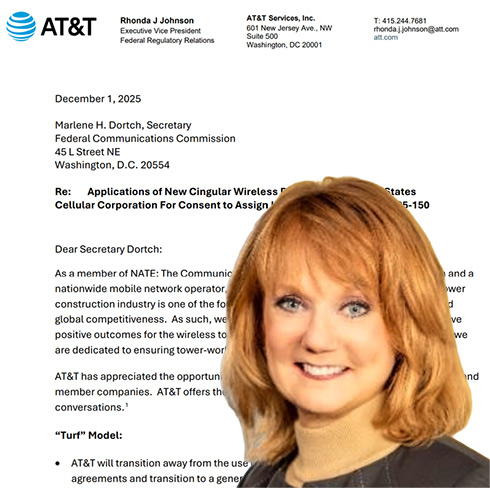
The NATE-AT&T agreement was submitted to the FCC by Rhonda Johnson, AT&T Executive Vice President, Federal Regulatory Relations, on Monday. The long-sought agreement is AVAILABLE HERE.
Under the agreement, AT&T commits to:
- Transitioning away from the turf model (upon expiration of existing agreements) to a single-tier subcontractor stacking scheme by June 2026 — eliminating the murky hierarchy of “super-GCs,” “turf vendors,” and multiple nested subcontractors.
- Adopting 30-day payment terms after project completion.
- Offering site-specific compensation and regional RFPs rather than one-size-fits-all “matrix pricing.”
- Enforcing safety standards: at least 50% of tower workers on AT&T jobs must hold valid NWSA certifications.
- Restricting use of 1099/independent-contractor labor, requiring I-9 verification, and limiting work to compliant vendors.
- Reimbursing third-party platform fees (e.g., vendor-management systems like Avetta or Ariba).
- Establishing a joint working group (NATE + AT&T) to monitor implementation and explore further enhancements — covering safety, pricing, maintenance, and operational efficiency.
In a joint message of support, NATE’s President and CEO, Todd Schlekeway, commended AT&T, stating, “NATE thanks AT&T for engaging in meaningful dialogue with our association and agreeing to implement positive modifications that will foster a healthier, safer, and more sustainable industry. The Association also extends its gratitude to FCC Chairman Brendan Carr and his staff for their engagement and support during this process.”
AT&T’s Senior Vice President in charge of network planning, Robert Walters, characterized the deal as a reaffirmation of the telco’s commitment to the skilled workforce building America’s wireless backbone. “At AT&T, we’re committed to supporting the skilled workforce that builds our nation’s wireless infrastructure. This agreement demonstrates our commitment to ensuring we continue to prioritize the health of the industry,” said Walters.
AT&T’s workforce pact with NATE gained new regulatory significance today when the FCC approved AT&T’s $1 billion U.S. Cellular deal after the carrier agreed to extend elements of the agreement and abandon its DEI programs—a concession similar to those imposed on Verizon and T-Mobile in earlier approvals.
The NATE agreement — filed with the FCC under transaction docket WT Docket No. 25-150 — marks a long-anticipated closing of the door on the opaque, multi-layered contracting “turf” model that many contractors blame for driving down wages, eroding safety, and destabilizing the industry.
The “Turf” Model — What It Was and Why It Mattered
Historically, large carriers such as AT&T, Verizon, and T-Mobile outsourced tower construction and maintenance under master service agreements that enabled complex, layered subcontracting. Under this “turf vendor / super-general-contractor (GC)” model:
- A “super-GC” (or turf vendor) would win a broad geographic contract.
- That vendor would in turn subcontract work out through several tiers — local vendors, sub-subcontractors, 1099 crews, sometimes undocumented or unqualified labor.
- Pricing was often set by a uniform “matrix pricing” (a rigid, flat-rate schedule), regardless of actual site conditions, regional cost differences, weather, terrain, or site complexity.
- Payment terms could be long, platform fees (vendor-management tools) non-reimbursed, and safety/training requirements minimal or unenforced.
- Both super-GCs and turfers operated under a similar construct, extracting 30% to 40% of contract value upfront—an arrangement many contractors now view as commercially unreasonable.
Over time, tower contractors — many large and small businesses — found themselves squeezed: shrinking margins, unpredictable payment timing, spiraling liability, and difficulty keeping certified workforce intact. Safety concerns rose, experienced crews left the industry, and many contractors collapsed or closed tower service divisions, eroding the skilled-labor base for U.S. wireless infrastructure. Wireless Estimator has chronicled the list of failures over the years: Velex/Nexius, Qualtek, Tilson Technology, and Crown Castle, Congruex, and Ericsson’s service groups, amongst others.
Over the past two weeks, Wireless Estimator has confirmed that three major contractors are preparing to reduce their field crews by 10% to 15%. One executive warned that, absent an immediate turnaround, the company may shutter its tower services division entirely.
Although year-end build opportunities remain, some contractors are now dangling bonuses of up to $5,000 per site to entice crews. Yet even with those incentives, the math doesn’t work. Several firms said they cannot complete the work profitably—particularly in regions where winter conditions routinely delay schedules and add days to already tight timelines.
Contractors repeatedly warned that the turf model was unsustainable, especially ahead of the large build-outs for 5G (and soon 6G). Those warnings have gained increasing resonance with regulators, particularly under the leadership of the FCC’s chair, who has signaled concern about the long-term stability of the tower-construction workforce.
How NATE’s Historic Deals with Verizon and T-Mobile Paved the Way for AT&T
Verizon: The first big restructuring
In May 2025, NATE and Verizon formalized a “breakthrough contracting framework” that began dismantling the turf model on Verizon sites. Under that deal:
- Verizon is committed to banning most 1099 contractor crews on its cell-site projects.
- Contractors gained the ability to report non-compliant workforces via a dedicated hotline — empowering crews to flag unauthorized or undocumented labor at risk of being “turfed.”
- Pricing practices and master service agreements were renegotiated to include fairer compensation structures tied to actual job site conditions rather than outdated matrix rates.
That move marked a historic win: one of the largest U.S. carriers essentially acknowledging, in writing, that its prior contracting practices were problematic and required fundamental re-engineering.
T-Mobile: Building momentum with a parallel agreement
On July 8, 2025, NATE and T-Mobile signed a new framework under which:
- T-Mobile pledged to scrap the rigid matrix pricing regime in favor of site-specific and regionally adjusted pricing.
- T-Mobile is committed to a 6% rate increase until a new RFP process is completed.
- T-Mobile said it would launch a “Scope-to-Quote” tool, enabling contractors to build job-specific scopes of work — say what needs to be done instead of being shoe-horned into a pre-defined matrix. It is unknown if they have met their projected September introduction commitment.
- Payment terms improved (30-day terms, up-front billing milestones), and the deal included protections against 1099/undocumented labor, restrictions on subcontracting tiers, and phasing out of the “Super GC” and “turf vendor” models. T-Mobile’s agreement, along with Verizon’s, created strong momentum: two of the “Big 3” carriers had publicly committed to overhauling their contractor relationships. The expectation grew that AT&T — historically the architect and biggest user of the turf model — would soon be pressured to act.
AT&T: From Stand-Alone Turf Titan to Industry Reform Participant
Given that history, the agreement between NATE and AT&T is arguably the most consequential. AT&T had been widely viewed as the major holdout — the carrier whose business model most relied on cheap, multi-tier subcontracting, matrix pricing, and minimal contractor oversight. Its agreement thus represents a fulcrum shift.
By committing to a general-contractor model capped at a single subcontractor tier, AT&T dramatically reduces the leverage of “super-GCs” and turf vendors. That means fewer layers of markup, less risk of non-compliant or under-qualified subcontractors, and — if enforced — better pay, safety, and accountability across the board.
The improvements in payment terms, pricing, and safety standards signal a structural reset in how AT&T will procure tower work. For contractors, it may stabilize margins and give breathing room to rebuild certified, experienced tower-climber workforces. For technicians, it could mean more secure work, safer jobsites, and less reliance on unstable, piecemeal “1099-crew” gigs.
Finally, by agreeing to set up a working group with NATE to oversee implementation, AT&T acknowledges this is not a one-off PR move — it’s a long-term commitment to reforming the contracting supply chain.
Why “Getting Rid of the Turf Model” Is the Real Story
Though the agreement touches on many improvements — payment terms, pricing, safety, subcontractor limits — the heart of the deal lies in dismantling the turf vendor/super-GC subcontracting cascade. That model is widely viewed as the root cause of the “race-to-the-bottom” for contracting firms and tower crews:
- Turf vendors often imposed matrix pricing that didn’t account for varying labor, travel, weather, and local cost factors — draining margins for all contractors.
- Multi-tier subcontracting made it harder to enforce safety standards, certifications, wage compliance, and timely payments, and diluted accountability.
- Widespread use of 1099 labor displaced certified W-2 technicians, undercutting both safety and long-term workforce viability.
By eliminating the turf model and placing responsibility for contracting, safety, pricing, and payment more directly on the carrier-first-tier contractor pair, the new framework restores transparency, accountability, and — ideally — sustainability for the entire ecosystem. As one industry observer put it: “This isn’t a tweak. It’s a structural overhaul.”
Bigger Picture: Why This Matters for Wireless Infrastructure, the Workforce, and National Resiliency
As base-station densification, fiber-to-the-tower upgrades, and 5G/6G rollouts accelerate, the demand for skilled tower technicians is growing — but only if contractors can survive economically. NATE has repeatedly warned that without fair compensation and stable contracts, small tower firms will exit, and the supply of certified technicians will erode.
The new agreements with Verizon, T-Mobile, and now AT&T thus provide a pathway to preserve and rebuild that workforce. That is critical not just for network upgrades, but for network maintenance, emergency restoration, and national infrastructure resilience.
Market structure and monopsony risk
According to an economic analysis commissioned by NATE (via The Brattle Group), the current wireless-infrastructure contracting market suffers from monopsony dynamics — a few mega-carriers dictating terms to hundreds of small contractors, suppressing wages, and saddling companies with unsustainable pricing models.
These agreements could mitigate some of that oligopsonistic pressure by rebalancing relationships, raising compensation, and improving contract fairness. Over time, that could increase competition among contractors and reduce the risk that carrier actions leave large swathes of the country with few qualified tower installation and maintenance firms.
Regulatory, policy, and future-proofing implications
The fact that these deals are filed at the FCC (in carrier-merger/transaction dockets) suggests regulatory pressure may have been a key motivator — not just contractor demands. That signals a new era where federal regulators, industry associations, and carriers may cooperate to ensure contractor viability, not just network rollout speed. For towers, fiber, small cells — and increasingly rural broadband and broadband-infrastructure deployment under federal programs (e.g., BEAD) — this could be foundational.
Also, by tying the agreement to certified, vetted labor (NWSA-certified techs, verified I-9s, no 1099 abuse), the industry takes a step toward standardizing training, safety, and compliance — which may influence public policy debates on workforce licensing, safety standards, and federal grant compliance.
T-Mobile currently mandates that 25% of on-site technicians hold an NWSA certification. Other major tower owners have adopted different certification thresholds, embedding NWSA credentials into their workforce requirements. While Crown Castle does not impose its own percentage, it actively monitors and enforces the standards set by its carrier partners.
Verizon remains the notable outlier in the carrier-tower ecosystem. Industry sources say the company has yet to meaningfully engage on NWSA safety initiatives, despite being fully aware of the advantages of certification—and despite having been encouraged to support the alliance when it launched a decade ago.
Risks, Challenges, and What Could Still Go Wrong
A few real-world risks and caveats remain with the AT&T agreement:
- Implementation matters far more than agreement language. If AT&T (or other carriers) let enforcement slip — subcontracting tiers creep back, payment delays return, or matrix-style pricing sneaks in — contractors will remain under pressure.
- Cost pressures remain real. Even with better terms, tower construction is variable: weather, access, materials, specialized crews, equipment rental, travel — site-by-site conditions can swing profitability. If carriers don’t truly account for those variables, margins may still be razor-thin.
- Smaller contractors may struggle to adapt. While the reforms benefit many, the transition may be wrenching for firms used to matrix pricing and turf subcontracting. Some may not have the capital or workforce flexibility to meet new compliance and certification standards.
- Regulatory fatigue or rollback. If political priorities shift, or if carriers consolidate again, pressure from regulators may fade — potentially allowing the old turf-model practices to return.
- Short-term bottlenecks. With many contractors re-qualifying crews, submitting new RFPs, renegotiating supply arcs, and adjusting workflows, there could be delays in builds or maintenance, which may slow down 5G/6G rollout or repair times.
What’s Next — What to Watch
- Rollout of the AT&T–NATE working group: Will it meet on schedule? Will minutes or progress reports become public?
- Benchmarking of payment and pricing behavior: Whether AT&T actually honors 30-day terms, fair pricing, and reimburses platform fees — or whether contractors still complain about late payments, slow-walking invoice approval, or hidden costs.
- Labor-compliance enforcement: Spot audits or whistleblower reports if 1099 or under-qualified crews reappear — on Verizon, T-Mobile, or AT&T sites.
- Impact on contractor stability: Whether contractor bankruptcies and exits decrease, new firms enter, or the tower-climber workforce stabilizes or grows.
- Regulatory and policy follow-through: Whether the FCC uses these deals as a model in the future — potentially embedding contractor-fairness standards in merger approvals, spectrum auctions, or infrastructure-funding programs.
Conclusion: A Turning Point — If the Industry Lets It Be One
The agreement between NATE and AT&T — following closely on similar deals with Verizon and T-Mobile — represents a potential turning point for the U.S. wireless-infrastructure contracting industry. By finally turning away from the opaque, sub-contracting-heavy “turf” model, and toward a more transparent, contractor-friendly, safety and compliance-centered paradigm, the carriers and NATE are signaling that the old “matrix + layering + 1099” approach may be over.
Whether this becomes a true structural shift — saving contractor firms, preserving certified tower technician jobs, and improving network build and maintenance quality — depends on faithful, ongoing implementation. If carriers or contractors revert to old habits, the systemic risks remain.
But for now, with all three major carriers in, this is the closest the tower industry has come to rewriting its playbook. Ideally, it will keep all carriers honest through competitive pressure. For contractors, technicians, and the millions relying on wireless connectivity, that may make all the difference.
Editor’s Note: For over 21 years, Wireless Estimator, without pay walls, has gone beyond surface-level press releases and generic reports skinned from other media. To stay informed with exclusive news, industry updates, and in-depth investigative articles you won’t find anywhere else, subscribe to our news releases on our home page today. And if you’re a supplier, service provider, or contractor, you’ll need to be listed at no charge in the industry’s most successful buyer’s guide, the BLUE BOOK, with almost 1.3 million ad views and the only industry platform offering Quick Connect to ensure your company’s success. Other time-honored successful advertising opportunities are available here.
