











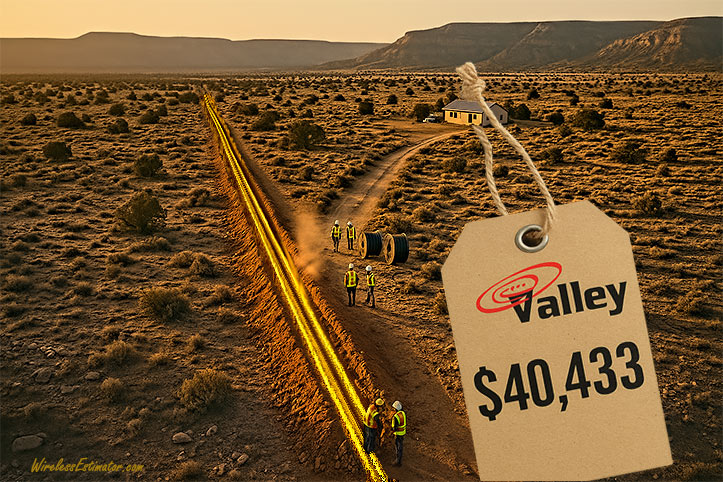
NEW MEXICO MATH: $100k home, $40k pass. Don’t worry, New Mexicans, taxpayers in 49 other states are chipping in for your gold-plated trenches.
Commentary:
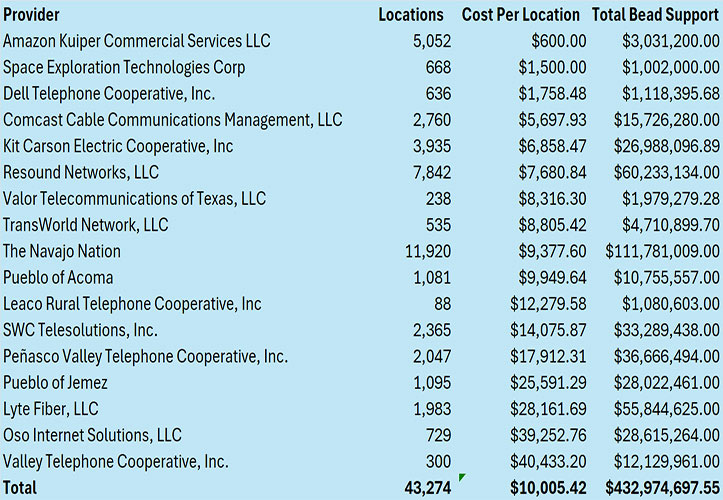
Valley Telephone Cooperative is slated for $40,433 per passing (300 locations), the highest line item in New Mexico’s final BEAD proposal. Oso Internet Solutions isn’t far behind at $39,253 (729 locations). In parts of Valley’s footprint, the typical home value hovers near $100,000, so U.S. taxpayers are being asked to fund a single pass that approaches half—or more—of a home’s value before the homeowner pays the normal monthly bill.
“No competing bidder” isn’t a blank check
BEAD’s 2025 reset requires technology-neutral, best-value selections. New Mexico already proved cheaper options exist by including Amazon’s Project Kuiper elsewhere in the plan at $600 per location (5,052 locations). If LEO satellite service can meet BEAD’s performance and standard installation rules for some clusters, the state should explain—clearly—why $40k fiber passes are still the best bargain in these particular areas.
There are also surgical middle-mile fixes that can mitigate the worst cost miles. A free-space optical (FSO) hop (e.g., Taara-style “fiber through the air”) can carry multi-gig, low-latency capacity 3 to 12 miles across the exact canyon/rail/arroyo segments that blow up budgets—installed in hours, not months, according to industry observers. FSOs serve homes via short fiber laterals or fixed wireless, and keep the FSO link as redundant backhaul when fiber eventually arrives. That approach can trim millions from total outlay and thousands per passing.
NTIA shouldn’t rubber-stamp this. Under the “Benefit of the Bargain” rules, NTIA can (and should) demand a side-by-side, tech-neutral justification for every very-high-cost Project Area:
A formal “LEO check” (could Kuiper or another LEO meet the standard-install and service requirements at far lower cost?).
A middle-mile alternatives check (FSO and/or microwave to bypass the punitive segments).
Documentation that no special construction would be charged to residents and that standard installs can happen within ~10 business days.
Other states have already begun calling out sticker shock and, in some cases, selecting LEO satellites or fixed-wireless solutions where terrain and density make fiber uneconomic in the near term.
New Mexico can do the same—without abandoning fiber—by using lower-cost technology as a bridge and reserving heavy construction for places where it actually makes sense.
When a pass costs $40,000 in neighborhoods with $100,000 homes, the public deserves more than “no one else bid.”
NTIA should condition approval on a transparent, tech-neutral recheck—including LEO and FSO—so New Mexico delivers the fastest, cheapest compliant coverage and preserves room to overbuild fiber where it truly makes sense.
–Craig Lekutis
