











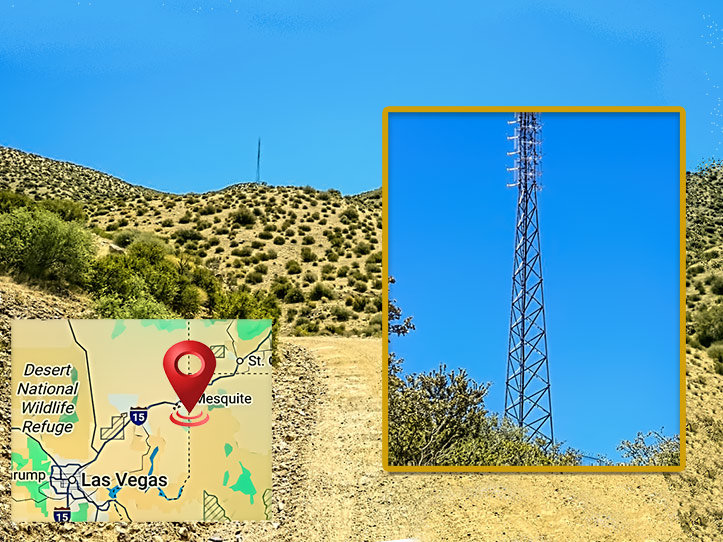
American Tower allegedly said it was tearing down this 190-foot self-supporting tower at Mount Diablo in Bunkersville, Nevada, where Radio Activo leases space for its broadcast equipment. A federal judge has temporarily barred dismantling the tower while a lawsuit proceeds; power to the site remains shut off pending a September 2 hearing.
A federal judge in Nevada granted Radio Activo Broadcasting LLC a temporary restraining order (TRO) blocking American Towers LLC and Insite Towers, LLC from decommissioning, dismantling, or removing the 190-foot self-supporting tower that carries the broadcaster’s signal, but declined to require American Tower to restore electrical service to the site immediately.
American Tower provides power for the site, constructed around 2009 by Insite Wireless LLC, whose structures were acquired by American Tower in 2020. Since then, Insite has operated as an American Tower subsidiary. The current lease with Activo, signed on August 3, 2023, with Insite, had a monthly base rent of $7,000.
In a four-page order, U.S. District Judge Jennifer A. Dorsey said the TRO will remain in place until 6 p.m. on Tuesday, September 2, when she will hold a hearing on Radio Activo’s motion for a preliminary injunction.
Radio Activo sued after, it alleges, the tower owner cut power and threatened to start taking down the structure on Friday, August 22, in violation of a long-running agreement.
The company says it has operated commercial stations from the Bunkersville, Nevada, site since 2012 and has kept current on rent and common-area maintenance (CAM) charges for which documentation has been provided.
In a sworn declaration filed with its injunction motion, owner Eric Palacios states that Radio Activo “has timely paid all rent and [CAM] charges for which [the owner] has provided adequate supporting documentation,” that July and August 2025 rent checks were accepted and deposited, and that the broadcaster wired $40,000 toward 2023 CAM charges after receiving support documents.
The declaration adds that Radio Activo has repeatedly requested backup for 2022 and 2024 CAM, is prepared to pay those once documented, and asserts the tower sits on BLM-managed national monument land, making replacement approvals impossible if the structure were removed.
American Tower has declared Radio Activo in breach; Radio Activo disputes that and says it remains willing to cure any substantiated obligations.
Judge Dorsey found the record shows at least serious questions on Radio Activo’s contract claims and a likelihood of irreparable harm if the tower were dismantled, given the potential permanence of losing the licensed site and signal coverage.
But she declined to issue a mandatory order compelling the defendants to restore electricity, noting that such injunctions are “particularly disfavored” and that the reputational and advertising harms from a temporary outage appear largely compensable with money damages at this early stage.
The court’s narrow TRO preserves the physical status quo—no teardown—while leaving the power dispute for the fuller preliminary-injunction hearing.
Radio Activo filed initially in the Nevada state court; American Tower and Insite removed the case to federal court on August 14, invoking diversity jurisdiction. In an amended complaint, Radio Activo also pleads that American Tower is the alter ego of Insite and should be jointly liable because it allegedly directed or ratified the power shutoff and decommissioning threats. It seeks damages for breach of contract, breach of the implied covenant, interference with contracts and prospective advantage, an accounting for CAM charges, and declaratory relief confirming access and power rights.
The defendants have not yet filed their merits response in the federal docket. The preliminary-injunction hearing on September 2 will determine whether the no-teardown restraint extends beyond that date and whether the court orders any additional interim relief while the case proceeds.
