












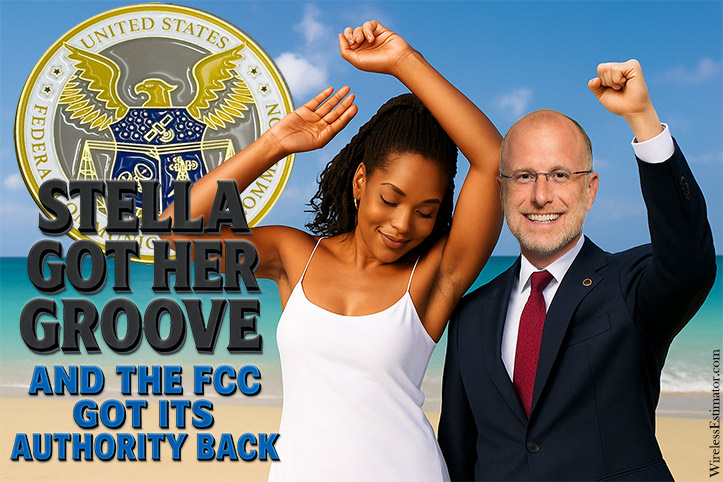
Visual added by WirelessEstimator.com; not part of the original WIA publication.
By Iain Gillott, Vice President of Technology & Innovation, WIA
Even better than Stella getting her groove back, the FCC got its spectrum auction authority back thanks to the One Big Beautiful Bill Act (OBBBA). And with it, an obligation to auction at least 800 MHz of spectrum within eight years, with a minimum of 100 MHz (but likely more) of Upper C-band spectrum auctioned by July 4, 2027. Congress provided the blueprint – now it’s up to us (government and industry working together) to get the job done.
This is a big deal. The entire digital infrastructure ecosystem — towers, small cells, cloud and edge data centers, fiber backhaul, and AI workloads — depends on having access to the right spectrum at the right time. Two things are needed for the U.S. to keep pace. First, block size – the US must allocate spectrum in large, contiguous blocks that truly move the capacity needle. And second, speed to market – make new spectrum available quickly and predictably to meet the needs of today’s and tomorrow’s applications.
There is still a lot of important work to be done to free up this spectrum. The deployment of 6G is expected to start by the end of the decade, and the U.S. mobile industry will need access to at least 600 MHz by then just to keep pace globally.
Bigger Pipes, Better Performance
Traffic volumes keep growing, driven not only by mobile streaming and gaming, but increasingly by enterprise, Internet of Things (IoT), augmented and virtual reality (AR/VR), edge-cloud, and artificial intelligence (AI) workloads. And these growth applications demand big, contiguous spectrum blocks that can support massive MIMO, carrier aggregation, ultra-low latency, and dense deployment.
Today’s wireless industry was built on relatively narrow blocks of spectrum – 4G LTE could make good use of a 20 MHz channel and was often deployed in 5 MHz or 10 MHz. This is no longer the case – 5G Advanced and 6G require much larger channel sizes to deliver the benefits promised. The United States needs large, clean lanes of mid-band spectrum, not leftover fragments.
As Yago Tenorio, CTO of Verizon commented at the recent WIA ‘Building the AI Future’ infrastructure summit, “you’re going to need channels probably of about 400 MHz of bandwidth. So just visualize that as super large, much larger than 5G contiguous blocks of a spectrum in bands that still propagate well enough to make coverage reach everywhere.”
I Feel the Need, the Need for Speed
Spectrum only creates value once it is deployed. A marathon is a 26.2 mile run: starting is good; getting half way is great; but you only get the medal and the recognition when you finish the whole race. The same with spectrum – benefits only come when there is a radio and antenna on a tower using that new spectrum.
So, for that new spectrum, timing matters as much as quantity. If new spectrum is identified but sits idle for years without a mandate to put it to use, network investment slows, capacity becomes constrained, and the nation loses its competitive edge.
Unfortunately, in the United States, the time between policy announcement and network activation has a habit of stretching to years. This is a frustration for the entire wireless ecosystem.
Technology does not wait for regulatory calendars. As networks evolve from 5G to 5G-Advanced and 6G, delay means lost market share and higher costs. The solution is simple: shorter decision cycles, clear deadlines, and defined paths from identification to assignment. Spectrum delayed is spectrum denied.
Fortunately, we’ve seen positive indications that both NTIA and the FCC understand the time crunch we face.
Now, to the question that everyone in wireless is asking. Where is the U.S. going to find these large contagious blocks of spectrum?
The Next Frontier: Upper C-Band
The FCC recently announced a Notice of Proposed Rulemaking on the “Upper C-Band” (3.98–4.2 GHz) at its next meeting on November 20th, 2025. The good news is that the proposal is to make available up to 180 MHz of spectrum for commercial wireless use, indicating the FCC’s desire to blow through the 100 MHz minimum requirement.
This band sits directly above the existing 3.7–3.98 GHz range that U.S. carriers have already deployed, making it a natural candidate for expansion. Its propagation and ecosystem fit make it the logical “next step” in the mid-band playbook.
Clearing and coordination will be complex, particularly with satellite incumbents and aviation concerns, but the potential reward is huge: adjacent, harmonized mid-band spectrum ready to add capacity and drive innovation.
The FCC’s task now is speed: defining transition frameworks, auction structure and timelines, and deployment milestones. If executed quickly, and the FCC is on pace to meet or beat its July 2027 deadline with its actions, the Upper C-Band could deliver some of the scale MNOs need for the next generation of mobile and enterprise applications.
Finding New Friends: The 4 GHz Band
The 4 GHz band (4.4–4.99 GHz) has long been reserved for DoD, public safety, supporting wireless LANs, fixed links, mesh networks, and backhaul for law enforcement and emergency response. But it appears this band could be cleared relatively easily (relatively is relative here of course!).
Arielle Roth, Administrator of the National Telecommunications and Information Administration (NTIA), captured the opportunity perfectly in her remarks at MWC Las Vegas 2025: “I am also growing increasingly excited about the 4 GHz band, and the opportunity to clear a large swath — potentially up to 400 MHz — of prime mid-band spectrum.”
She added, “I am laser-focused on getting this band studied and cleared as quickly as possible. If not during this Administration, then teeing it up for the next one.” Her words convey urgency and optimism. This is the exact mindset needed to break the current U.S. spectrum bottleneck and offers the potential for the large contiguous blocks needed.
This band also matches with efforts in the last few years to find common global bands for 6G. For example, at the World Radiocommunication Conference 2023 (WRC-23), the International Telecommunication Union (ITU) formally recommended a study of the 4.4–4.8 GHz band for 6G. This was supported by Japan and South Korea, among others, creating scale opportunities for devices and network equipment.
Why “Now” Really Means Now
As you may have already worked out, I believe we must act quickly to deliver large, contiguous mid-band spectrum for innovation and growth. The FCC’s Upper C-Band proposed rulemaking and NTIA’s leadership on the 4 GHz band represent a dual-track opportunity to combine the necessary scale with the needed speed. The 4 GHz band and the Upper C-Band can form the backbone of the nation’s next-generation wireless fabric, enabling AI, IoT, smart venues, and digital transformation at unprecedented scale and speed. Policymakers must therefore treat speed as a policy objective, not an afterthought. That means concrete dates for clearing, auctioning, and deployment; streamlined inter-agency coordination; and aggressive accountability.
One final point. While I am voicing optimism for progress in the Upper C-band and the 4GHz band, there are a lot of other potential bands under consideration to meet the OBBA 800 MHz goal. We are in the early stages of the spectrum marathon, and we should keep as many options on the table as possible as we work to turn Congress’ spectrum blueprint into the next generation networks that will be the foundation of our connected future.

