















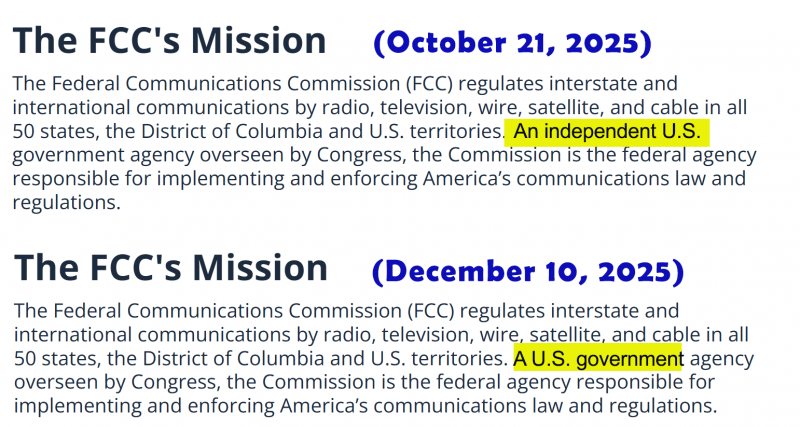
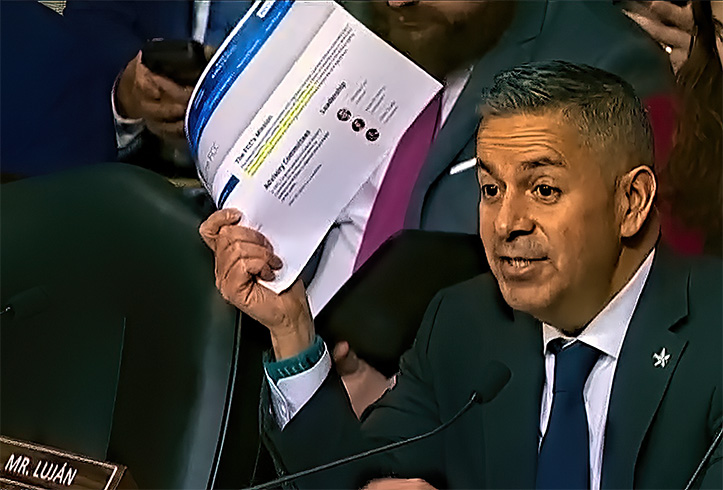
Sen. Ben Ray Luján (D-N.M.) brandishes a printout of the FCC’s homepage during a heated oversight hearing, using the agency’s own words to box in Chairman Brendan Carr on whether the commission is truly “independent.” The prop did its job. By forcing FCC leadership to either disavow the website or change it, Luján turned a semantic dispute into a public showdown over agency autonomy—one that ended with the word “independent” quietly vanishing from the FCC’s site. (Photo: C-SPAN)
The most contentious moment in this week’s Senate oversight hearing of Federal Communications Commission leadership had nothing to do with spectrum auctions, broadband deployment, or media ownership. Instead, it revolved around a single word that has defined the agency for nearly a century: independent. By the end of the exchange, that word had disappeared from the FCC’s website (View Video Below).
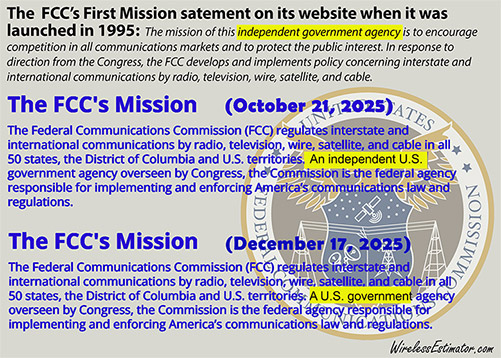
FCC ERASES ‘INDEPENDENT’ FROM MISSION STATEMENT – When Luján asked whether Congress should clarify the FCC’s independence through legislation, Chairman Carr flatly shut down the premise, asserting that Congress cannot legislate around the Constitution’s vesting of executive power in the president. He also authorized removing ‘independent’ from the agency’s website.
The sequence has raised questions not only about the FCC’s legal status, but about why Sen. Ben Ray Luján (D-N.M.) devoted a significant portion of his limited questioning time to an issue he clearly anticipated—and why Chairman Brendan Carr allowed the confrontation to conclude with a public concession and a visible change to the agency’s public-facing language.
FCC Long Described Itself as Independent Across Republican and Democratic Administrations
Historically, the FCC has consistently described itself as an independent regulatory agency. That description dates back to the Communications Act of 1934 and carried through decades of FCC annual reports, budget justifications, congressional testimony, and public statements. It remained intact when the FCC launched its website in 1995 and survived Republican and Democratic administrations alike. Until now, it had never been publicly repudiated by sitting FCC leadership.
Against that backdrop, Luján’s questioning was neither exploratory nor accidental. From the outset, he demanded a binary answer, repeatedly cutting off Carr’s attempts to explain legal nuance. Luján was not testing Carr’s grasp of administrative law; he was forcing the chairman to take a definitive position on the record. Carr ultimately did, stating that the FCC is “not an independent agency,” grounding his answer in a legal theory increasingly embraced by conservative jurists: that because FCC commissioners lack for-cause removal protections, they do not meet the modern constitutional test for independence.
Luján Presses Carr on FCC Website Language During Heated Exchange
Once Carr made that assertion, Luján pivoted from theory to credibility. He repeatedly cited the FCC’s own website, reading directly from its mission statement and asking whether the agency was “lying” to the public. As Carr reiterated that, “formally speaking,” the FCC is not independent, the exchange ceased being an academic debate and became an institutional reckoning. Either sworn testimony was wrong, or the FCC’s public materials were.
Luján then widened the confrontation by turning to Commissioner Olivia Trusty, who echoed Carr’s position, arguing that because commissioners can be removed by the president, they cannot be considered independent. Luján responded sharply, reminding the commissioners that they are the officials in charge of the agency and that website content necessarily reflects their authority. If the FCC’s public description was inaccurate, he said, they should “just fix it.”
FCC Website Change Followed Direct Challenge From Senate Oversight
That moment left Carr little room to maneuver. Allowing the website to remain unchanged would have left a direct contradiction between sworn testimony and official agency language. Changing it would signal control—and alignment between Carr’s constitutional view and the FCC’s public posture. Carr chose the latter.
The exchange took on added significance when Luján turned to Democratic Commissioner Anna Gomez, who answered unequivocally that the FCC is an independent agency and should remain so. That response exposed a clear philosophical split within the commission itself: a Republican chairman and commissioner asserting the FCC is not independent, and a Democratic commissioner defending Congress’s long-standing intent to structure the agency that way. Luján did not manufacture that divide; he deliberately placed it on the record.
Luján Raises Question of Congressional Authority Over FCC Independence
Luján’s final question revealed the broader objective behind the confrontation. He asked whether Congress now needs to clarify, through legislation, that the FCC is an independent agency. In doing so, he reframed the dispute as one between congressional authority and an emerging executive-branch theory that independence is largely illusory. Carr’s answer was consistent with that theory. He asserted that all executive power is vested in the president and that Congress cannot override that principle through statute.
FCC Dispute Aligns With Trump-Era Push to Expand Presidential Control Over Agencies
That exchange did not occur in a vacuum.
Carr and Trusty’s insistence that the FCC is not independent tracks a broader Trump-era effort to assert greater presidential control over agencies long treated as independent. In recent years, Trump has pursued removals or challenges involving leaders and members of other boards and commissions, advancing a unitary-executive theory that sharply limits Congress’s ability to insulate regulators from presidential authority. Those efforts have already triggered litigation over removal protections at other agencies and are now converging at the Supreme Court, which is widely expected to clarify—or significantly expand—the president’s power to fire officials traditionally viewed as independent.
Seen through that lens, Luján’s questioning was less about correcting a website and more about forcing FCC leadership to align publicly with one side of a constitutional battle already playing out across the federal government. By compelling Carr to say the FCC is not independent, and by highlighting the contradiction with the agency’s own materials, Luján built a record that could support future oversight, legislation, or litigation aimed at preserving Congress’s role in structuring independent regulators.
Why the FCC Independence Debate Matters to the Wireless Infrastructure Industry
By the end of the hearing, the immediate outcome was clear. Carr asserted control, the FCC’s website was changed to reflect his position, and the record now captures a stark disagreement over the agency’s constitutional standing. But the implications extend well beyond semantics. The FCC’s independence has long underpinned how it regulates carriers, tower owners, broadcasters, and contractors. Challenging that premise reopens questions about oversight, accountability, and political influence that the wireless infrastructure industry has not had to confront in decades.
Luján did not spend three minutes pressing the issue by accident, and Carr did not allow the website to be changed by inertia. The exchange was a deliberate collision between two governing philosophies—one rooted in congressional design, the other in executive authority—and Carr emerged visibly in control.
What comes next, whether through Supreme Court rulings, congressional action, or further oversight, will determine whether “independent” remains a historical descriptor of the FCC or becomes a contested concept with real regulatory consequences for the communications industry.
Editor’s Note: For over 21 years, Wireless Estimator, without pay walls, has gone beyond surface-level press releases and generic reports skinned from other media. To stay informed with exclusive news, industry updates, and in-depth investigative articles you won’t find anywhere else, subscribe to our news releases on our home page today. And if you’re a supplier, service provider, or contractor, you’ll need to be listed at no charge in the industry’s most successful buyer’s guide, the BLUE BOOK, with almost 1.3 million ad views and the only industry platform offering Quick Connect to ensure your company’s success. Other time-honored, successful advertising opportunities are available here.
