














By Gershwyn Fortune, CEO & COO, Ritel Incorporated
When I stood before industry leaders at NATE UNITE 2026, my intention was not to deliver a ceremonial address. It was to speak plainly, candidly, and urgently about what many of us are experiencing but few have articulated at scale.
I spoke as a General Contractor. As an operator. As someone responsible not just for projects, but for people.
What I shared was not theoretical. It is the reality reshaping our industry.
A Shift That Cannot Be Ignored
For over five years, Ritel Incorporated has operated as a General Contractor working directly with T-Mobile. That direct relationship created operational clarity. It allowed us to maintain sustainable margins, stabilize our workforce, and compensate skilled tower technicians fairly for high-risk, highly specialized work.
Today, that model is shifting.
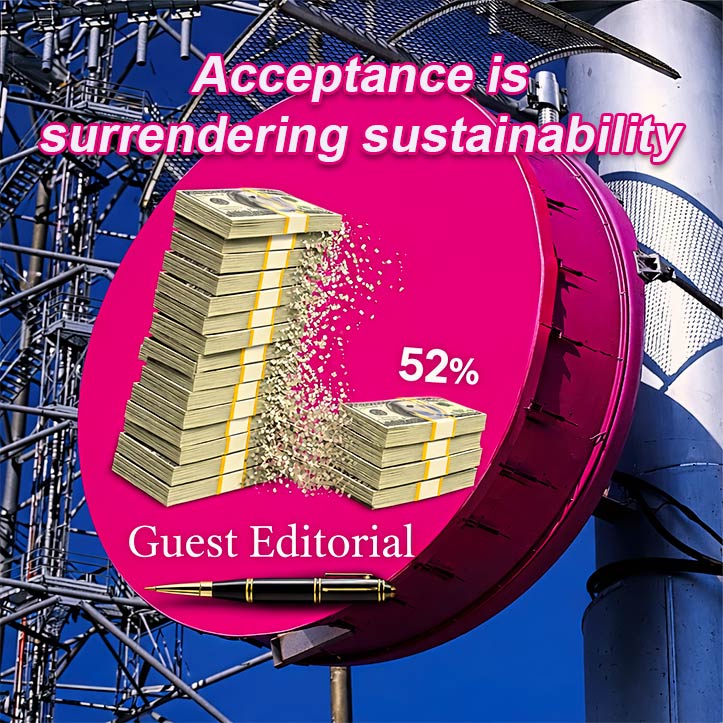
Under a newly implemented structure, General Contractors are now being required to perform the same scope of work under a management company intermediary, with compensation reduced by as much as 52%.
Fifty-two percent.
This is not market fluctuation. This is not efficiency. This is structural compression.
The layers have increased. The expectations have not changed. The risk has not changed. The labor has not changed.
But the compensation has.
And that changes everything.
What concerns me most is not just the shift in management but the impact it has on the contractors who have invested years building the infrastructure, training crews, and maintaining performance standards for the carrier.
A Question That Stilled the Room
In that moment, I asked a question that was not rhetorical:
Do I accept a 52% deduction in compensation knowing that my company cannot survive within that range and still maintain standard operations?
That question carries weight.
Because accepting those terms is not adaptation. It is surrendering sustainability.
It means jeopardizing payroll, compromising operational integrity, and undermining years of disciplined growth.
Another contractor in the room immediately echoed the same stance. He would not accept those terms either.
Because we all understood what was truly at stake.
This is not about trimming excess.
This is not about improving efficiency.
This is about survival.
The Human Reality Behind the Numbers
Behind every percentage point are real people. Tower climbers who scale steel structures in freezing winters and relentless summer heat. Men and women who operate at dangerous heights so the rest of the world can remain connected, so businesses function, families communicate, and emergency calls go through without interruption.
They carry the industry on their backs.
And now, under these structural changes, it feels as though the ground beneath them is shifting.
When contractor compensation is compressed at this level, the pressure does not disappear. It transfers.
It reaches the workforce.
It impacts wages, benefits, stability, and livelihoods.
And ultimately, it challenges whether those risking their lives daily can continue to provide for themselves and their families.
That reality should give every stakeholder pause.
The Economic Squeeze on Small Business
As both CEO and COO, my perspective is grounded in daily operational reality.
This is not abstract.
General Contractors are responsible for ensuring climbers are OSHA-compliant and properly trained, investing in fall protection and safety innovation, maintaining vehicles, equipment, and tooling, managing timelines, quality, and delivery expectations, and supporting administrative teams that handle logistics and compliance.
These are not optional costs. They are the foundation of safe and effective operations.
So when revenue is reduced by more than half, the math becomes unforgiving.
How do we maintain competitive wages?
How do we preserve benefits?
How do we fund training and certifications?
How do we continue building the next generation of skilled workers?
Small businesses like Ritel Incorporated are not expendable vendors.
We are employers.
We are trainers.
We are mentors.
We are community anchors.
We are the backbone of the infrastructure supply chain.
And when that backbone is strained, the impact extends far beyond a balance sheet. It reaches families, communities, and the long-term viability of the industry itself.
The Generational Consequence
One of the most pressing questions I raised is this:
How do we attract and retain the next generation under these conditions?
We are already facing a skilled labor shortage.
To recruit new talent, we must offer more than opportunity. We must offer stability, growth, and fair compensation.
But if contractors cannot sustain payroll, if administrative teams are reduced, and if training investments are limited, then what future are we presenting?
An industry that cannot sustain its contractors cannot scale its ambitions.
If the foundation weakens, the structure above it will inevitably follow.
An Important Response from Industry Leadership
In response to these concerns, members of the NATE Board acknowledged that they had not previously received formal documentation outlining the severity of this compensation compression.
They requested that I submit a detailed account of these challenges so the issue can be escalated to the carriers for review.
That moment mattered.
Because it marked the beginning of accountability.
The concern has now been voiced.
The documentation is in motion.
The conversation has begun.
A Call for Equilibrium
Let me be clear. This is not resistance to progress.
Our industry must evolve. It must innovate. It must scale.
Carriers play a critical role in advancing connectivity that powers economies, education, healthcare, and emergency response systems.
But sustainability must exist at every level.
If General Contractors absorb disproportionate financial strain, the result will not be efficiency. It will be fragility.
A resilient industry requires transparent structural transitions, fair and sustainable compensation models, shared risk across stakeholders, viable contractor margins, and long-term partnership thinking.
Without these, the system becomes unbalanced.
Protecting the Builders of the Network
My remarks were not intended to disrupt. They were intended to illuminate.
Because the truth is simple.
The networks of tomorrow cannot be built on unsustainable economics today.
If small and mid-sized General Contractors are forced into contraction, or worse, closure, the industry risks undermining its own foundation.
Small businesses are not just part of the ecosystem.
They are the hands that build it.
So the question before all of us, carriers, management companies, and industry leaders, is not whether change will continue.
It will.
The real question is whether that change will preserve the very contractors who make nationwide connectivity possible.
Because if we are to build higher, faster, and smarter, we must first ensure that the builders themselves can endure.

ABOUT GERSHWYN FORTUNE:
Gershwyn Fortune is the Chief Executive Officer and Chief Operating Officer of Ritel Incorporated, with over 30 years of experience in wireless infrastructure, engineering, and operations. He is recognized for delivering consistent, high-level execution in complex network environments—proving that performance, not size, defines success.
For the past five years, Gershwyn has led Ritel in executing the T-Mobile Microwave program, establishing it as one of the carrier’s most successful and consistently delivered deployments through disciplined processes, bench-testing excellence, and a zero-punch installation standard.
His leadership is grounded in accountability, safety, and operational discipline, and he is strongly committed to the workforce that powers the industry.
He challenges a fundamental question: Is our industry rewarding performance or proximity to power?
