















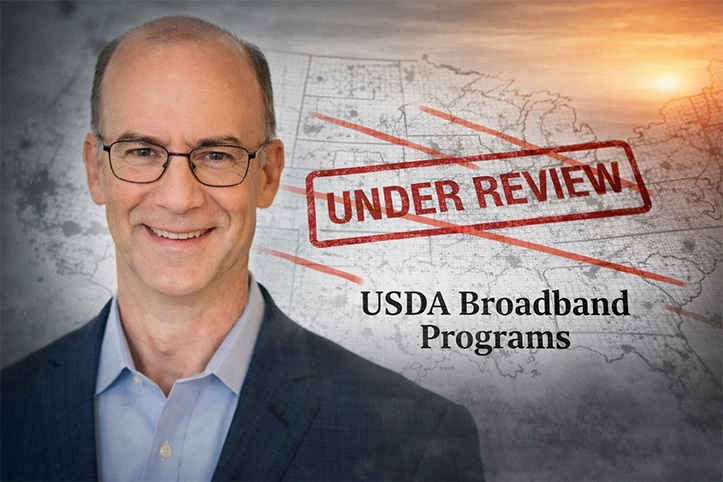
A mix of fiscal watchdog groups, former regulators, and some policymakers are calling for the elimination or consolidation of the U.S. Department of Agriculture’s broadband programs, arguing they’ve become redundant, inefficient, and out of step with today’s funding landscape.
The roots of that debate go back more than a decade.
From stimulus solution to structural problem
In 2009, Jonathan Adelstein, appointed by the Obama administration, led the Rural Utilities Service during the rollout of the American Recovery and Reinvestment Act, overseeing roughly $3.5 billion in rural broadband funding and transforming USDA into a central player in broadband deployment.
The mission was clear: extend connectivity into rural areas where the private market wouldn’t go. But the model—large funding programs distributed through complex applications, layered oversight, and multiple agencies—didn’t stay contained. It expanded.
Programs like ReConnect, launched in 2018, followed that same framework. Today, that structure is colliding with a new reality: too many programs targeting the same problem.
A crowded federal landscape
With the addition of the $42.45 billion BEAD program, federal broadband funding now spans more than 100 programs across multiple agencies. Critics argue that maintaining USDA programs alongside BEAD risks duplication, slower deployment, and administrative overlap.
The latest push, highlighted by watchdog groups and former policymakers, calls for eliminating USDA broadband programs entirely or folding them into larger, centralized efforts.
The debate is no longer about funding broadband—it’s about how many federal programs are needed to do it.
Ongoing oversight concerns
Concerns about USDA broadband programs are not new. A Government Accountability Office review found that ReConnect lacked clear performance metrics and had gaps in fraud risk management and oversight documentation.
The program has also faced criticism over slow application timelines, restrictive eligibility rules, and questions about whether funding consistently reaches truly unserved areas.
While the intent has remained consistent, execution has repeatedly drawn scrutiny.
From policy to industry—and back again
Adelstein’s influence didn’t end at USDA. He later led the PCIA—now the Wireless Infrastructure Association—before moving into advisory and leadership roles with DigitalBridge and Vertical Bridge, placing him at the intersection of policy, capital, and infrastructure deployment.
That trajectory reflects the same interconnected system now under review—one that has grown increasingly complex as funding has expanded.
A system under reconsideration
What began as a targeted effort to close the digital divide has evolved into a layered and overlapping funding structure that is now being reassessed.
For contractors, any consolidation could mean fewer but larger funding streams, shifting work toward firms with the scale to compete at a national level.
The push to eliminate USDA broadband programs is ultimately a question of efficiency—not intent—but it underscores a broader reality: today’s challenges are the product of more than a decade of expansion built on a system that was never fully streamlined.
And as billions more in funding begin to flow, how that system is reshaped may determine not just how networks are built—but who gets to build them.

