















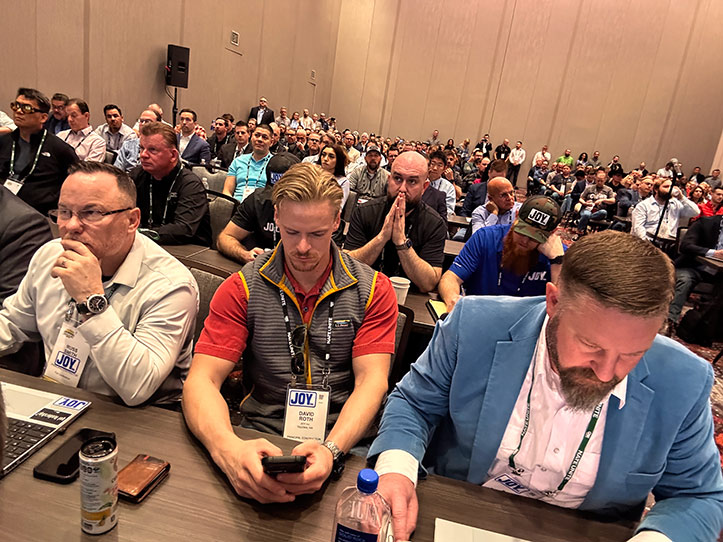
More than 300 contractors packed the session on Tuesday to hear NATE leaders Todd Schlekeway, Craig Snyder, and Victor Drouin detail fourteen months of hard-fought negotiations with the nation’s three largest wireless carriers. While progress was reported across the board, panelists made little effort to conceal that Verizon had proven the most resistant partner at the table.
For the first time in recent memory, contractors working on America’s wireless infrastructure have commitments from AT&T, Verizon, and T-Mobile. These agreements address pricing, payment terms, audit practices, and the use of unlicensed crews that industry leaders say have long suppressed wages and undercut legitimate businesses.

The faces in the room told the story: Contractors listened intently as NATE leaders laid out the details of framework agreements that many in the industry see as a last line of defense against pricing practices and contracting structures that have pushed small businesses to the financial edge.
Although they are not binding, the agreements, secured over fourteen months by NATE: The Communications Infrastructure Contractors Association, were detailed at a member session yesterday moderated by NATE President and CEO Todd Schlekeway, with panelists Craig Snyder, Chairman and Founder of VIKOR, and Victor Drouin, NATE Chairman and President of Green Mountain Communications.
“For the first time in a very long time, we have formal, FCC-recognized commitments from all three major carriers,” Schlekeway told attendees. “Are they perfect? No. Is there still a lot of work to do? Absolutely. But this is real, hard-won progress.”
How the FCC Became the Leverage Point
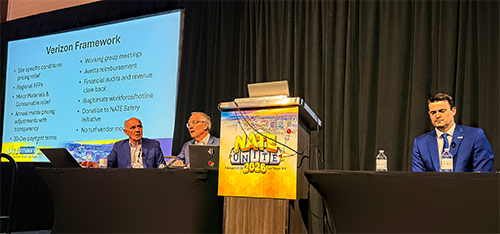
Victor Drouin, NATE Chairman and President of Green Mountain Communications, (LtoR) Craig Snyder, Chairman and Founder of VIKOR and Todd Schlekeway, President & CEO of NATE, delivered a message that the wireless infrastructure contracting industry has waited years to hear, that for the first time, all three major carriers are operating under formal, FCC-recognized commitments to the contractors who build and maintain their networks, even as the panelists acknowledged the hard work of enforcement and getting all of the proposed obligations is only just beginning.
The breakthrough came not through traditional contract negotiations alone, but through a strategic alignment with federal regulators. Each of the three framework agreements was embedded as a condition of a major carrier acquisition approval — a tactic that gave NATE’s advocacy real teeth.
Verizon’s framework was tied to its acquisition of Frontier. T-Mobile was attached to its acquisition of US Cellular. AT&T’s provisions were made a condition of a spectrum acquisition approval, finalized in December after a government shutdown delayed filing by more than 48 days.
Snyder credited FCC Chairman Brendan Carr with making it possible. “About a year ago, Chairman Carr called and said he had been reading about the challenges our contractors were facing and wanted to help,” Snyder said. “What the FCC did, what was truly remarkable, is they used the leverage of those acquisition approvals to embed contractor provisions directly into the agreements.”
The visibility of the effort was underscored, Snyder noted, when Chairman Carr chose a tower training center in Sioux Falls, South Dakota, as the backdrop to unveil his “Rebuild America” agenda. “He didn’t want suits standing behind him,” Snyder said. “He wanted technicians, people in harnesses and hard hats.”
NATE also engaged the U.S. Department of Homeland Security regarding national security concerns related to the use of unvetted, foreign-connected crews on critical communications infrastructure — an issue the association says compounds the pricing suppression problem.
Verizon: Pricing Adjustments, a Six-Month Audit Cap, and a Clawback Fight
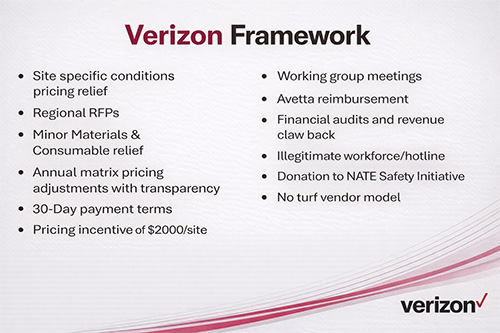 Verizon was the first carrier to reach an agreement, and the negotiations were described as contentious before ultimately being slightly productive. The carrier recently rolled out price adjustments of 3.7% to 4%, covering approximately 47 new line items. The effective increase for most contractors, however, works out to roughly 3%, a figure NATE acknowledges falls short of what the industry needs, but accepts as a step forward.
“Pricing had been essentially flat since around 2020,” Snyder said. “Every incremental gain counts.”
Verizon has committed to completing a national rollout of the updated pricing across all 19 of its regions by the end of the first quarter and to annual pricing reviews in the future. Payment terms have been standardized at 30 days.
However, as reported by Wireless Estimator, the durability of those commitments was tested early. Within months of Verizon’s May 2025 FCC filing pledging 30-day payment terms, vendors received a separate operational notice announcing a move to net-90 payment terms effective February 2026. The directive was traced to Verizon’s finance and sourcing leadership in Ireland, apparently disconnected from the regulatory commitments made in Washington, though following the public exposure of that gap, Verizon recommitted to honoring the original 30-day terms.
The audit and clawback issue proved to be one of the most heated points of negotiation. Verizon had been conducting retroactive audits reaching back years, in some cases generating clawback demands of hundreds of thousands of dollars against contractors whose work had been approved at the time.
“What we do not agree with is when regional leaders approve work, you complete it in good faith, and then months or even years later they come back and say they think they overpaid,” Snyder said. The final agreement caps the lookback window at six months. NATE urged members to notify the association immediately if they receive audit notices exceeding that window.
T-Mobile: Reversing a 20% Maintenance Cut and Eliminating Factoring Fees
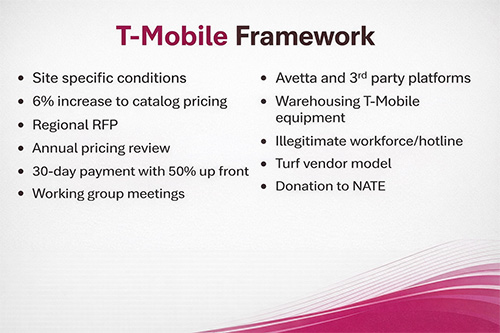 The T-Mobile framework centered on reversing what NATE described as an extraordinary pricing rollback. In 2024, T-Mobile cut its national maintenance pricing by approximately 20%, a move that Drouin called “deeply damaging” to contractors across the country.
“We got them to reverse that,” Drouin said. “They came back to 6% above the prior baseline, which does not fully repair the damage, but it is meaningful progress.”
The data, however, tells a more complicated story. T-Mobile has approximately 240 line items in its maintenance pricing, of which roughly 120 are commonly used. The initial cut affected about 77 of those, representing the majority of work most contractors perform on a day-to-day basis. After the negotiated rollback and a subsequent regional adjustment, NATE estimates that 60 line items still sit below 2021 pricing levels.
“We count these as incremental wins, but there is still work to do,” Drouin said.
T-Mobile has committed to a three-year agreement with annual pricing reviews, 50% advance payment on major project mobilization costs, and the elimination of factoring fees, a practice in which contractors were charged approximately 1/30th of an invoice’s value per day for late submission. That fee structure is now gone.
T-Mobile also committed to moving toward a single-tier subcontracting model, targeting the elimination of the multi-layer pyramid structures that NATE says make it economically impossible for the crews actually performing the work to operate sustainably.
AT&T: Restructuring the Turf Model and a June 1 Deadline
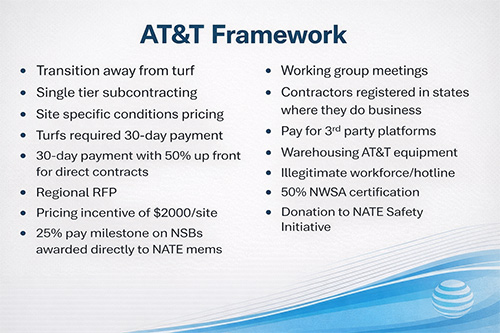 AT&T came to the table last, but NATE described it as among the most engaged partners once negotiations were underway. The AT&T working group, which now includes representatives from major GC partners Ericsson, MasTec, Amentum, and Ansco, alongside AT&T executives, has been meeting regularly since January.
The central structural issue is AT&T’s “turf model,” in which large general contractors control geographic territories and manage the subcontracting chain beneath them. NATE has long argued this model suppresses pricing and insulates AT&T from visibility into what contractors on the ground are actually being paid.
AT&T has committed to moving to a single-tier contracting structure. By June 1 of this year, the carrier has agreed to eliminate all contracting arrangements more than two tiers below AT&T — meaning the chain is limited to AT&T, one GC layer, and then the contractor performing the work.
“That is a significant structural change,” Snyder said, adding that the transition is already beginning to occur in practice.
Additional AT&T commitments include a 50% NWSA certification requirement for crews, annual pricing reviews, 30-day payment terms, elimination of factoring fees, and a $2,000 reimbursement adjustment for small mod sites priced below a certain threshold. AT&T has also established a dedicated reporting line with separate options for immediate on-site safety issues and broader compliance concerns.
The Enforcement Question
One question raised repeatedly by attendees cut to the heart of the matter: if these frameworks are not legally binding contracts, what actually compels the carriers to follow through?
Snyder outlined four mechanisms. The FCC, he said, can call carrier CEOs directly and demand accountability. The working groups themselves, which meet monthly and document every gap, create a paper trail of non-compliance.
Public accountability through member reporting gives NATE the specific case data needed to escalate. And carriers have a reputational stake in maintaining credibility with the commission that approved their acquisitions.
As proof of concept, Snyder pointed to Verizon’s audit wave last year. Of the audits that NATE members flagged and escalated, 19 were waived outright, and 16 were significantly scaled back.
“That is the working group in action,” he said.
What Members Can Do Now
NATE leaders closed the session with a direct call to action for contractors in attendance.
Members who believe they are not receiving the pricing adjustments they are entitled to, particularly those working as principal contractors for any of the three carriers, were urged to contact NATE for escalation support.
Members were also strongly encouraged to report unlicensed and unregistered crews to the carrier hotlines, which all three carriers have now established. Drouin estimated that in some regions, up to 50% of work has been performed by crews not properly registered in the states where they operate, a dynamic that NATE says makes it impossible for legitimate contractors running insured, tax-compliant operations to compete.
When “No” Puts You on the Outside Looking In
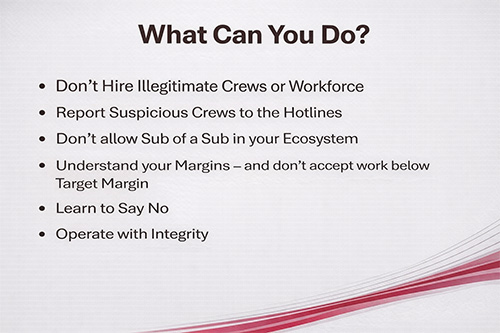 Among the guidance NATE offered attendees was a slide encouraging contractors to “Learn to Say No,” to refuse work priced below sustainable margins rather than accept terms that slowly erode their businesses. The advice is sound in principle. In practice, for many small- and mid-sized contractors that form the backbone of the wireless infrastructure workforce, it is easier said than done.
The reality on the ground is that saying no carries consequences that extend well beyond a single declined job. Several contractors told Wireless Estimator that when they pushed back on below-market pricing, they were told bluntly that the carrier or GC would send someone else to do the work, a thinly veiled reminder of how replaceable any individual contractor is in a tiered, commoditized supply chain.
The fear of being quietly sidelined, effectively blocked without any formal process, is not paranoia. It is a lived experience for contractors who have watched work dry up after raising objections. Unlike larger companies with diversified revenue streams and the financial cushion to walk away from a single carrier relationship, most wireless infrastructure contractors are deeply dependent on a narrow set of clients. For them, “just say no” is less a business strategy than a luxury, one that the economics of their industry rarely afford.


