














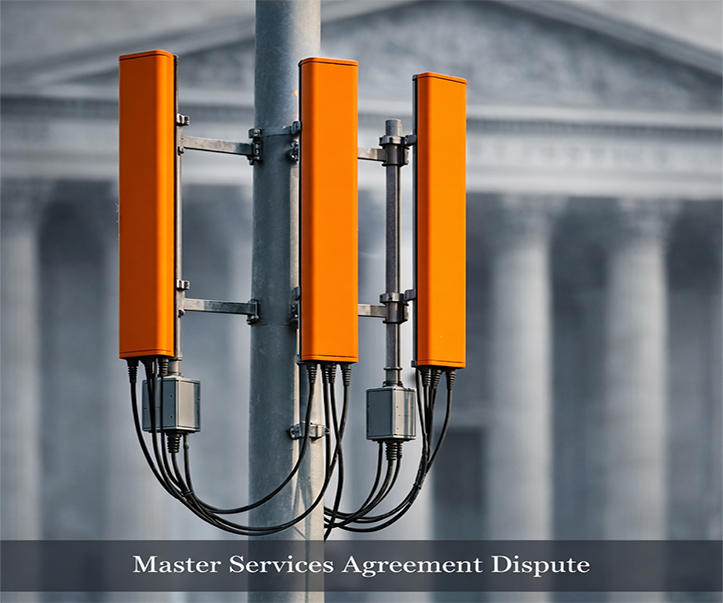
DISH Network is facing litigation over the interpretation and enforcement of master services agreements governing wireless tower leases. In its newly filed answer to Crown Castle’s lawsuit, DISH denies breaching the MSA and advances the same contractual defense it previously asserted in a similar dispute brought by American Tower, arguing the claims stem from differing interpretations of payment obligations rather than an outright refusal to perform.
DISH Network filed its formal response Friday to Crown Castle’s lawsuit, reinforcing a legal strategy it first deployed earlier this year in its answer to American Tower’s similar complaint. Together, the filings underscore a widening dispute between DISH and the nation’s largest tower owners over the interpretation and enforcement of long-term master service agreements (MSAs).
At the outset, it is worth noting that payment disputes tied to DISH are not limited to the largest tower companies. According to documents reviewed by Wireless Estimator, a smaller U.S. tower owner has not been paid for approximately three months on dozens of sites leased by DISH, with payments ceasing in October. That company issued a formal notice of default last month, citing an outstanding balance now in the mid-six figures. While Crown Castle and American Tower have not publicly disclosed the dollar amounts at issue in their respective cases, they are clearly in a far stronger financial position to absorb delayed or disputed payments than smaller tower operators.
In its newly filed answer to Crown Castle’s complaint, DISH broadly denies that it breached the MSA, disputing claims that it improperly stopped making payments or attempted to unilaterally abandon its contractual obligations. DISH argues that Crown Castle has mischaracterized both the nature of the agreement and the circumstances surrounding DISH’s evolving network deployment strategy.
Crucially, the allegation that DISH “ceased payments” originates in Crown Castle’s and American Tower’s complaints—not in any admission by DISH. In both cases, DISH explicitly does not concede that it stopped payments in breach of the agreements. Instead, DISH maintains that the payments claimed by the tower owners were not contractually owed under a proper reading of the MSAs, which it argues do not function as unconditional, take-or-pay arrangements divorced from actual deployment or usage.
Beyond standard denials and affirmative defenses, DISH’s response advances a consistent narrative also seen in its American Tower filing: that the tower owners failed to meet certain contractual obligations, that DISH’s changing operational needs were contemplated within the agreements, and that the plaintiffs are attempting to retrofit the MSAs into fixed-revenue instruments not supported by their original terms.
While the Crown Castle and American Tower agreements differ in detail, DISH’s legal posture in both cases is strikingly similar. The carrier challenges the tower companies’ damage calculations, disputes claims of material breach, and subtly invokes doctrines akin to frustration of purpose and commercial impracticability—without expressly labeling them—by tying its performance to regulatory, financial, and market realities.
The affirmative defenses asserted in both responses are largely identical and include failure to state a claim, breach by the plaintiff, waiver, estoppel, laches, failure of consideration, and unclean hands. The near-mirror structure of the filings suggests a coordinated litigation strategy rather than a fact-specific defense unique to each tower owner.
As Crown Castle follows American Tower into court, the cases collectively raise broader questions for the wireless infrastructure sector—particularly for smaller tower companies—about how MSAs will be enforced when a carrier’s business model shifts mid-term, and how much risk tower owners may be forced to shoulder when contractual interpretations collide.
