















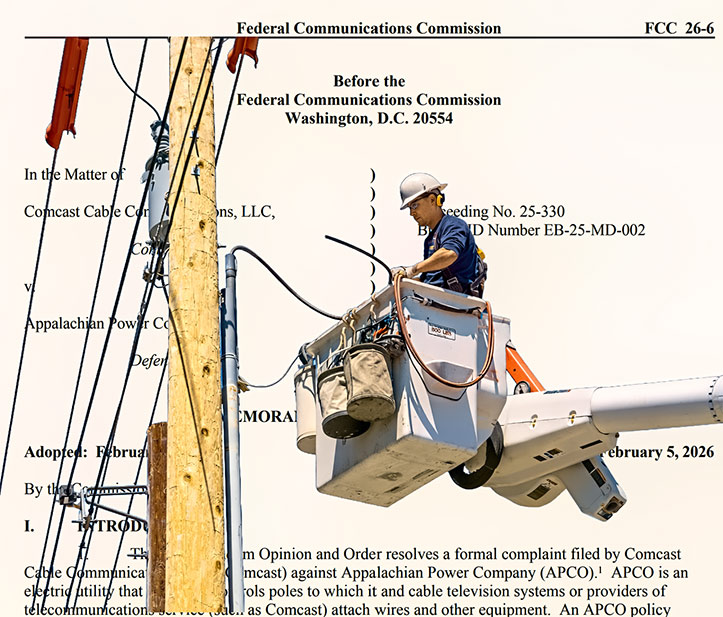
The FCC says it has just proven a new enforcement tool can do what broadband builders have asked for years: resolve pole-attachment disputes quickly enough to keep construction moving.
In what the agency is calling a “first-of-its-kind” action, the Commission used its new Accelerated Docket process—run by the FCC’s Rapid Broadband Assessment Team (RBAT)—to resolve a pole attachment complaint in under 60 days, clearing a cost-allocation dispute the FCC said was slowing deployment and threatening to inflate costs for BEAD-funded projects in Virginia.
The dispute: who pays when the pole already violates safety rules?
The complaint pitted Comcast, seeking pole access for broadband expansion, against Appalachian Power Company (APCO), a utility subsidiary of American Electric Power. Comcast argued that APCO’s pole-replacement policy unlawfully forced new attachers to absorb the full cost of replacing poles that already had preexisting safety or engineering violations caused by third parties.
The FCC agreed. In its Memorandum Opinion and Order, the Commission held that APCO’s policy violates Section 224 of the Communications Act and long-standing FCC precedent: a utility cannot require a new attacher to pay the entire cost of a pole replacement when the pole already fails to comply with existing safety or engineering standards.
What the FCC decided: Comcast pays only the “incremental” cost
The Commission’s ruling draws a clean line between correcting a preexisting violation and upgrading a pole specifically to accommodate a new attachment.
Under the FCC order, Comcast is obligated to pay only the incremental increase associated with installing a stronger and/or taller pole needed to support Comcast’s attachment—not the full cost of replacing a pole that had to be replaced anyway to cure a prior violation.
That distinction matters because pole replacement is often one of the largest—and most unpredictable—line items in rural builds, particularly when a utility’s standards require widespread replacement rather than make-ready adjustments.
Why Virginia and BEAD mattered to the FCC’s timeline
The FCC explicitly framed the dispute as a deployment risk for federally subsidized broadband construction. Comcast told regulators it had been awarded a $126 million BEAD grant to connect approximately 13,000 unserved and underserved locations in Virginia, and that delays tied to pole access and cost disputes could jeopardize schedules and inflate costs.
Commission staff had already placed the case on the FCC’s accelerated docket in December, setting expectations for an agency decision within 60 days.
Carr: Pole disputes are “a significant obstacle” to broadband builds
FCC Chairman Brendan Carr cast the action as an early win for the Commission’s Build America agenda, arguing that utility-provider fights over poles have become a recurring choke point for rural deployments.
“A key pillar of the FCC’s Build America Agenda is to unleash high-speed infrastructure builds,” Carr said, adding that disputes between providers and pole owners are “a significant obstacle” and that the FCC’s RBAT and Accelerated Docket procedures are a “powerful tool to resolve disputes quickly.”
What it signals for broadband builders—and pole owners
The immediate impact is narrow—one dispute, one utility, one provider—but the precedent is broader. The FCC has now put pole owners and attachers on notice that disputes tied to BEAD-driven deployment can be elevated and decided on a compressed timetable, and full pole replacement cost can’t be shifted to new attachers when the replacement is required primarily to cure preexisting violations.
For contractors and project managers in BEAD states, the decision is likely to be cited quickly in negotiations where pole replacement charges have become a gating issue. For utilities, the order is a warning that replacement-cost policies that effectively socialize legacy noncompliance onto new attachers may not survive FCC scrutiny—especially when they threaten federally funded broadband milestones.
