















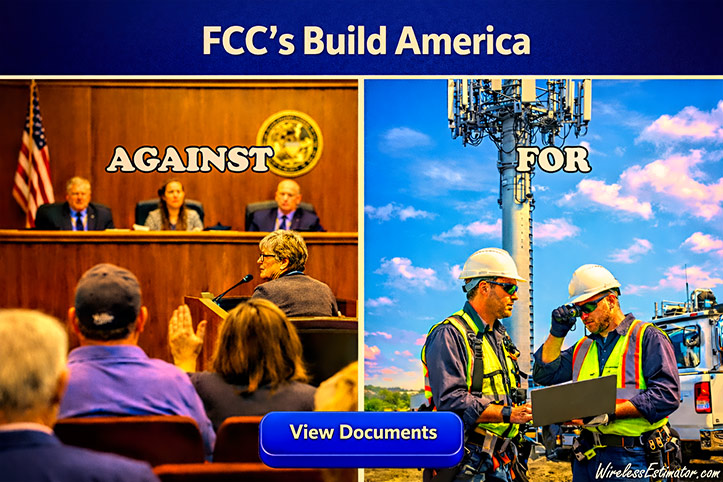
Filings in the FCC’s Build America: Eliminating Barriers to Wireless Deployments proceeding (WT Docket No. 25-276) began appearing in late October 2025, weeks before the formal comment period, and have continued steadily as the docket has grown to more than 3,000 submissions.
While the NPRM’s publication in the Federal Register triggered the formal deadlines—December 31, 2025, for initial comments and January 15, 2026, for reply comments—the docket itself has been active for months, underscoring the level of early engagement and controversy surrounding the proceeding.
Cities and Counties Lead Early Opposition
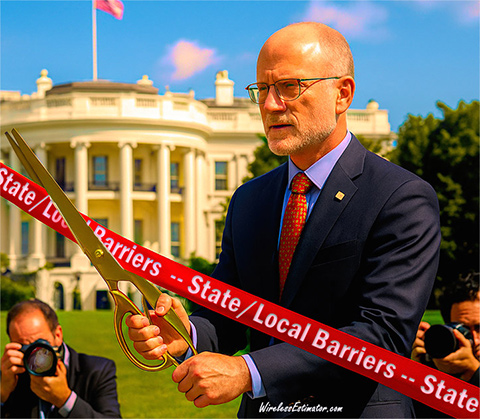
FCC Chairman Brendan Carr’s agency has initiated an inquiry into state and local statutes, ordinances, and practices that may “effectively prohibit” deployment, signaling potential federal preemption where local processes conflict with federal law. (Wireless Estimator graphic)
A significant portion of the filings to date have come from cities, counties, and municipal associations, many of which argue that the FCC’s proposals go beyond streamlining and instead represent an expansion of federal preemption over local zoning and land-use authority.
Local government commenters repeatedly warn that accelerated shot clocks, expanded “deemed granted” concepts, and tighter limits on fees and conditions would strain planning departments, reduce public input, and expose municipalities to legal and public-safety risks. Several filings also suggest the Commission may be exceeding its statutory authority, raising the likelihood of litigation if the rules are adopted as proposed.
Industry and Pro-Deployment Advocates Support Streamlining
On the other side of the docket, wireless deployment advocates and industry policy groups are urging the FCC to strengthen and clarify federal guardrails governing local review. These commenters argue that inconsistent local processes, extended review timelines, and excessive fees continue to slow network upgrades and expansion, particularly for modifications and densification.
Pro-deployment filings generally align with the FCC’s stated goal of accelerating infrastructure deployment as part of a broader “Build America” agenda focused on connectivity, economic competitiveness, and network resiliency.
Public-Interest Filings Echo Familiar Concerns
Wireless Estimator has reviewed more than 200 filings from the docket, and among those submissions, the majority oppose the FCC’s proposed actions. Many of these comments—submitted mainly by individuals and community groups—rely on recurring themes that have appeared in prior infrastructure proceedings.
These filings frequently raise RF health concerns, often citing studies that have been repeatedly reviewed and debunked by federal health agencies and courts. Others assert that cell towers depress property values, despite longstanding evidence showing no consistent correlation.
A common misconception, reflected in numerous comments, is that the FCC’s proposal would allow wireless developers to place towers “anywhere,” regardless of existing zoning restrictions—an interpretation that mischaracterizes the scope of the NPRM.
One commenter said, “These rules would allow towers to be placed virtually anywhere, with no say from the people who must live with them.” He also incorrectly stated that the new regulations would “undermine property rights by driving down home values without recourse or compensation”.

