














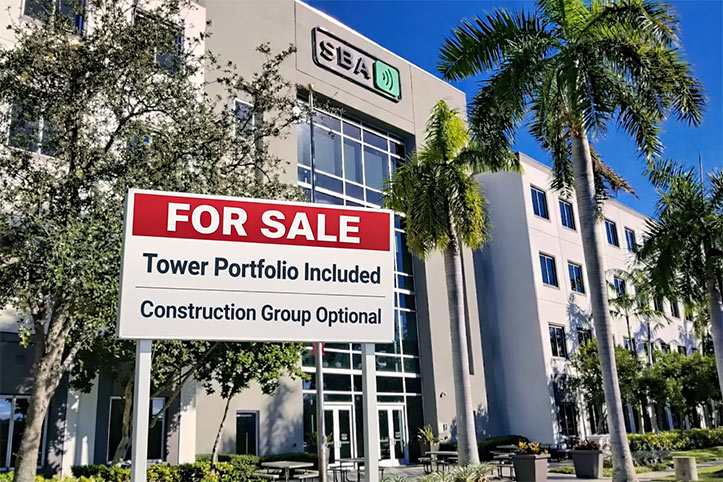
SBA Communications, the Boca Raton, FL-based tower owner that has long stood as one of the industry’s “Big Three” REIT landlords, is reportedly exploring strategic options, including a potential sale, after receiving preliminary takeover interest. Bloomberg News, reported Thursday that SBA is working with advisers as it evaluates that interest.
If the process advances beyond the “exploring options” stage, it would mark one of the most consequential developments in communications infrastructure in years. SBA finished 2025 owning or operating more than 46,000 communications sites across the U.S. and international markets, supported by billions in recurring leasing revenue and long-term carrier contracts.
Investors reacted quickly. SBA’s stock surged to roughly $205 intraday Thursday, closing at $204 after a nearly 14% jump on takeover interest. By midday Friday, shares were holding those gains and trading around $209, signaling continued investor confidence that a transaction—or at least strategic action—could materialize.
Why SBA is drawing interest now
The timing of the reported interest is telling, pointing to a deliberate move by investors who see value aligning at just the right moment. SBA has spent the past year reshaping its portfolio and balance sheet, expanding internationally while refining its domestic footprint. At the same time, it continues to generate strong, predictable cash flow from leasing—exactly the kind of revenue profile infrastructure investors pursue.
For potential buyers, SBA represents a rare opportunity:
- A scaled U.S. and international tower platform
- Long-term contracted revenue streams
- Built-in escalators tied to inflation
- And continued demand driven by 5G densification
In short, it’s a yield-generating asset with growth embedded in the network.
Who could buy SBA—and why it matters
While no buyers have been publicly identified, early reporting suggests interest from large infrastructure funds rather than a straightforward tower-to-tower merger. That distinction matters.
A transaction involving another major U.S. tower REIT would likely face immediate antitrust scrutiny, given the already concentrated nature of the domestic tower market. By contrast, private infrastructure capital—flush with dry powder and seeking stable, long-duration returns—faces fewer structural barriers.
For those investors, SBA isn’t about running a tower company—it’s about owning one.
That difference in mindset could have ripple effects beyond Wall Street.
What a potential sale could mean for contractors
Lost in the market speculation is a question that matters far more on the ground: what happens to SBA’s construction arm—and who picks up the work?
SBA has long maintained internal construction capabilities that support site development, modifications, and maintenance. But in most acquisition scenarios—particularly those involving private infrastructure capital—that model is unlikely to remain intact in its current form.
Infrastructure investors don’t buy tower companies to run construction crews. They buy predictable cash flow—long-term leases, escalators, and EBITDA stability. Construction, by contrast, is variable, labor-intensive, and margin-sensitive. It becomes a cost center to optimize, not a business to expand.
That creates a likely shift: less self-perform, more outsourcing. For contractors, that can cut both ways.
On one hand, a reduction in internal crews could open the door to increased third-party opportunities, particularly in markets where SBA has historically self-performed work. New ownership often looks to external vendors to scale activity without adding operational complexity.
On the other hand, those same ownership groups tend to bring tighter procurement discipline. That means, more centralized vendor selection; fewer approved contractors; higher financial thresholds, and continued pressure on pricing.
In other words, more work may become available—but not necessarily on better terms.
There’s also the issue of transition. SBA’s internal teams carry institutional knowledge—local permitting nuances, site history, and established workflows. If those resources are reduced or restructured, contractors could see short-term disruption as new processes and vendor relationships are put in place.
According to industry insiders, SBA’s construction group is currently understaffed, and it has been alleged that the company is using 1099 contractors to fulfill contractual obligations, which violates framework agreements with NATE and the FCC.
Is the whole worth less than the sum of its parts?
For an industry already grappling with extended payment cycles and margin compression, the bigger question may not be volume—it may be how that volume is contracted and paid.
If SBA ultimately changes hands, contractors won’t just be watching who buys the company. They’ll be watching how the new owner chooses to build—and who they expect to carry the financial weight of getting it done.
SBA’s construction arm, like any contractor operating in today’s environment, faces the same pressures—tight margins, rising labor costs, and the ongoing challenge of sustainable pricing. That reality raises a key question for any prospective buyer: whether the service side belongs inside a tower REIT at all. If it is producing limited or inconsistent returns, it may actually weigh on overall valuation.
In that case, an acquirer could determine that the whole is worth less than the sum of its parts, and move to separate the construction business from the core leasing platform. A divestiture to a scaled operator such as MasTec would be a logical outcome, allowing the tower assets to be optimized for predictable cash flow while placing the construction business in a structure better suited to manage operational risk and margin discipline.
What comes next
For now, SBA has not confirmed a formal sale process, and no transaction is assured. The company remains fundamentally strong, with a large, diversified portfolio and stable cash flow.
But the mere presence of takeover interest sends a signal: tower assets are still in demand, and strategic repositioning across the sector is far from over.
Whether this results in a sale, a recapitalization, or simply heightened investor attention, one thing is clear—any move involving SBA will have consequences well beyond the balance sheet.
And for those building and maintaining the networks that sit on those towers, those consequences could be felt quickly.
