














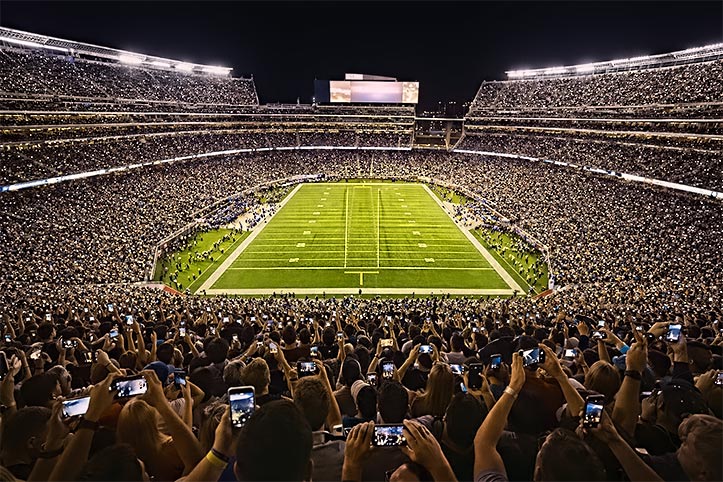
Beyond public-safety coordination, carriers and venue engineers are preparing for another massive surge in consumer data traffic surrounding Super Bowl LX this Sunday. With roughly 65,000 fans expected inside Levi’s Stadium, projections indicate spectators and nearby tailgaters could generate tens of terabytes of wireless and Wi-Fi traffic through social posting, livestreaming, and multi-device viewing.
Engineers supporting the event have planned for more than 35 terabytes of in-venue data, backed by nearly 1,500 Wi-Fi 7 access points, expanded fiber backhaul, and real-time cybersecurity monitoring, underscoring how the Super Bowl has evolved into one of the most demanding single-day network events in the United States.
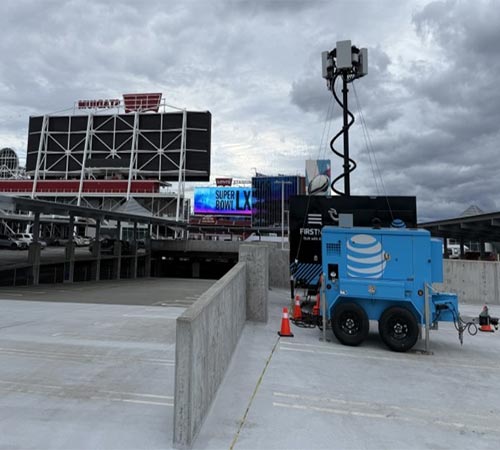
FirstNet, Built with AT&T, has outlined a connectivity plan to support first responders and public safety officials during the Super Bowl in the Bay Area. In a statement, Scott Agnew, President – FirstNet, AT&T, said the planning has involved more than a year of coordination with the City of San Jose, the San Jose Police Department, and the San Jose Fire Department, as well as other federal, state, and local agencies.
Historical carrier data shows that traffic does not decline during halftime. Instead, usage patterns typically shift. Previous Super Bowls have recorded peak or near-peak data loads at kickoff and during the halftime show, as fans transition from passive viewing to uploading video, sharing highlights, posting on social platforms, and streaming alternate camera angles.
In other words, halftime functions less as a network lull and more as a behavioral pivot from download-heavy viewing to upload-driven engagement, often sustaining or increasing total throughput.
To handle that demand, nationwide carriers are layering commercial capacity on top of public-safety readiness. Network upgrades across the Bay Area include expanded mid-band and millimeter-wave spectrum, additional small-cell density near transportation and rideshare zones, and hardened fiber connectivity feeding the stadium’s distributed antenna and Wi-Fi systems.
The result is a multi-carrier, multi-spectrum architecture designed to keep first responders prioritized on FirstNet while simultaneously supporting consumer traffic at Super Bowl scale.
Attendance for Super Bowl LX is expected to closely mirror last year’s championship crowd, mid-60,000s inside the stadium, but the true growth metric is no longer headcount.
Instead, the ongoing rise in per-fan bandwidth consumption, real-time video sharing, and always-connected devices now defines the wireless challenge of the Big Game, making each Super Bowl a real-world stress test for the nation’s most advanced communications infrastructure.
