








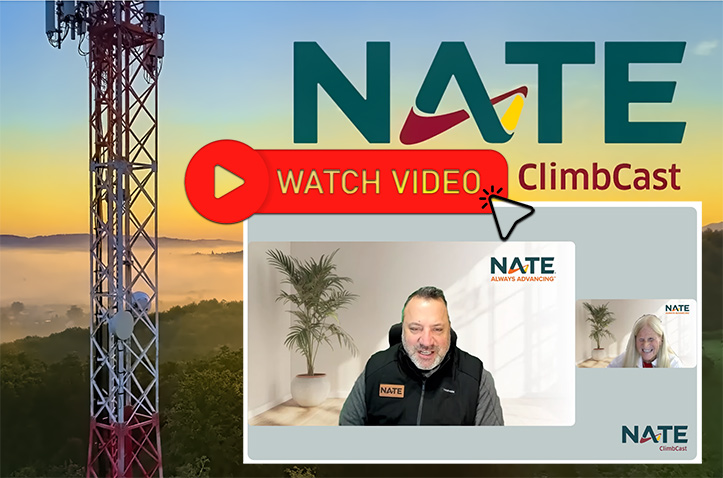
NATE: The Communications Infrastructure Contractors Association has debuted the first episode of its new podcast, ClimbCast, using the premiere installment to reinforce a message the association says has been embedded in its mission since day one: safety is not a program or a slogan—it is the organizing principle of the communications infrastructure industry.
Hosted by Brian Bicknese, NATE’s Director of Safety and Education, the episode features Kathy Stieler, NATE’s Director of Safety and Compliance, in a discussion that traces NATE’s contractor-founded roots and the group’s continuing push for uniform safety standards, practical field guidance, and stronger accountability across the ecosystem of carriers, tower owners, manufacturers, and service providers.
Stieler describes NATE as an “anomaly” within the broader construction industry, arguing that tower work—particularly rigging and hoisting—often involves dynamics that most construction sectors do not routinely face, including tower-specific lifts, angles, and operating conditions that demand highly specialized training and planning.
She points to the industry’s development of its own standards, including A10.48, as evidence that contractors and safety leaders have had to educate outside standards bodies on how tower operations differ from conventional crane-centric models.
Bicknese underscores the theme by emphasizing the role of education in converting what was historically lived as “tribal knowledge” into documented training standards—citing areas such as climbing rescue and rigging—so crews can execute complex work more consistently and safely.
Both emphasize that the work requires multi-disciplinary competence—rigging, rescue, test equipment, and applied math—and that misconceptions about the job being “easy” overlook the technical demands tower technicians manage daily.
The conversation also frames safety as inseparable from contractor advocacy. While NATE was founded to reduce risk to workers at height, Stieler argues the organization’s mission now extends to issues that affect whether safety can be sustained in practice, including regulatory engagement, workforce development, and fair contracting principles.
The episode closes with a preview of NATE UNITE 2026 in Las Vegas, promoted as both a training-heavy event and a venue for the industry’s “community” function—where field personnel, safety leaders, and vendors compare best practices, evaluate new equipment, and strengthen peer-to-peer learning that can translate into fewer incidents on the job.
The podcast audio is also available on iHeart and Spotify.

