













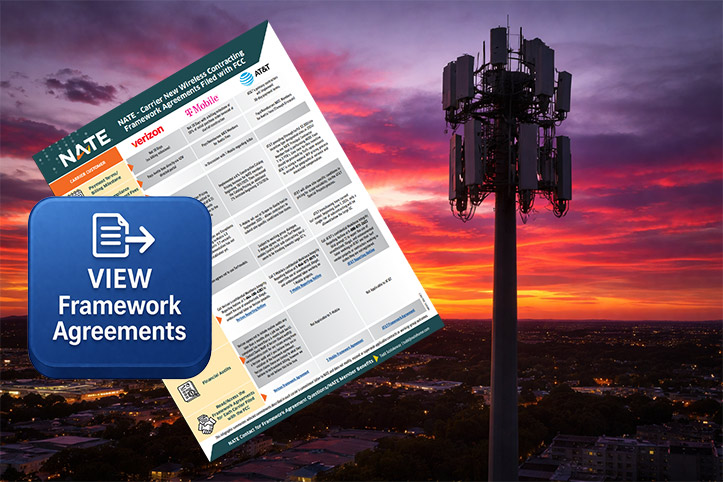
After more than a year of hard-fought negotiations, NATE: The Communications Infrastructure Contractors Association has secured landmark framework agreements with AT&T, Verizon, and T-Mobile — all three filed with the FCC. The association has released an updated infographic (March 21, 2026) summarizing the key commitments each carrier has made, and what NATE member contractors can expect as implementation continues to roll out.
Payment Terms — A Win Across the Board
All three carriers have committed to 30-day payment terms, a long-overdue reform for an industry that has historically struggled with slow-paying customers. Verizon’s terms carry no billing milestone requirement, while T-Mobile’s include a 50% billing milestone, invoiced at the start of construction. AT&T’s primary contractors are also implementing 30-day terms. For contractors who have been waiting months to get paid, this alone is a significant step forward.
Pricing Reform — Still a Work in Progress
This is arguably where contractors are watching most closely — and where patience is still required. Verizon is currently conducting new construction pricing RFPs across all 19 regions, with a commitment to complete the process by June 30, 2026 (end of Q2). However, the infographic notes a concern worth watching: Verizon appears to be trending toward large GCs or companies that agree to the current 2021 Pricing Matrix, which could leave smaller contractors behind.
T-Mobile has been the most aggressive on pricing relief, implementing a 6% construction catalog pricing increase for NATE members beginning October 1, 2025, followed by an additional 2% increase effective February 15, 2026. T-Mobile also rolled out its Scope-to-Quote tool in September 2025, allowing contractors to submit site-specific conditions and line items — a meaningful shift away from one-size-fits-all pricing.
AT&T is offering a $ 2,000-per-site incentive in 2026 to NATE Principal Contractor Members performing MODS with 1 to 3 PTNs on designated sites, with the line item available through Turfs upon request. AT&T is also using a regional RFP pricing process to account for geographic variance.
Turf Models — A Hard Deadline Coming
One of the most significant structural changes is the phaseout of the layered “turf vendor” model. Verizon has already agreed not to use turf models. T-Mobile has agreed — subject to working group dialogue — to eliminate turf vendor models and limit subcontracting tiers, though, like Verizon, it also appears to be trending toward large GCs. The biggest date on the calendar for AT&T contractors: beginning June 1, 2026, AT&T will allow only a single tier of subcontracting below the large GC, marking the formal end of its current turf model structure.
A Growing Concern: T-Mobile’s Shift Toward Large GCs
While T-Mobile has agreed — subject to working group dialogue — to eliminate the turf vendor model and limit subcontracting tiers, a troubling trend is emerging on the ground that the framework has not yet addressed. In the Dallas market, T-Mobile appears to be moving toward a large general contractor model, and many long-time, experienced contractors are finding themselves squeezed out of work they have performed for years.
It is not yet known whether this approach is being rolled out in other markets, but the Dallas situation is drawing attention. The larger GCs T-Mobile is channeling work through include major industry players such as Ericsson, MasTec, American Tower, SBA, and Smartlink. Although MasTec and SBA have many in-house crews, these large companies do not have the internal workforce to complete all the projects assigned to them, so they are turning to smaller contractors to subcontract the work, while negotiating rates that many in the industry say are simply not sustainable.
Smartlink’s T-Mobile Ties Run Deep — But Who’s Actually Doing the Work?
Smartlink Group, headquartered in Annapolis, Maryland, has a well-documented, longstanding relationship with T-Mobile that extends far beyond the Dallas market. Smartlink has openly represented T-Mobile in local markets, working on their behalf to secure cell tower leases and lease amendments.
That relationship appears to be reinforced at the executive level — Brendan Bellotte, a member of Smartlink’s leadership team, previously worked directly at T-Mobile as Senior Development Manager for Washington, DC, and later as General Manager for Virginia. However, a closer look raises a serious question: while Smartlink markets itself as a full-service infrastructure provider, its LinkedIn profile identifies it primarily as a “national talent solutions and telecom services company” with only 51 to 200 total employees.
More tellingly, Smartlink field technician job postings explicitly state “no cell tower climbing”—strongly suggesting the company has no meaningful self-performing tower-construction capability.
If T-Mobile is positioning Smartlink as a general contractor in markets like Dallas without the in-house crews to back it up, the work gets pushed down to subcontractors at whatever compressed margin Smartlink leaves on the table — exactly the cycle NATE’s framework agreements were designed to end.
The irony is hard to miss. One of the core promises of the framework agreements was to move away from the very kind of multi-layered subcontracting and unsustainable pricing that has pushed smaller contractors to the financial brink. If large GCs are backfilling their workforce through subcontractors at compressed margins, the industry may find itself back where it started — just with different names at the top of the chain.
NATE members experiencing this in their markets are encouraged to document these situations and bring them to NATE’s attention so the association can address them directly in its ongoing working group sessions with T-Mobile.
Third-Party Platform Fees
On compliance onboarding costs, all three carriers are making moves. Verizon pays Avetta fees directly through its VZW-directed portal. Both T-Mobile and AT&T (through Ericsson) are paying or reimbursing NATE members for Avetta fees. Discussions are still ongoing with T-Mobile regarding Ariba fees — an item contractors should keep an eye on.
Allowances, Exceptions & Site-Specific Conditions
Verizon has unveiled updated Allowances and Exceptions information in its new Matrix 4.0 (updated from Matrix 3.7). However, a timeline for full implementation has not yet been established — leaving contractors in a holding pattern on that front. T-Mobile’s Scope-to-Quote tool is already live. AT&T will accommodate site-specific conditions through its Special Projects process.
Workforce Integrity Hotlines
Each carrier now has a confidential reporting hotline for contractors to report the use of unauthorized, illegal, or undocumented labor on carrier projects — a direct result of NATE’s advocacy. These hotlines are active now, and NATE members are encouraged to use them:
Verizon: 1-844-588-6283
T-Mobile: 1-866-577-0575
AT&T: 1-888-871-2622 (dial prompt 2)
Financial Audits — Verizon’s Look-Back Window Capped, But Conflict Remains
Verizon has agreed not to initiate routine audits more than 6 months after job completion, capping the retroactive look-back window previously used to claw back payments for work that had already been approved and completed in good faith. This is a hard-won protection for contractors who had previously faced clawback demands reaching back years.
However, NATE has been transparent with its members about an ongoing point of contention: Verizon is claiming that audits conducted beyond the six-month window are limited strictly to what it believes is fraudulent billing — essentially carving out an exception that could allow it to reach back further under that justification. NATE does not agree with that interpretation. The association views this as a potential workaround that could undermine one of the key protections contractors were promised under the framework agreement, and they are continuing to push back on it in working group sessions.
NATE members who encounter issues arising from a Verizon audit — or who believe Verizon violates the framework agreement — are encouraged to contact David Wolff at Verizon directly at david.wolff@verizonwireless.com.
This protection does not apply to T-Mobile or AT&T, as financial audits are listed as not applicable for those carriers.
The Bottom Line
Meaningful progress has been made, but contractors still have items to watch closely in the months ahead — particularly Verizon’s regional RFPs, which must be completed by June 30; AT&T’s turf model transition on June 1; and the ongoing T-Mobile Ariba fee discussion. The emerging large GC trend in markets like Dallas is a red flag that warrants close monitoring and direct engagement with NATE’s working groups. NATE members with questions about the framework agreements or their specific member benefits are encouraged to contact NATE President & CEO Todd Schlekeway directly at todd@natehome.com.
