









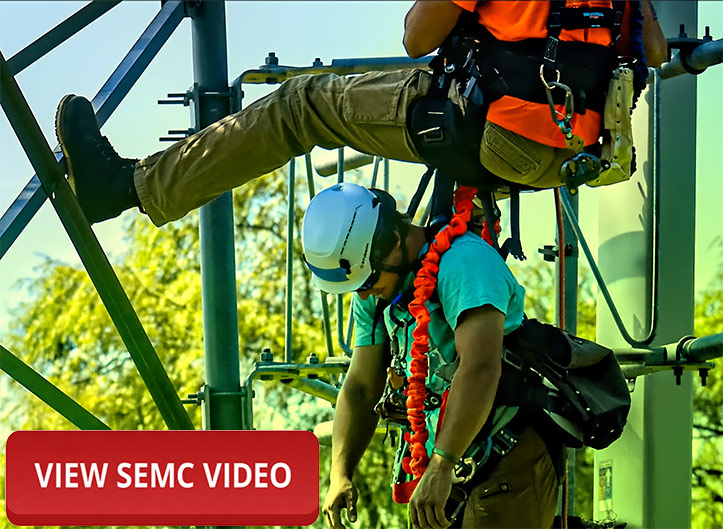
NATE: The Communications Infrastructure Contractors Association’s new video offers viewers an exclusive look at how NATE and SEMC are advancing safety standards through rigorous real-world testing.
Two-person pickoff rescues are a core part of tower-climber training. Yet, new testing conducted by the Safety Equipment Manufacturers Committee (SEMC) suggests that some commonly used backup fall-arrest systems may be relied upon beyond their tested design limits.
SEMC Testing Triggered by Concerns Over Trailing Rope Grab Misuse
The testing was documented in a recent NATE Climber Connection episode narrated by Brandon Foster, who guided viewers through the two-day testing effort conducted at the Smart Lab in Dayton, Ohio after concerns surfaced that automated trailing rope grabs could be misused during rescues involving both a rescuer and an incapacitated climber.
While trailing rope grabs are designed to slide along a vertical lifeline and lock when a sufficient applied force is present, SEMC members questioned how reliably they perform under the combined weight of two climbers in real-world conditions.
Standards Gap: Equipment Designed for One, Used by Two
SEMC Chairman Jeremy Buckles of SBA Communications, who provided extensive commentary throughout the video, said the industry faces a significant standards gap.
Many fall-arrest products are designed and tested for a single user, and current ANSI standards do not prescribe testing methods for two-person rescue loads. Although the NATE Climber Rescue Training Standard requires a backup fall-arrest system during a two-person pickoff, Buckles noted that the requirement does not ensure the system itself is rated or tested for the combined load.
Three Test Scenarios Reflect Real-World Rescue Conditions
To better understand the risk, SEMC developed three testing scenarios based on common field practices. The first established a single-user performance baseline. The second simulated a two-person pickoff rescue, where combined loads can reach approximately 620 pounds—double the 310-pound per-user allowance permitted under ANSI guidance. The third evaluated performance under wet conditions, reflecting the reality that rescues are often conducted in rain or other moisture.
More Than 40 Drop Tests Conducted in Two Days
Over two days, the team conducted more than 40 controlled drop tests, averaging one test every seven minutes. After each drop, all system components were inspected at a dedicated inspection table.
During post-drop evaluations, inspectors examined connectors, shock packs, lanyards, ropes, and rope grabs for deformation, damage, stitching failures, and whether shock packs were fully or partially deployed. The team also documented whether the system successfully arrested both the climber and the rescuer and measured the force imparted at the anchor point.
Data Collection Focused on Force Impact and System Integrity
That data was then transferred to a data-entry team led by the group, and they refined its data-collection process to ensure consistency and clarity. One of the most significant advancements was the system used to measure and record force impact in pounds during each drop, which is expected to yield valuable insights once fully analyzed.
“Chaos Central” Highlights the Complexity Behind Each Test
Behind the scenes, Sheri O’Dell-Deuer of Vertical ProsGear oversaw logistics and sample handling at what the team called “Chaos Central.” Sheri explained that each piece of equipment was pre-inspected, measured, tagged, logged, tested, re-inspected, documented, and then stored, underscoring the amount of preparation required before a single drop could take place.
Buckles also detailed the effort required to prepare the test structure itself. The tower used for the testing was donated by a New York company and transported to Ohio by SEMC members. Additional engineering was required to design a custom top fulcrum arm to achieve appropriate standoff distances for realistic drop testing, all while ensuring the safety of more than 30 onlookers during the event.
Key Takeaways: Moisture, Compatibility, and Following Instructions
As testing concluded, Buckles summarized several key takeaways. Moisture and weather conditions can affect rope and rope-grab performance; system compatibility plays a significant role in functionality; and manufacturer instructions must be followed precisely. He emphasized that ANSI requirements do not address two-person loads and cautioned that, even in emergency situations, equipment must be used within its rated limits.
The broader objective of the testing, Buckles said, is education. SEMC aims to help end users avoid inappropriate equipment selection, provide manufacturers with real-world data to support product development, inform standards committees about how rescues actually occur in the field, and assist training organizations in reassessing whether a traditional pickoff rescue is always the safest option.
In some circumstances, the committee suggested, alternative rescue methods may yield safer outcomes when equipment limitations are taken into account.
As Foster concluded in the video, the message to climbers was unambiguous: a backup lifeline is critical during a rescue, but it must be rated for both the rescuer and the person being rescued. The stakes are high, and proper equipment selection and use can be the difference between a successful rescue and a preventable tragedy.