








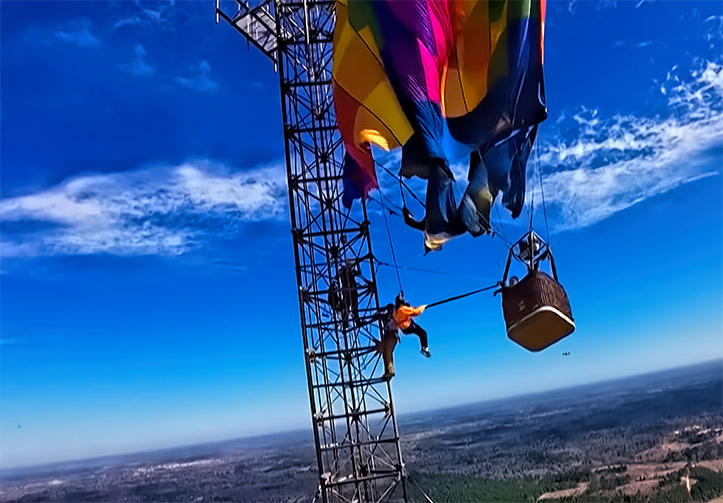
UPDATE (March 5, 2026) – The hot air balloon that became entangled on a broadcast tower north of Longview, TX, was safely removed by Tower King technicians Marshall Salsman and his nephew Adrian Salsman, who used specialized rigging and a cable-suspended work platform more than 900 feet in the air to lower the balloon’s gondola and retrieve the canopy. After climbing the tower to set up ropes, a winch, and a “pan” basket, the crew secured and cut the balloon free, carefully lowering the gondola before gathering the large envelope, a difficult task in the wind. Although both men are experienced tower workers, Marshall—who has 30 years in the industry—said the unusual balloon entanglement required adapting to a situation unlike typical tower work. A video and additional information from KLTV are available here.
________________
A routine Saturday morning balloon flight in East Texas turned into a high-risk technical rescue after a hot-air balloon collided with a communications tower, leaving two occupants dangling 900 feet above the ground. The incident has drawn sharp attention across wireless-infrastructure circles. Although nearly every news outlet labeled the structure a “cell tower” in their headlines, its roughly 1,100-foot height clearly identifies it as a broadcast-class structure.
What happened
On the morning of February 28, 2026, a hot-air balloon carrying two people struck Vertical Bridge’s 1,092-foot communications tower, constructed in 1996, in north Gregg County near Longview, Texas, close to the intersection of State Highway 300 and FM 1844.
Authorities reported that the balloon made contact with the structure at roughly 920 feet above ground, tearing portions of the envelope and leaving the basket suspended and swaying in the wind. Emergency calls began shortly after 8:15 a.m., triggering a multi-agency response and what responders later described as one of the most complex rope rescues they train for.
A dangerous entanglement
Fire officials said the balloon fabric became wrapped around the tower legs, bracing, and guy wires, leaving the basket hanging hundreds of feet in the air precariously. The two occupants—a man and a woman—remained conscious but were unable to descend on their own. When firefighters arrived, they found the balloon more than 900 feet above ground. The extreme elevation immediately ruled out conventional rescue methods and required a technical climbing response.
The rescue operation
The Longview Fire Department initiated a high-angle technical rescue involving approximately 14 specialized responders, including off-duty personnel called in to assist. Crews began climbing operations and worked methodically to secure the occupants of the balloon. By late morning, rescuers had transferred both individuals from the basket to the tower structure using harnesses and rope systems. The victims were then lowered in stages during a careful, hours-long descent. One rescue official later characterized the incident as the “Super Bowl of rope rescues,” underscoring the difficulty and risk involved.
Condition of the occupants
Despite the dramatic circumstances, both individuals escaped serious injury. They were evaluated by emergency medical personnel and transported to a hospital as a precaution. Officials credited the occupants’ calm demeanor during the prolonged rescue with helping crews complete the operation safely.
Factors and investigation
The precise cause of the collision remains under investigation. Early indications suggest the balloon may have been pushed off course by winds at altitude. The Federal Aviation Administration has opened a review, and the aircraft involved was identified as a Cameron Z-77 balloon. Investigators are expected to examine weather conditions, pilot decision-making, airspace awareness, and whether tower marking and lighting met all federal requirements.
Tower and cleanup
Images from the scene showed the balloon envelope twisted through the tower steel, requiring careful removal after the rescue was completed. Crews planned to dismantle the remaining material piece by piece. There were no immediate reports of structural damage to the tower or service outages, but incidents of this nature typically prompt an engineering inspection to verify structural integrity, antenna and feedline condition, lighting system status, and—if applicable—guy tension.
It’s not as rare as reported
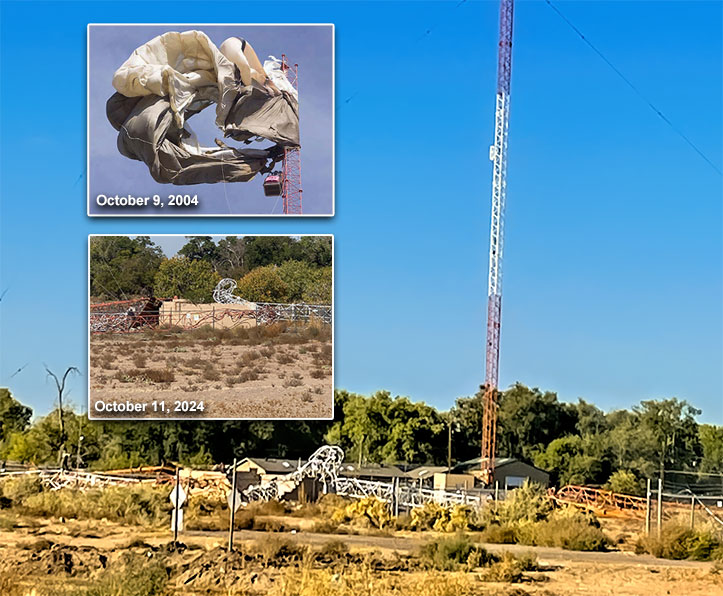
Although many media reports have characterized the Texas incident as a rare occurrence, recent history suggests balloon-to-tower interactions may be less uncommon than portrayed. As previously reported by Wireless Estimator on October 11, 2024, in its coverage of a hot air balloon collision during the Albuquerque International Balloon Fiesta, similar events have occurred within a relatively short timeframe. Coincidentally, the last two known balloon impacts have both involved towers owned by Vertical Bridge
The incident also underscores the specialized expertise required for extreme-height rescues. High-angle tower recoveries demand advanced rope systems, experienced climbers, and coordinated incident command capabilities that not every jurisdiction can rapidly deploy.


