















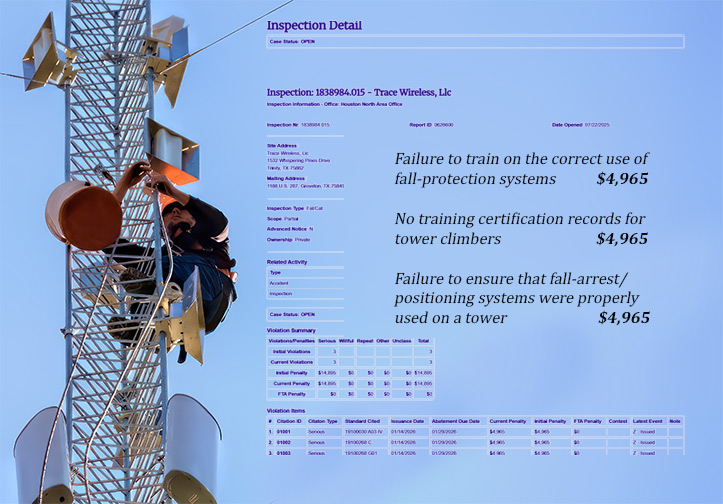
Federal Occupational Safety and Health Administration enforcement records recently published show the agency cited internet service provider Trace Wireless, LLC, with three “Serious” safety violations connected to the July 14, 2025, tower fatality that killed 46‑year‑old Calvin Wayne Sellars in Trinity County, Texas.
The citations were issued January 14, 2026, and carried a total proposed penalty of $14,895 ($4,965 each).
What OSHA cited, and what each violation means
Wireless Estimator previously reported that Sellars died after falling from roughly the 50‑foot level of an “internet tower” at the Whispering Pines golf course near Sebastopol, Texas, citing a statement from the Trinity County Sheriff’s Office.
Together, the three Serious violations center on fall protection: (1) training, (2) documentation that training occurred, and (3) ensuring fall‑arrest/positioning gear is actually used correctly while climbing and working on towers.
Failure to train on the correct use of fall‑protection systems:
Citation 01001 cites 29 CFR 1910.30(a)(3)(iv), OSHA’s general‑industry fall‑protection training requirement addressing instruction in the correct use of personal fall protection systems (including hook‑up, anchoring, tie‑off techniques, and equipment inspection/storage).
The citation indicates that on or about July 14, 2025, at the worksite’s internet tower, an employee used fall‑protection equipment but was not provided training on correctly using the equipment required to climb and perform tower maintenance. OSHA listed one instance and seven employees exposed, with a gravity score of 10 and a $4,965 penalty.
This standard applies before employees are exposed to fall hazards and requires employers to ensure training covers the core competencies OSHA lists for fall‑protection users.
No training certification records for tower climbers:
Citation 01002 cites 29 CFR 1910.268(c) under OSHA’s telecommunications standards. OSHA alleged Trace Wireless did not prepare the required training certification records (including the identity of the person trained, the signature of the employer or trainer, and the training completion date).
OSHA said that the deceased employee was using a fall‑protection system to climb the tower, and no training certification record was provided documenting that employees climbing towers had been trained on the required subjects. OSHA again listed one instance, seven employees exposed, and a $4,965 penalty.

In other words, this item is not simply a “paperwork” violation in isolation—OSHA positioned it as the absence of proof that climbers received the telecom‑specific training the standard requires.
Failure to ensure that fall‑arrest/positioning systems were properly used on a tower
Citation 01003 cites 29 CFR 1910.268(g)(1), the telecom rule requiring employers to provide and ensure the use of safety belts/straps or equivalent fall protection when work is performed more than four feet above ground on poles and towers (subject to limited exceptions). OSHA said an employee was utilizing a fall‑arrest system that was not adequately used while climbing and performing maintenance. OSHA listed one instance, seven employees exposed, and a $4,965 penalty.
This item goes directly to the hazard that kills in tower work—an elevated worker being exposed to a fall because a fall‑arrest or positioning system is not being used correctly at the time of climbing/working. OSHA did not determine whether a fall arrest system was present on the structure.
Why the timing matters: OSHA’s six‑month citation window
OSHA’s citation issuance date—January 14, 2026—is notable because it is exactly six months to the day after the fatal incident date of July 14, 2025.
That alignment matters because the Occupational Safety and Health Act contains a hard limitation on enforcement timing: “No citation may be issued… after the expiration of six months following the occurrence of any violation.”
OSHA’s own enforcement guidance similarly describes this six‑month statute of limitations framework (with limited tolling exceptions, such as concealment).
What Wireless Estimator documented when the investigation began
When Wireless Estimator first reported the fatality, the website said the death was not immediately reflected in OSHA’s public establishment search platform, despite fatalities often appearing within days.
Wireless Estimator further reported that OSHA’s Houston North Area Office indicated it was not aware of the fatality until contacted, after which an OSHA inspector confirmed an investigation had been opened and Trace Wireless contacted.
The report also highlighted the federal rule requiring employers to report a workplace fatality to OSHA within 8 hours, under OSHA’s severe‑injury/fatality reporting requirements.
Wireless Estimator also pointed to the company’s social media content at the time—images and videos it characterized as depicting unsafe climbing and inadequate PPE—contrasting that with the industry’s well‑known “100% tie‑off” expectation for elevated climbing work.
OSHA ignores willful violations that could have cost Trace Wireless $500,000 in fines.
By classifying the violations as serious rather than willful, OSHA did not allege intentional or egregious disregard of safety standards. This distinction kept the penalties and legal stakes relatively modest.
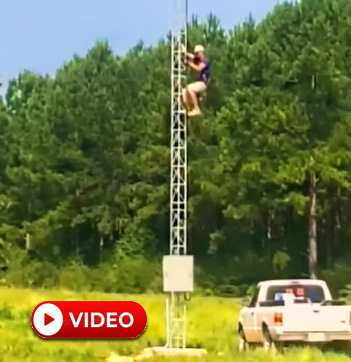
Trace Wireless previously shared social media posts showing a technician free-climbing a tower without proper fall protection. In another photo, ground crew members stand below without helmets. Such images of apparent safety violations have fueled debate over whether the company’s actions constituted a willful disregard for OSHA rules.

The decision not to pursue a willful violation – which OSHA defines as a violation “committed with intentional, knowing or voluntary disregard for the law’s requirements, or with plain indifference to worker safety” – likely reflects both evidentiary and historical factors.
Proving a willful violation carries a high burden of proof that the employer knowingly ignored its legal obligations, and OSHA may have determined that while Trace Wireless’s safety culture was deeply flawed, it lacked clear prior violations or warnings on record that would bolster a willful case.
The company’s post-incident cooperation and any corrective actions taken may have further influenced OSHA’s more measured response. Notably, a willful citation could have triggered far steeper penalties – up to about $165,000 per violation under federal guidelines – and potentially landed the firm in OSHA’s Severe Violator Enforcement Program.
By issuing serious citations instead, regulators avoided a protracted legal battle but also forewent the harsher punishment that a willful classification entails. The outcome underscores OSHA’s cautious approach in an industry with persistent safety challenges, and it raises broader questions about whether the penalties levied are sufficient to deter companies from dangerous practices in the wireless infrastructure sector.
Case status and enforcement posture
OSHA required Trace Wireless, LLC to abate the violations by January 29, 2026, meaning the company had to correct the hazards cited in its inspection. OSHA’s abatement verification regulation states, in black-and-white: “Abatement means action by an employer to comply with a cited standard or regulation or to eliminate a recognized hazard identified by OSHA during an inspection.”
If those hazards were not corrected and certified to OSHA by the deadline, the agency could issue a failure-to-abate penalty of up to about $16,550 per day until the violations were corrected.
