














A Florida sewage spill tied to an AT&T fiber project is now at the center of two lawsuits—one seeking damages, the other seeking to avoid paying them—highlighting how a single underground strike can trigger a chain reaction of liability, insurance disputes, and contractor failure.
In a complaint filed April 24, 2026, the City of Lake Worth Beach is seeking more than $7.5 million in damages stemming from an April 9, 2024 rupture of a critical 36-inch sewer force main during a directional drilling operation.
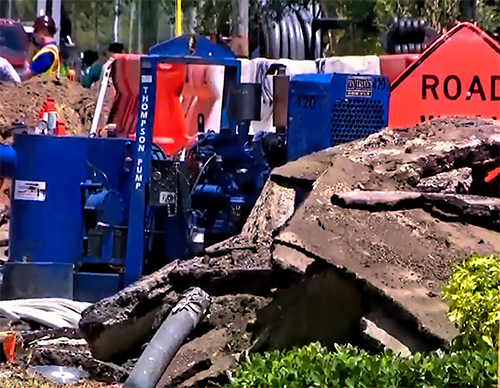
The lawsuit names AT&T Florida, Blue Streak, LLC, HAOB Horizontal Drilling, LLC, and USIC Locating Services, LLC, alleging a series of failures that led to the release of more than 6 million gallons of raw sewage into surrounding canals and waterways.
A second lawsuit: insurer moves to deny coverage
Running parallel to the city’s case is a separate federal action—Kinsale Insurance Co. v. Haob Horizontal Drilling Inc.—filed by Kinsale Insurance seeking a declaration that it owes no duty to defend or indemnify HAOB or related parties in connection with the same incident.
That case was filed after the spill and before the city’s 2026 lawsuit, as insurers often move early to define coverage obligations before liability is fully adjudicated.
Kinsale’s position is straightforward: the damages arise from the release of raw sewage, which it classifies as a pollutant, triggering the policy’s absolute pollution exclusion.
If the court agrees, it could mean that the contractor has no insurance coverage for the loss; defense costs and damages fall directly on the insured parties; and other defendants may be forced to absorb a greater share of liability.
In practical terms, the Kinsale case may determine who actually pays for whatever judgment or settlement emerges from the Lake Worth lawsuit.
A strike on critical infrastructure
According to the city’s complaint, the damaged line was not just another buried utility—it was the backbone of the region’s wastewater system, carrying sewage from multiple municipalities to a central treatment facility.
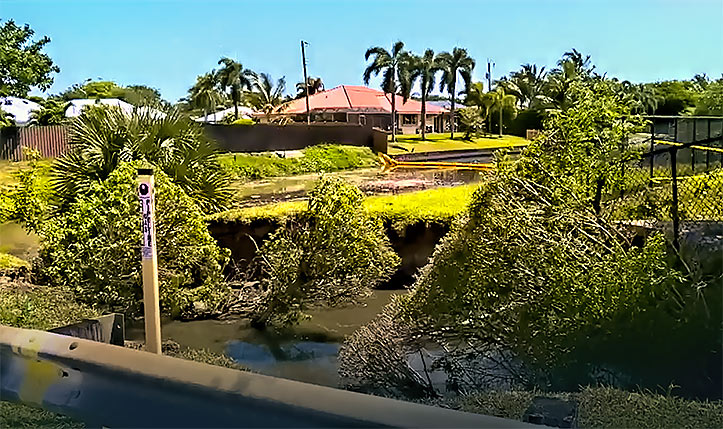
The rupture occurred along Florida Mango Road near the L-10 Canal when a directional drilling operation struck the force main at approximately 16 feet below ground—exactly where the city’s as-built drawings placed it.
The result was immediate. A sinkhole formed, surrounding land washed out, and approximately 6,050,000 gallons of raw sewage were discharged into the environment, most of it flowing into the canal system.
Plans, depth errors, and a critical miss
At the center of the dispute is a claim that AT&T’s project drawings were wrong.
The city alleges it provided accurate as-built drawings showing the force main between 13 and 16 feet deep. AT&T’s plans, however, depicted the line roughly 2.5 feet higher—effectively showing clear soil where the pipe actually existed.
The drilling intersected the line at the true depth, not the depicted one.
The complaint further alleges that separate plan submissions failed to show the force main entirely and miscalculated bore elevations, compounding risk in an already congested corridor.
The contractor chain—and where it broke down
The project followed a familiar structure: AT&T retained Blue Streak as its contractor, which subcontracted the drilling to HAOB, while USIC handled utility locating.
Each party now faces allegations.
HAOB is accused of deviating from the planned bore path and drilling deeper than specified, ultimately striking the pipe while pulling conduit through the bore.
Miami-based Blue Streak is alleged to have retained control over the work and to have carried a nondelegable duty to ensure its safe execution, including supervising subcontractors.
USIC is accused of failing to properly locate the sewer line and failing to provide a required post-incident report.
AT&T, meanwhile, is accused of providing inaccurate plans while retaining control over the project’s design and execution.
Warning signs were already there
The corridor itself was densely packed with underground utilities, with markings for gas, fiber, sewer, water, and electric infrastructure visible along the route.
Despite that, the locate ticket identified an excavation depth of just three feet, far shallower than the actual drilling depth of 16 feet.
From field failure to environmental crisis
The rupture triggered a weeks-long environmental response. Crews deployed containment booms, aeration systems, and vacuum equipment while conducting daily water quality testing.
Health alerts remained in place until early May, and the city says it was forced to take out a loan to fund cleanup and repairs—costs that continue to accrue interest.
Three months later: one contractor gone
The financial consequences extended beyond the job site.
Founded in 2015, Doral-based HAOB Horizontal Drilling filed for Chapter 11 bankruptcy on July 19, 2024—just over three months after the incident—and is now out of business.
If Kinsale prevails in its coverage lawsuit, the absence of insurance could help explain how quickly a contractor can be overwhelmed by a single catastrophic event.
A shifting contractor landscape
Blue Streak, the contractor hired by AT&T and named in the lawsuit, has since been acquired by Circet USA in September 2025, part of a broader consolidation of fiber construction firms into national platforms.
That evolution is reshaping risk. What once might have been a localized contractor issue now involves layered corporate structures, complex liability chains, and higher financial stakes.
A preview of BEAD-era exposure
The case arrives as the industry prepares for an unprecedented wave of fiber deployment funded through the Broadband Equity, Access, and Deployment Program. Much of that work will rely on horizontal directional drilling in the same type of congested corridors seen in Lake Worth Beach, where aging infrastructure, imperfect records, and tight clearances increase the likelihood of failure.
