












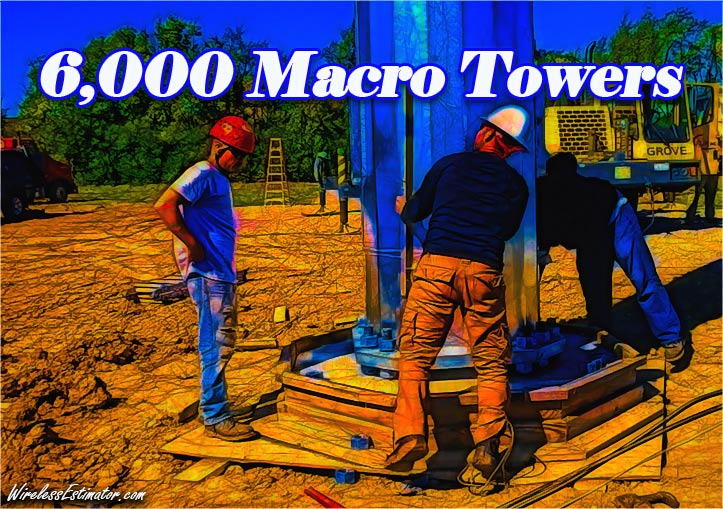
Building roughly 6,000 new macro towers—about 1,200 per year—would equal five to six years of typical U.S. tower construction and could extend 5G coverage to roughly 99% of Americans, according to T-Mobile CTO John Saw. The buildout would close most remaining rural coverage gaps but would not end macro tower construction, which would likely continue at a slower pace as carriers add sites to increase capacity, address terrain-related gaps and support future network upgrades.
The U.S. wireless industry built roughly 900 to 1,200 new macro towers in 2025, based on reporting and earnings disclosures from major tower operators including American Tower, Crown Castle, and SBA Communications.
Against that backdrop, a proposal from T-Mobile President and CTO John Saw could dramatically reshape the pace of tower construction. In a blog post last week, Saw suggested that about 6,000 new macro sites could extend 5G coverage to roughly 99% of Americans.
If built, that would equal five to six years of typical U.S. tower construction, potentially triggering a new rural infrastructure cycle.
BEAD Savings Could Fund the Build
Saw’s proposal centers on the federal $42.5 billion Broadband Equity, Access and Deployment (BEAD) program, which is primarily focused on expanding high-speed internet access to unserved and underserved communities.
The National Telecommunications and Information Administration (NTIA) reported late last year that its “Benefit of the Bargain” state application review process generated roughly $21 billion in savings from the program’s original allocation.
Those savings have sparked debate across the telecom industry about how the remaining funds should be used. As Fierce Network and Light Reading have reported, policymakers are weighing whether BEAD should remain focused strictly on fixed broadband deployment or address other connectivity gaps.
Saw argues that rural mobile coverage gaps should be the next priority.
Closing Rural Mobile Dead Zones
According to T-Mobile, more than 3 million Americans still lack access to basic 4G connectivity, leaving large stretches of rural communities and highways without reliable mobile service.
While BEAD has focused on bringing broadband into homes, Saw said the next step is ensuring connectivity continues once people leave their property.
“About 6,000 more mobile macro sites could extend 5G coverage to roughly 99% of Americans,” he wrote.
T-Mobile estimates the effort would require about $8 billion, while still leaving more than $13 billion in BEAD funding unspent.
A Multi-Year Buildout
Based on typical U.S. tower development timelines—including site acquisition, zoning, permitting, and construction—the proposed build would likely take three to five years to complete.
That would represent a significant acceleration compared to the current pace of tower construction, which slowed after the initial surge of 5G midband deployments, when carriers focused more on upgrading existing sites than building new ones.
Louisiana as an Early Model
Saw pointed to Louisiana’s ConnectLA broadband initiative as an example of how states could combine fixed broadband expansion with improved mobile coverage.
Through the Louisiana Local Fiber Consortium, T-Mobile is participating in projects expected to expand connectivity to more than 66,000 locations, while cutting the state’s mobile coverage gaps roughly in half.
The Next Phase of U.S. Connectivity
With BEAD deployments now underway nationwide, the next policy question may be whether the program should also address the country’s remaining mobile infrastructure gaps.
If policymakers embrace the idea, Saw’s proposal could transform what has recently been a slow tower construction market into the next major rural build cycle, potentially adding thousands of macro sites nationwide.
