
















Commentary — Verizon made a promise. It made that promise not in a private email or an offhand remark at a trade show, but in a formal framework agreement — one that its own representatives negotiated with NATE: The Communications Infrastructure Contractors Association and, by extension, with the Federal Communications Commission. The promise was straightforward: fair pricing reviews, regional flexibility, transparency, and a commitment to treating the contractors who build and maintain its network as genuine partners in commerce.
That promise has been broken. Comprehensively, deliberately, and at a scale that now threatens the financial survival of the very workforce upon which Verizon depends.
This is not hyperbole. This is a documented pattern of behavior that the FCC has both the authority and, we would argue, the obligation to examine.
What Verizon Actually Agreed To
The language in the framework agreement is worth quoting in full because it is precise, and Verizon’s subsequent conduct represents a near-total repudiation of every meaningful commitment it contains.
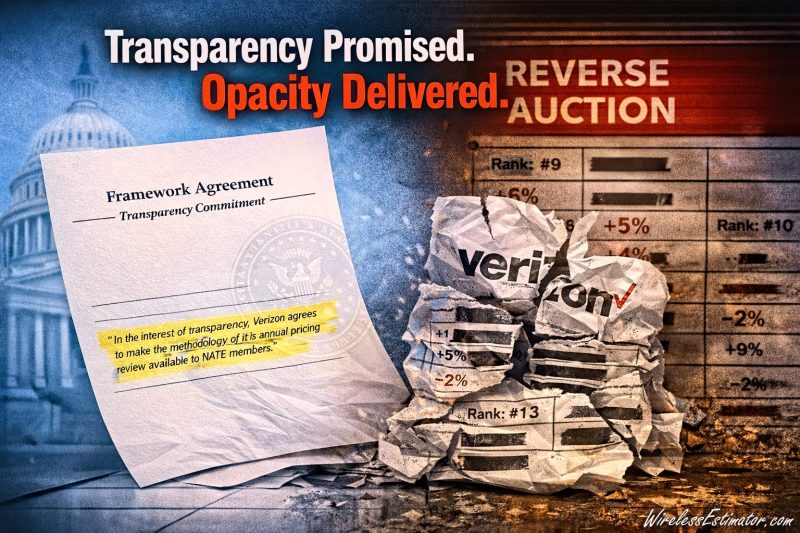
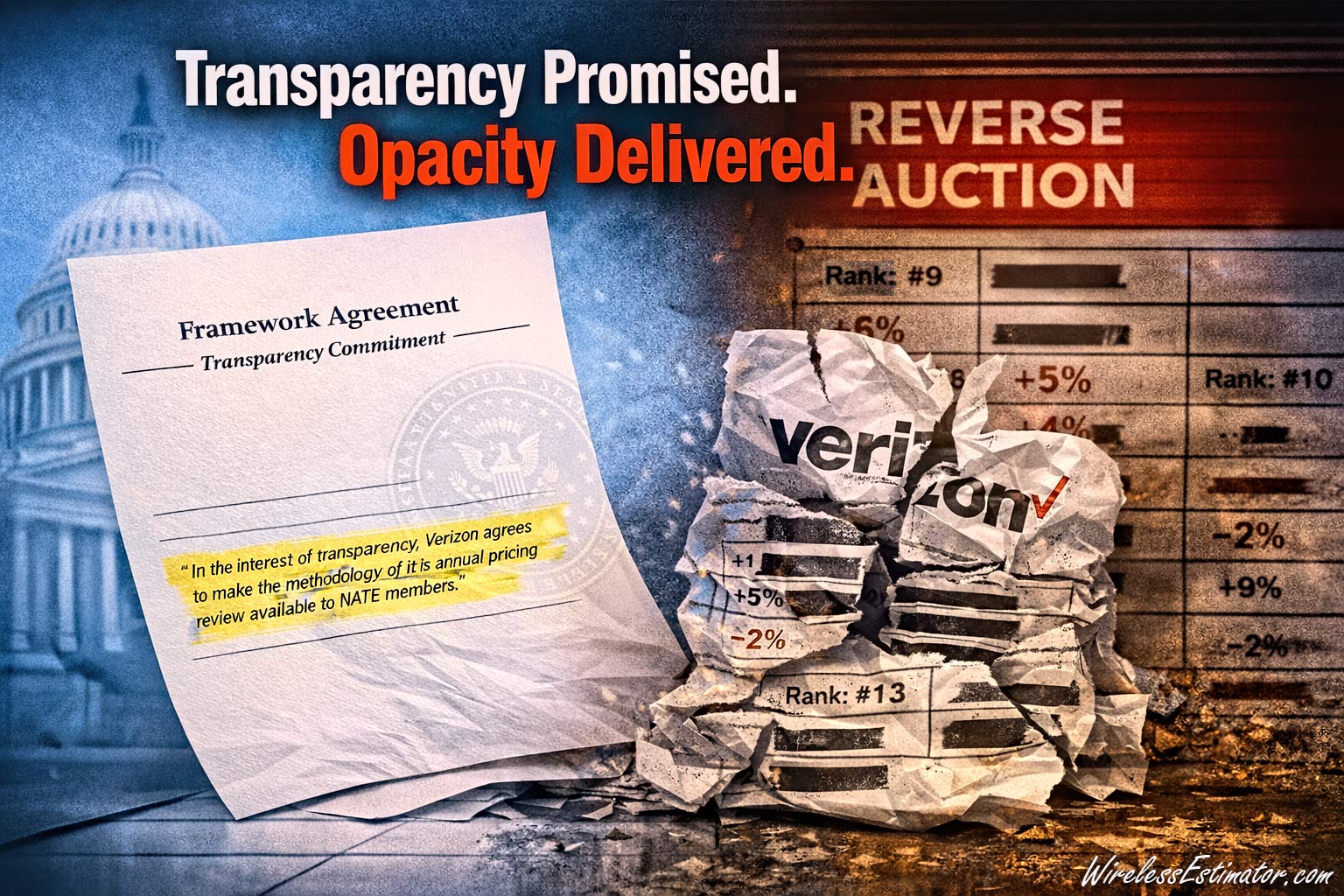
Verizon agreed to institute a regional-based RFP process built on its matrix pricing structure “to allow for vendors to account for inflation.” It agreed to conduct “an annual review of the pricing matrix to evaluate whether macro-economic adjustments are warranted.” Most strikingly, it agreed to the following: “In the interest of transparency, Verizon agrees to make the methodology of its annual pricing review available to NATE members, and to consider adding factors to that review based on input from NATE members.”
Transparency. That is the word Verizon used. Transparency.
What has followed bears no relationship to that word.
The Reality on the Ground
The pricing matrix that contractors are being asked to accept today is the same one that was in place in 2021. Five years of inflation in labor costs, materials, fuel, insurance, compliance, and virtually every other input a contractor carries have produced no upward adjustment.
In fact, even though Verizon asked contractors to provide that inflation modifier increase, the trajectory has moved in the opposite direction: contractors in multiple markets are being pushed to accept negative adjustments, meaning they are being asked to perform the same work for less than they were paid five years ago.
In one recently completed regional Request for Proposal (RFP), the matrix change for the next 3 years was set to 0. For at least one contractor in that process, the offer was a negative percentage. Word from subsequent markets suggests the downward pressure is intensifying further, with offers reportedly as low as negative 12% in some cases.
This is not what a good-faith “annual review to evaluate whether macro-economic adjustments are warranted” looks like. This is a freeze, followed by a rollback, dressed in the language of process and partnership.
The Reverse Auction Problem
What Verizon has put in place is not a competitive procurement process. It is a reverse auction designed to extract maximum price concessions, and it achieves that goal through deliberate opacity.
Contractors who have participated in the regional RFPs report that they are assigned numerical rankings — told, for instance, that they rank 15th or 20th out of a field of bidders — with the clear implication that improving their ranking requires lowering their price. But the rankings themselves appear to be internally inconsistent in ways that make no logical sense.
Consider the following data points that have emerged from one market’s bidding rounds:
A contractor requesting a 5% increase on modifications and a 2% increase on macro work was told they ranked 15th and 12th. A different contractor requesting 10% increases across the board was also told they ranked 15th. and 14th. Another contractor requesting 10% for modifications was told they ranked 19th. How can three contractors with materially different pricing submissions occupy the same or adjacent positions in a supposedly objective ranking? They cannot — not in any honest system.
The answer that contractor participants are beginning to accept is that the rankings may not reflect any genuine comparative analysis. They may simply be a pressure tool, calibrated to drive each bidder toward zero or below in their second round.
And here is the most troubling dimension of this problem: nobody is auditing Verizon’s process. There is no independent verification that rankings are calculated honestly. There is no mechanism for a contractor to challenge a ranking using actual data. The FCC established the framework agreement in part to prevent exactly this kind of information asymmetry from being weaponized against contractors. Yet here we are.
A Monopsony in Practice
NATE has used the word monopsony in its discussions with the FCC, and events in the field are validating that characterization with every passing RFP cycle.
A monopsony exists when a single buyer — or a small number of buyers — has such dominant purchasing power in a market that sellers have no meaningful ability to negotiate. They must accept the buyer’s terms or exit the market entirely.
That is precisely the situation contractors describe. In at least one regional market, a group of contractors agreed in principle that they would not accept zero or negative matrix pricing. They recognized collectively that accepting such terms would be economically ruinous. Yet when the RFPs closed, the agreements were held only in principle. In practice, contractors accepted the terms they had pledged to reject — because the alternative was closing their businesses entirely.
This is not a failure of a contractor’s resolve. It is a demonstration of monopsonistic market power. When walking away from a contract means closing your company, you do not have a genuine choice. You have the illusion of a choice.
Verizon has further amplified this dynamic by expanding the bidder pool in ways that appear specifically designed to depress pricing. In markets where a handful of experienced regional contractors have historically performed the work, Verizon has introduced large national contractors and entities with little or no prior presence in those markets.
The effect is predictable: the presence of large firms with economies of scale, or of smaller firms desperate enough to bid below cost, establishes a price floor that incumbent regional contractors cannot match without bleeding.
The expansion of the bidder pool is not being done to improve quality or expand coverage. It is being done to drive prices down. That is a legitimate observation about market strategy — and it is one the FCC should examine in the context of the framework agreement’s stated intent.
There is one more dimension of the monopsony problem that deserves specific attention: Verizon’s financial qualification requirements are structured in a way that may be designed to fail.
The RFPs require contractors to maintain annual revenue at least three times the projected Verizon revenue they would receive under the contract. In practice, contractors say that threshold disqualifies most of the firms bidding — including large, established regional players — precisely because those firms are Verizon-dependent.
They do not have three times the projected Verizon revenue sitting elsewhere because Verizon has historically been their primary customer. Verizon already has their financials. It knows this. And yet the requirement stands. One executive familiar with the bidding process put it plainly: the way the contract is written financially, none of them would qualify even if they won.
The total of what Verizon actually delivered on its framework commitments was captured bluntly by one NATE member who reviewed the new RFP: “They never really made any changes; we can now charge for lugs, but that’s all they did, along with a lot of lip service.”
Ireland Is Calling the Shots — and Doesn’t Know the Market
Making matters worse, the procurement decisions driving this process are being directed out of Verizon’s Ireland sourcing operation — thousands of miles removed from the American markets, contractors, and communities that will bear the consequences — creating a fundamental disconnect between the people setting the terms and any meaningful understanding of local market realities, long-standing contractor relationships, or the ground-level economics that determine whether this network gets built at all.
As we reported in our earlier coverage of this issue, the working group charged with overseeing the RFP process is led by Ireland Sourcing in conjunction with Basking Ridge, NJ procurement and D.C. regulatory executives — a structure that has effectively insulated the decision-makers from the field-level consequences of their own pricing mandates. For more on that dynamic, see our report: Verizon’s New Sourcing Model Promises Scale — But No Guarantees; Contractors Call It a Financial Trap.
The AI Distraction and the Silence of Internal Advocates
There is a deeper structural problem at work within Verizon that compounds all of the above. The company’s new leadership has made clear that cost reduction through automation and artificial intelligence is the paramount strategic priority.
Employees across the organization have been put on notice that their roles may be evaluated for AI replacement — and some have reportedly spent their lunch time writing their own job descriptions for that purpose.
The effect on contractor relations has been predictable and corrosive. Verizon personnel who might otherwise serve as internal advocates — who understand the local market, who have working relationships with contractors, who know that the numbers being offered are unsustainable — have gone quiet. They are not going to push back against a procurement process that has the visible backing of corporate leadership when doing so might cost them their own positions.
This leaves contractors with no meaningful point of contact inside Verizon. The framework agreement’s working group process was supposed to provide a channel for contractors to raise concerns and for Verizon to respond. That channel has effectively closed.
What the FCC Should Do
We recognize that regulatory intervention is rarely fast and that the regional RFP process may be substantially complete before any formal review could be initiated. We are under no illusions about that timeline.
But documentation matters. Patterns matter. And the FCC’s framework agreement with Verizon was not a suggestion — it was a negotiated commitment, made with the explicit purpose of ensuring that contractors who build and maintain the nation’s wireless infrastructure are treated fairly.
Here is what the evidence suggests the FCC should examine:
The transparency commitment is not being honored. Verizon agreed to make the methodology of its annual pricing review available to NATE members. There is no indication that any such methodology has been shared. There is no indication that any review has taken place in any form that would produce upward pricing adjustments commensurate with documented inflation.
And the framework agreement’s 30-day payment commitment appears to be undermined by an internal practice of delaying the formal “receipt” of completed work — contractors report that work completed in November 2025 was not formally received until January 1, 2026, and that March 2026 work may not be received until early April, effectively pushing the payment clock out by weeks or months beyond the agreement’s terms. Contractors are also being asked to push April billing to May 1.
The RFP process is structurally opaque. Contractors are being given rankings they cannot verify, by a process whose criteria have not been disclosed, in a system that appears designed to produce a predetermined price outcome. This is incompatible with the transparency commitment Verizon made.
The “market has spoken” defense does not hold. Verizon has reportedly argued that the zero and negative pricing outcomes simply reflect market competition. But a market in which contractors accept prices below sustainable costs because the alternative is closure is not a well-functioning competitive market. It is a market in distress, and the distress is a direct consequence of monopsonistic pricing power.
The contractor base is approaching a breaking point. The contractors who build and maintain Verizon’s network are not optional infrastructure. They represent decades of accumulated expertise, established safety cultures, local relationships, and technical capacity that cannot be replaced overnight.
When they close — and some will close if current pricing trajectories continue — Verizon will discover that the cheapest vendor is not always the most expensive problem to fix. In fact, the consolidation strategy may produce the exact opposite of its stated intent: if the financial qualification screen is too tight and the pricing too punishing, the result will be fewer qualified bidders, greater reliance on large national primes, and a deeper subcontracting stack for the same work — precisely the dynamic that has been compressing margins and destabilizing the labor pool for years.
The FCC Has the Authority. The Question Is Whether It Has the Will.
There is, in fact, a specific and available regulatory remedy that the FCC has yet to employ. Because Verizon’s framework agreement with NATE was tied directly to the conditions of its Frontier Communications acquisition approval, the FCC retains authority to pursue formal enforcement action against Verizon for failure to honor the agreement’s terms.
Such an action would not merely issue a reprimand — it would compel Verizon to produce the backup documents, pricing data, bid rankings, and internal communications that contractors have never been permitted to see, and that would either vindicate Verizon’s process or expose it.
Whether the FCC has the appetite for that confrontation is an open question, but we remain optimistic. However, the authority exists, the predicate is established, and the framework agreement’s own language provides the evidentiary foundation.
The FCC does not need new rules or new legislation to act. It needs only the will to hold a regulated entity to the commitments it made as a condition of receiving regulatory approval, which, by any measure, is the minimum the word “condition” should mean.
A Final Word on What Vendors Actually Need
There is a business principle so basic that it should not need to be stated, but apparently does: any sustainable supply chain requires that the suppliers in it can survive.
Contractors need consistent revenue. They need the opportunity for growth. They need the opportunity for profit. And they need to be treated with basic mutual respect. Verizon’s current RFP process delivers on the first of these incompletely and conditionally. It fails on the other three.
The framework agreement was an opportunity to build a healthier ecosystem — one in which Verizon got the predictability and efficiency it wanted, and contractors got the pricing stability and transparency they needed. Instead, the agreement’s commitments have been honored in form while being gutted in substance.
The FCC has an obligation to look at this. Not because wireless contractors are a special interest deserving of protection from market forces, but because Verizon made specific, negotiated commitments to the FCC and NATE — commitments about transparency, about process, about fair treatment — and the evidence strongly suggests those commitments are not being kept.
We are documenting this now, while there is still time to act, because waiting to say “we told you so” is not our style.
Craig Lekutis,
Publisher
Wireless Estimator has reviewed internal correspondence, bid data, and firsthand contractor accounts in preparing this commentary. The identities of all contractor sources have been withheld to protect their business relationships.
