















A $2.2 million civil settlement announced by the Maryland Attorney General on April 9, 2026, resolved one of the more consequential environmental enforcement actions in the tower industry in recent years — and it did so by naming not just the painting contractor responsible for the damage, but the owner of the tower itself. That detail is worth examining carefully by anyone who owns, manages, or insures tower assets.
Television Tower, Inc. (TTI) did not scrape lead paint off its Baltimore broadcast tower. It hired a contractor to do that. The contractor, Skyline Tower Painting, Inc. of Colorado, did the work improperly, without containment, and without the state accreditation required to perform lead abatement in Maryland. Lead chips spread across surrounding neighborhoods, reaching parks, playgrounds, and a daycare. And yet TTI — the tower owner — ended up in the same consent decree as the contractor that caused the harm.
TTI is a joint venture of three Baltimore television stations: WJZ-TV, WBAL-TV, and WMAR-TV.
What happened
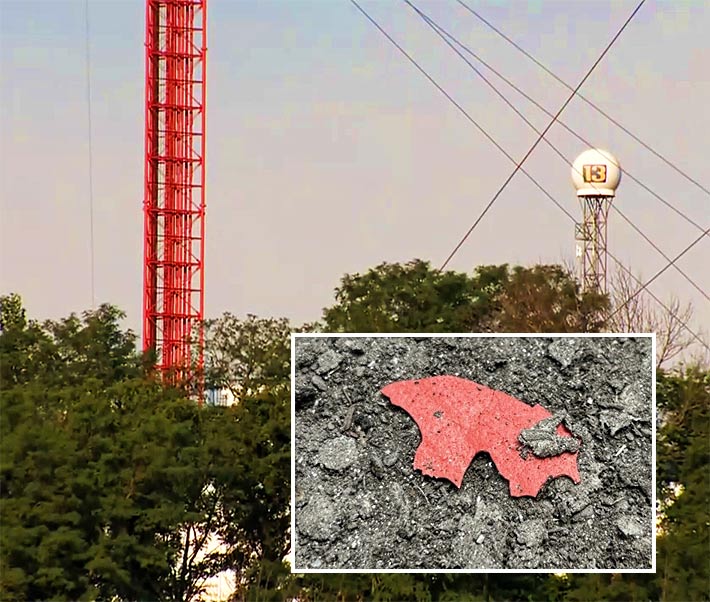
In May 2022, TTI hired Skyline to repaint its approximately 1,000-foot candelabra broadcast tower near the 3700 block of Malden Avenue in Baltimore City, MD. TTI knew the structure contained lead-based paint. Between May 28 and June 21, Skyline workers scraped and power-washed the tower with no containment systems in place. Lead paint chips spread as far as a quarter to half a mile from the base, contaminating residential yards, parks, and a daycare in the Woodberry neighborhood.
State authorities ordered the work to be stopped. Despite years of ongoing cleanup, Maryland Department of the Environment (MDE) has continued to find paint flakes in the area as unstabilized paint releases from the tower structure itself.
The criminal case came first. Skyline and its president, Christopher Mecklem, 43, of Scottsbluff, Nebraska, each pleaded guilty to criminal violations of Maryland’s environmental laws, resulting in a combined $100,000 fine, reduced to $50,000. Mecklem was charged personally alongside the company. The $2.2 million civil settlement followed, with both TTI and Skyline bound by the consent decree.
Why the tower owner was named
TTI’s inclusion in the civil action reflects a straightforward regulatory principle: a property owner who knows a hazard exists on their structure bears responsibility for ensuring that hazard is managed properly — regardless of whether they hire that work out. TTI knew the tower contained lead-based paint. Hiring a contractor who was not accredited to handle it did not transfer that responsibility to Skyline alone.
This is the part of the case that should resonate most with tower owners. The instinct to hire out hazardous work and consider the liability transferred is understandable. Contracts are written. Insurance certificates are collected. Indemnification clauses are signed. But regulators do not view those documents the way contractors and owners do. When contamination spreads into a community, the question of who owned the structure and what they knew tends to follow.
The insurance gap tower owners often miss
Standard commercial general liability policies contain pollution and environmental exclusions. Lead paint dispersal across a community is precisely the type of event those exclusions are designed to push out of coverage — for both the contractor and any tower owner named as an additional insured on that policy. If a contractor does not carry a dedicated environmental or pollution liability policy, the additional insured status on a standard GL certificate may provide little meaningful protection when an environmental enforcement action follows.
Civil penalties compound the problem. As a matter of public policy in most states, regulatory penalties are not insurable. Whatever portion of a settlement represents penalty rather than remediation cost is an exposure that no insurance product will absorb — for the contractor or the owner.
What the industry should take from this
Thousands of towers built in the mid-twentieth century carry lead-based paint on their steel. As those structures age and require maintenance, the owners and contractors who work on them operate in an environment where the regulatory and legal stakes are not always well understood.
Before awarding painting or maintenance work on any structure with known or suspected lead paint, tower owners should confirm that the contractor holds state-specific lead abatement accreditation for the jurisdiction where the work will be performed — EPA RRP certification alone is not sufficient in states like Maryland. They should also verify that the contractor carries a dedicated environmental or pollution liability policy, and obtain a certificate specifically evidencing that coverage rather than relying on a standard GL certificate.
The Baltimore case is not an anomaly. It is a foreseeable outcome of foreseeable shortcuts. TTI and Skyline are both named in a consent decree that will govern their obligations through at least late 2026. The cleanup of the Woodberry neighborhood is ongoing. And the record is now public.
Under the consent decree, TTI must complete all repainting using proper containment systems and accredited contractors by June 30, 2026, with final replacement of the elevator carriage by August 31, 2026. TTI must conduct a final cleanup and inspection followed by at least three months of ongoing monitoring. TTI must also repeat a soil sampling study to confirm no increase in lead levels since MDE’s 2023 baseline. Skyline is permanently barred from performing lead abatement or painting work in Maryland, and its principals are prohibited from forming or controlling any company offering such services in the state.

