














First-quarter results from the nation’s three publicly traded tower companies—American Tower, Crown Castle, and SBA Communications—delivered a consistent message to investors: demand for wireless infrastructure remains intact.
But that message doesn’t fully translate to the field.
American Tower and SBA Communications reported earnings on April 29, followed by Crown Castle on April 30, with each company reinforcing steady carrier activity during their same-day earnings calls. Executives pointed to continued leasing demand, active amendment pipelines, and ongoing colocation activity as evidence that mobile network operators are still investing in their networks.
Two of the three tower REITs—American Tower and SBA Communications—raised or updated their full-year 2026 outlooks. Crown Castle held its guidance unchanged, signaling that while activity is improving, it has yet to broaden enough to materially shift expectations.
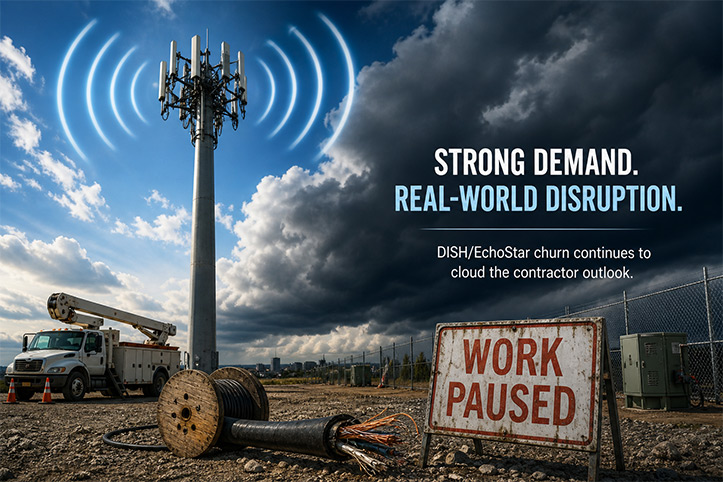
What continues to weigh on the sector is churn—primarily tied to DISH Network, now operating under EchoStar.
While Sprint-related lease cancellations still appear in reported results, they are largely a legacy of T-Mobile’s network integration and have already been absorbed operationally. For contractors, that work cycle—decommissions, modifications, and consolidations—has largely run its course.
DISH is a different story.
Unlike Sprint’s planned and phased rationalization, DISH/EchoStar-related terminations have introduced a more abrupt and uneven reset, forcing tower companies to adjust based on their exposure while leaving contractors to deal with the immediate consequences—paused projects, uncertain timelines, and in some cases, payment concerns.
That divergence is clear in the numbers.
Historically, organic tenant billings growth for the large tower companies has landed in the 4.5% to 5% range. In the first quarter, that figure compressed to the low single digits once churn and accounting adjustments were factored in.
Remove those distortions, and the underlying activity looks far more consistent.
American Tower reported U.S. and Canada organic growth of roughly 1% for the quarter, but approximately 5% when excluding DISH-related churn. Crown Castle posted 3.1% organic growth excluding Sprint and DISH impacts, or 3.3% when adjusting prior-year comparisons. SBA Communications, with less exposure to both tenants, reported approximately 4% organic growth excluding related lease terminations.
That’s not a demand problem—it’s a visibility problem.
On earnings calls, executives across all three companies emphasized that distinction. American Tower underscored that normalized leasing activity remains strong despite one-time churn impacts. SBA Communications pointed to steady colocation and amendment work as evidence of continued carrier investment. Crown Castle, taking a more measured tone, acknowledged improving activity but reiterated that capital deployment remains disciplined and growth uneven across its portfolio.
The underlying drivers remain unchanged.
Mobile data consumption continues to climb, driven by 5G adoption, fixed wireless access, and enterprise applications. Forecasts from Ericsson and CTIA indicate that wireless data usage is expected to roughly double over the next five years, reinforcing the need for additional network capacity.
For tower companies, that translates into continued amendments, new colocations, and selective densification. SBA noted that much of its first-quarter growth was driven by colocations as carriers expand and upgrade their networks.
Looking ahead, executives also pointed to longer-term catalysts, including the eventual transition to 6G and increasing demands from AI-driven applications—both expected to place additional strain on wireless infrastructure and support future tower activity.
But for contractors, the near-term outlook hinges less on long-term demand and more on near-term execution.
Carrier spending remains targeted, not expansive. Lease churn continues to distort reported growth. And while Sprint has largely moved into the background as a financial factor, DISH/EchoStar continues to create real-time disruption.
The bottom line: the tower sector is showing underlying strength—but until DISH-related uncertainty clears, contractors will continue to operate in a market where the numbers look better than the workload.


