















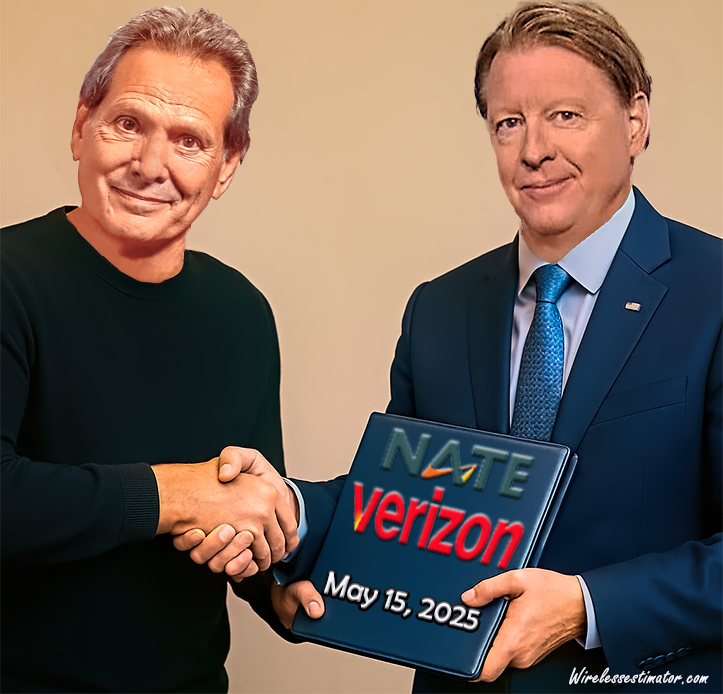
A TIMELY HANDOFF – With Verizon CEO Hans Vestberg (right) aware of the financial squeeze on contractors, the call is for the new CEO, Dan Schulman, to move the May 15 NATE: The Communications Infrastructure Contractors Association’s framework from policy to field reality—because several July 1 promised fixes remain overdue, leaving many of the nation’s contractors disillusioned by what they view as a slow-walk in commitments. Although Schulman founded Virgin Mobile, his experience in wireless infrastructure deployment is limited.
Commentary
Verizon has named Dan Schulman, former PayPal chief and longtime Verizon board member, as CEO, succeeding Hans Vestberg. Vestberg will remain as a special adviser through 2026 to assist with the transition and integration of Frontier. In his first statement as CEO, Schulman said Verizon is “at a critical juncture,” pledging to “maximize our value propositions, reduce our cost to serve, and optimize our capital allocation” to drive sustainable growth.
Background in brief — and why infrastructure now lands on his desk
Schulman’s resume spans AT&T, American Express, Priceline, and the founding CEO of Virgin Mobile USA. Crucially, Virgin was an MVNO: it did not own towers or spectrum, instead leasing network access—“we do not own or operate a physical network, which frees us from related capital expenditures,” Virgin’s SEC filings stated.
That history matters. At Verizon, Schulman assumes direct accountability for physical network builds, including macro sites, small cells, fiber backhaul, and the contractor ecosystem that brings them to life. Unlike at Virgin, capex discipline and follow-through on field execution will be pivotal to the carrier’s performance and success.
The contractor crunch Schulman can’t ignore
For years, wireless construction firms have warned that matrix pricing—standardized, take-it-or-leave-it rate cards—has become untenable across the Big Three carriers, squeezing margins and degrading safety and quality. In May, after NATE’s advocacy and extensive trade reporting, Verizon publicly committed to course-correct with:
Retire “turfing” and overhaul matrix pricing so no contractor is forced into unsustainable rates.
Add “Exceptions & Allowances” for site-specific conditions and regionalize RFPs to reflect inflation.
Improve payment terms, form a standing MSA working group with NATE, limit improper 1099 usage, and set up a hotline to report abuse.
Those commitments were memorialized in a May 15, 2025 letter from William H. Johnson, Verizon’s SVP & Deputy General Counsel, filed with the FCC, with several items slated to take effect on July 1, 2025—including the pricing-matrix revamp and the Exceptions & Allowances process.
Reality check from the field
Unfortunately, four mid-sized Verizon contractors tell us that, since July 1, they haven’t seen meaningful matrix relief; two report allowance requests were denied despite documented out-of-scope conditions. (These accounts are on background from contractors who requested anonymity to preserve customer relationships.)
If accurate, that gap between policy and practice risks draining skilled crews from the workforce—precisely the outcome NATE warned would imperil build timelines and reliability. The broader thrust from contractors and NATE remains: matrix rigidity plus inflation equals attrition, and attrition ultimately threatens carrier rollouts, maintenance, and emergency restoration capacity.
Why this belongs on the CEO’s agenda
Schulman’s first-day message emphasized customer focus, cultural accountability, and achieving financial targets by deploying capital where it truly yields a return.
Ensuring that Verizon’s infrastructure team delivers on its May 15 commitments fits squarely within that mandate.
Customer impact: Sites delayed by pricing disputes or crew shortages result in capacity constraints, slower 5G/Home growth, and increased churn.
Financial impact: Paying fairly for complex, out-of-scope work prevents costly rework and schedule slips.
There’s also a values through-line in Schulman’s record. During the 2019 U.S. government shutdown, as PayPal’s CEO, he acknowledged that many workers live paycheck to paycheck and offered interest-free cash advances (up to $500) to federal employees, committing $25 million to the effort.
That action—meeting people where the hardship was—resonates today with wireless contractors struggling to keep doors open under legacy pricing and inflation.
A constructive ask tailored to Schulman’s playbook
Reaffirm—publicly—the May 15 package and set a short internal deadline to audit regional adoption of the Exceptions & Allowances pathway and matrix updates. Publish a simple scorecard (requests submitted, cycle times, approval rates, top rejection reasons).
Empower the NATE–Verizon working group to fast-track fixes where data indicates denials are inconsistent with the letter’s intent.
Pilot regional RFPs that reflect local cost drivers (labor, fuel, site access), index key line items to reputable inflation benchmarks, and—once validated—scale the model nationwide. Industry veterans from carriers and turf vendors who have built and maintained matrix pricing say these updates are straightforward and can be executed in 1–2 months while preserving a reasonable margin for contractors. Pushing it out any longer is disingenuous.
The tone for the road ahead
This is a complementary handoff: Vestberg’s legacy is a formidable network and a public commitment to fix the contracting model; Schulman’s edge is operational discipline and customer-centric execution. His own words—”maximize our value propositions, reduce our cost to serve, and optimize our capital allocation”—are perfectly aligned with making the contractor ecosystem profitable and predictable, because reliable, motivated, and safe crews are the most cost-effective path to reliable builds.
If there’s one message to carry upstream in the transition brief, it’s this: Verizon’s continued success depends on a stable, fairly paid field force. Closing the gap between the May 15 letter’s promise and what contractors experience will be an early, high-leverage win for Verizon, its customers, construction and maintenance crews, and shareholders alike.
Verizon’s brand rests on rock-solid network reliability. Schulman’s task is to shed the “reliable but costly” label by redefining Verizon’s value proposition—without sacrificing performance. That means pairing pricing and product reforms with a fully supported field workforce, because under-resourced crews will erode the very network advantages that make Verizon competitive. He must drive both tracks in tandem.
Craig Lekutis
Publisher
