















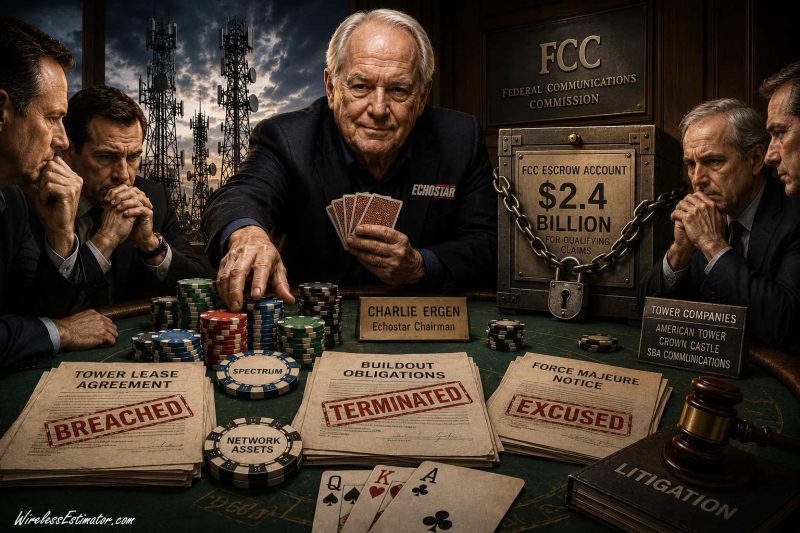
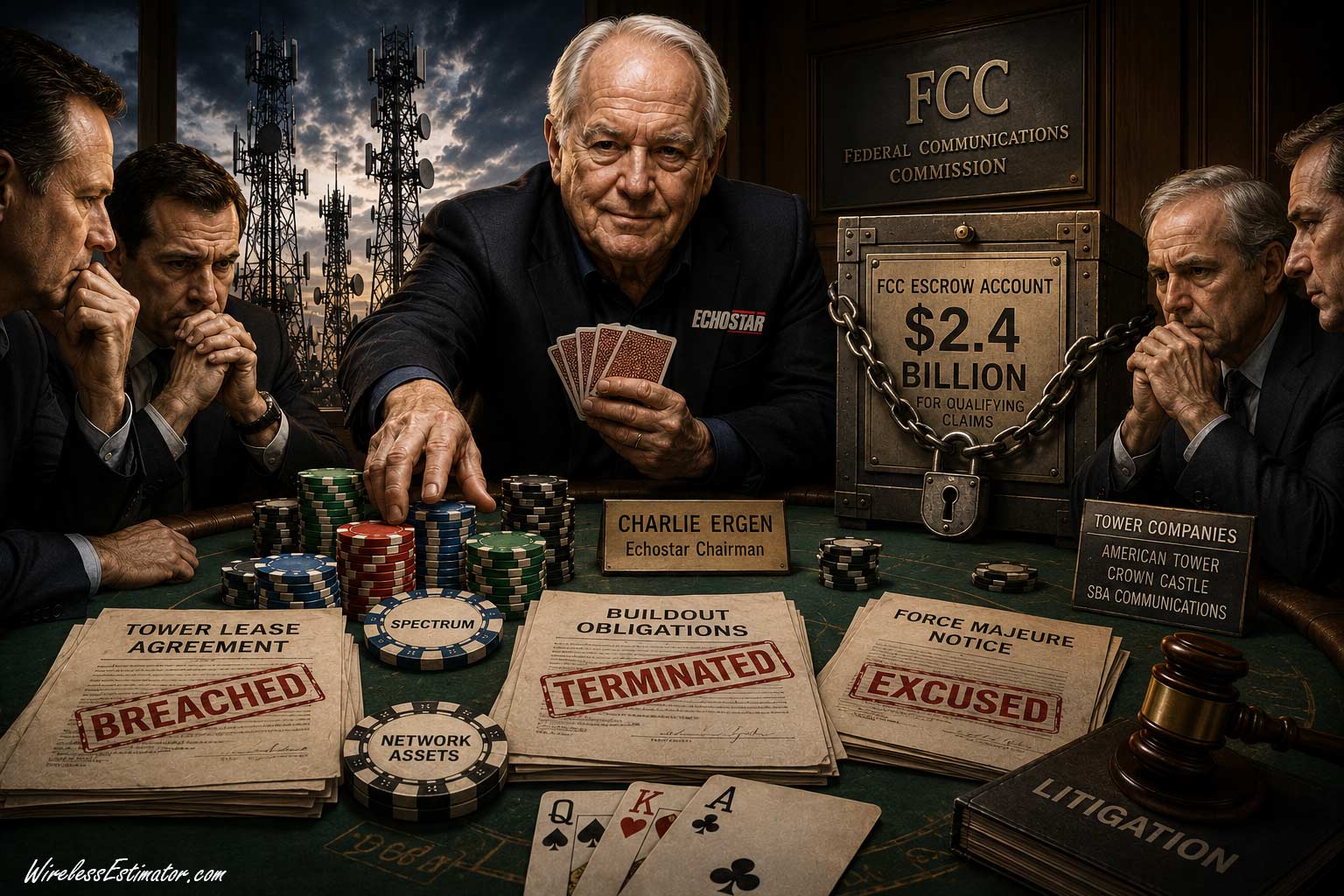
The wireless infrastructure industry scored what many are calling a landmark victory Tuesday when the Federal Communications Commission approved EchoStar’s $42.6 billion spectrum sale to SpaceX and AT&T — attaching a condition that EchoStar establish a $2.4 billion escrow account to cover potential obligations owed to tower companies, contractors, and infrastructure providers left behind when Dish Wireless walked away from its 5G network buildout.
The celebration was immediate and widespread. The Wireless Infrastructure Association (WIA), NATE: The Communications Infrastructure Contractors Association, and a coalition of more than 40 companies that had spent months lobbying Chairman Brendan Carr and the FCC to attach exactly this kind of condition all praised the decision. For an industry that had watched Charlie Ergen and his EchoStar machine execute what many described as a calculated financial maneuver to shed billions in contracted obligations while pocketing tens of billions in spectrum proceeds, the escrow requirement felt like justice.
But before the industry pops the champagne, a sober reality check is in order.
Eight Words Are Not a Legal Document
The FCC’s actual language regarding the escrow, the operative phrase that supposedly protects tower companies and contractors, amounts to a single sentence: “This encourages the resolution of outstanding claims while leaving the merits of any dispute to the parties or outside fora.”
That is it. No enforcement mechanism. No claims process. No defined standard for what constitutes a “qualifying claim.” No timeline. No administrator. No appeals process. No definition of who qualifies or how disbursements will be made.
The FCC order states that EchoStar must establish “an escrow account of $2.4 billion that can be drawn upon for qualifying claims,” and that the agency “would allow courts and other bodies to adjudicate the issues.” In plain English: the FCC has parked $2.4 billion in a holding account, declared victory, and handed the entire legal fight back to the courts, the same courts where American Tower, Crown Castle, SBA Communications, and others have already been slugging it out with Dish Wireless for months with no resolution in sight.
The FCC is not deciding who is owed money. It is not deciding whether Dish’s force majeure defense is valid. It is not administering the claims. It simply requires that a pool of money exist so that if courts eventually rule against EchoStar, there is something left to collect. That is a meaningful protection — but it is far from a guarantee.
The Reality on the Ground
Here is what makes this more nuanced than the headlines suggest: according to multiple contractors and at least one Dish manager with knowledge of the situation, most, if not all, contractors have already been made whole. Dish did not stiff the people climbing the towers. The payments that stopped flowing were largely the ongoing tower lease obligations owed to the major tower companies — American Tower, Crown Castle, and SBA Communications — not the workforce that built the sites.
That distinction matters enormously when evaluating what the $2.4 billion escrow is actually protecting. The primary beneficiaries of any court victory against EchoStar will be the publicly traded tower REITs and private towercos, not the small and mid-sized contractors who were on the front lines of the buildout.
Crown Castle alone is seeking more than $3.5 billion. American Tower disclosed that Dish represented approximately $210 million of its annual U.S. revenue. The escrow, at $2.4 billion, may not even be sufficient to satisfy the tower companies’ claims if courts rule fully in their favor.
The FCC’s $2.4 billion escrow may sound enormous politically and publicly, yet it could represent only a fraction of the total financial exposure EchoStar potentially faces if the tower REITs and related infrastructure claimants were to achieve substantial victories in litigation.
For contractors, the more tangible near-term opportunity may actually come from decommissioning work. If the major tower companies are made whole, or even substantially so, through court settlements or escrow disbursements, the logical next step is the systematic decommissioning of thousands of Dish sites that were built, activated, and then abandoned. That work — removing equipment, restoring sites, and managing the transition — represents a real pipeline of activity for the contractor community that built those networks in the first place.
Trust But Verify: The Framework Agreement Problem
Industry observers recall the FCC’s framework agreements from last year, which recognize a familiar pattern. Framework agreements sound authoritative. They create the impression that the regulatory machinery is engaged and that commitments will be enforced. In practice, they frequently amount to little more than aspirational language that regulated parties can — and do — largely ignore.
NATE knows this firsthand. The association was party to a framework agreement between the FCC and Verizon that was supposed to protect contractors and workers and establish standards for how infrastructure work would be handled. By most accounts, that agreement is being widely ignored, with little apparent appetite at the commission level to enforce it.
The EchoStar escrow condition is a more substantial tool than a framework agreement — real money has been set aside — but the absence of a clear disbursement mechanism, defined eligibility criteria, and an independent administrator means that accessing the escrow is likely to be far harder than it appears.
Towercos will almost certainly need to prevail in litigation or reach negotiated settlements before they can touch a dollar of that $2.4 billion. EchoStar, which has already told the FCC this condition is “unprecedented” and said it is “evaluating next steps,” is unlikely to make that process easy or fast.
The FCC’s own language acknowledged as much by explicitly deferring the merits to courts and “outside fora.” In regulatory terms, that is the agency saying: we’ve done what we can, now it’s someone else’s problem.
Bottom Line
The escrow condition is better than nothing. It is substantially better than a framework agreement. It ensures that if courts rule against EchoStar, the money exists to pay those judgments rather than having evaporated through debt repayments and corporate transactions before a verdict is rendered. For that, the American Wireless Builders Coalition deserves credit for a sustained and effective advocacy campaign.
But the idea that $2.4 billion is sitting in an account waiting to be distributed to aggrieved tower companies and contractors based on an FCC statement of a few dozen words is wishful thinking. The legal battles between Dish and the major tower companies are far from over.
The claims process will be contested. EchoStar has already signaled it intends to fight. And the FCC — which has demonstrated a consistent reluctance to wade into private contract disputes — has made clear that it sees its role as creating the conditions for resolution, not delivering one.
For the industry, yesterday was a win. Whether it ultimately becomes the victory it appears to be will depend entirely on what happens next, in courtrooms, not at the FCC.


