













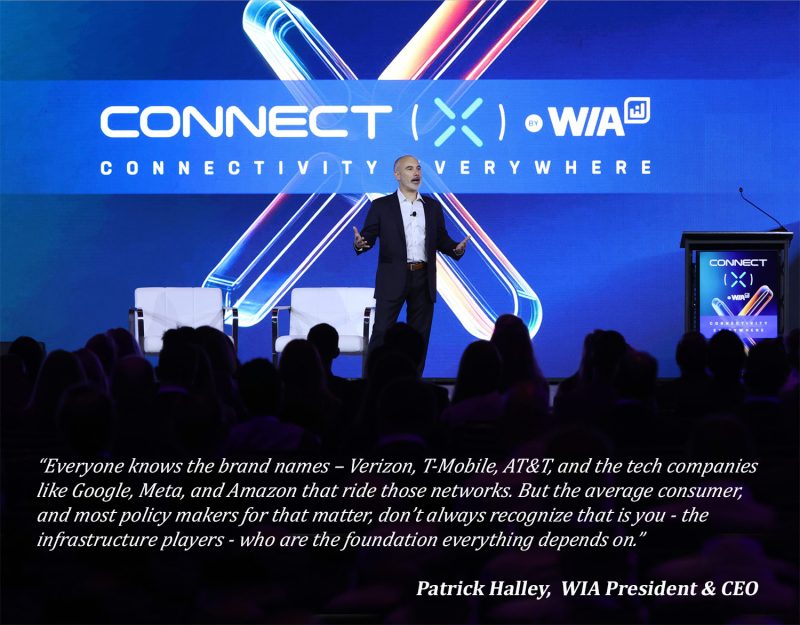
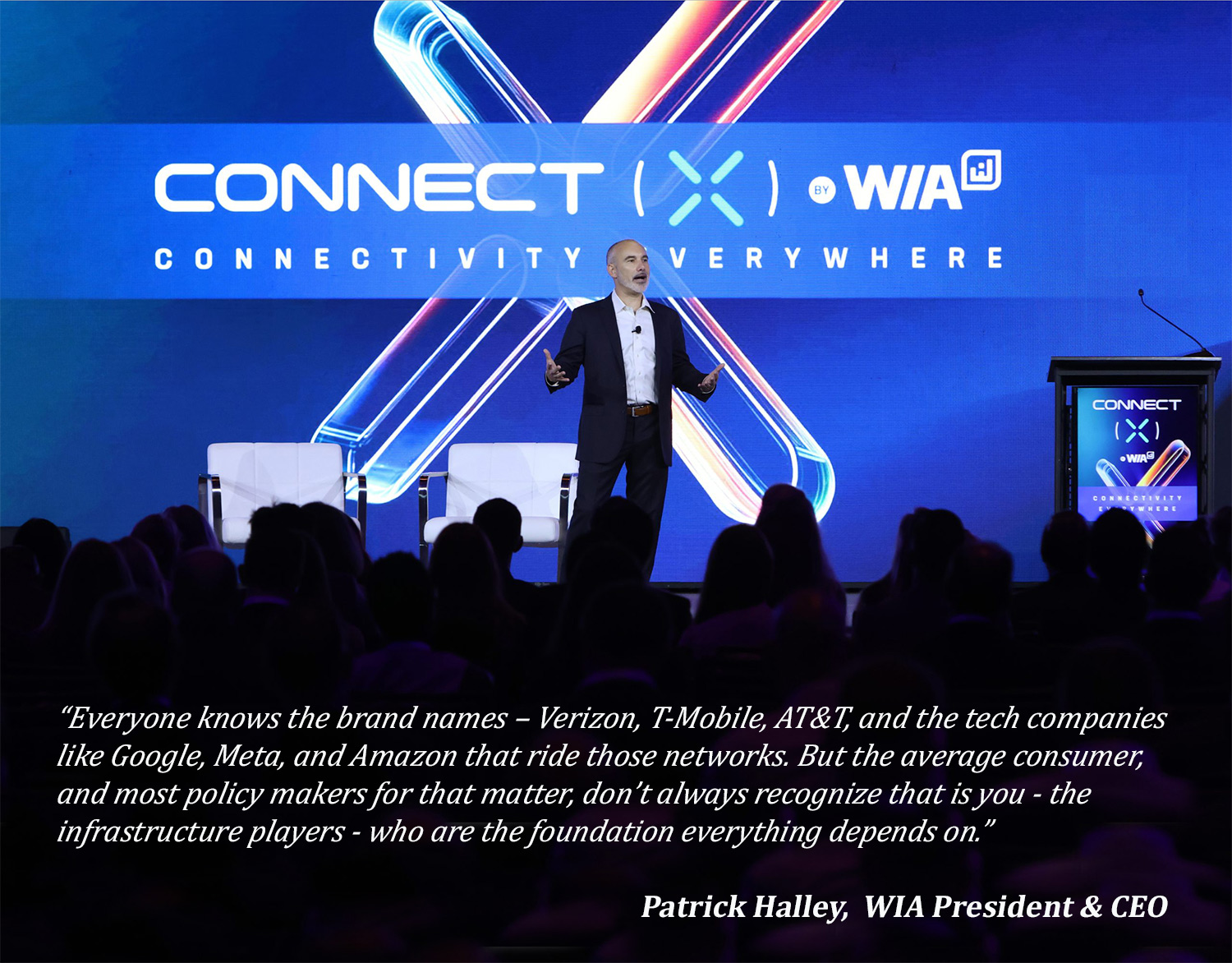
Ask Patrick Halley about the future of wireless, and he will, almost certainly, start talking about soccer. Not as a metaphor borrowed for the occasion—as a genuine, deeply felt lens through which he sees the world. At the opening of Connect (X) 2026 in Fort Lauderdale, the Wireless Infrastructure Association’s president and CEO revealed a side of himself that policy briefings rarely show: a man who still plays the game, coaches youth teams, holds DC United season tickets despite what he calls the sadness that implies, and has traveled the world with his family just to watch it live.
“Raise your hand if you’ve heard of Messi,” he told a room full of tower engineers and infrastructure executives, suppliers and contractors on Tuesday morning. Nearly every hand went up. He tried Cristiano Ronaldo. Same result. Then he asked about Gerard Piqué and Toni Kroos. Silence.
That was precisely his point. “Every superstar needs a foundation to rely on. It’s the same in our industry,” he said.
Piqué and Kroos—the central defenders and midfield engines who win the ball and thread the pass that puts the superstar in position to score—are the players nobody celebrates. They are, Halley argued, the wireless infrastructure industry in human form. Verizon, T-Mobile, AT&T, Google, Meta: those are Messi. The people building and operating the towers, running the fiber, powering the data centers? They are the players you have never heard of, without whom none of it is possible.
A World Cup, Thirty Years Apart
Halley grounded his love of soccer in something concrete: the United States is hosting the FIFA World Cup again this summer, the first time since 1994. He used that 30-year gap as a benchmark for what the industry has actually accomplished.
- Wireless connections: 8 million in 1994 → nearly 600 million today
- Network era: 2G then, approaching 6G now
- Mobile data: 132 trillion MBs carried annually today
To make the last number tangible, Halley translated it: 44 billion one-hour episodes of Ted Lasso. Played nonstop, that is roughly five million years of HD streaming. “From Netscape and Yahoo to ChatGPT and Gemini,” he said. “From networks on earth to networks in space. From wireless in the trunk of the car to wireless driving the car.”
Three Plays, One Playbook
The coach in Halley came fully to the surface in the speech’s centerpiece: a three-play strategic framework drawn straight from the training pitch.
Play 1 — Watch the ball. Not where it is now, but where it is going. The best players run to the open space before the ball is even played. For the infrastructure industry, that space is the AI cell site of the future, data centers in orbit, and humanoid robots in living rooms.
Play 2 — Innovate. His proof of concept: a behind-the-scenes visit to the Ryder Cup at Bethpage, where T-Mobile deployed network slicing for vendors, a private 5G network for broadcasters, and untethered cameras that captured angles the sport had never seen before. A 5G feed next to a fiber feed—identical picture quality, but one of them could go anywhere.
Play 3 — Advance the game. Halley invoked Xavi, Barcelona’s legendary playmaker renowned for always knowing where every player on the pitch was before the ball ever reached his feet, as the model for how WIA approaches policy. “We know what move to make before the ball hits our foot,” he said.
What We Now Know About the Future
Halley’s soccer metaphors were charming, but they were carrying serious freight. WIA’s own consumer research found that nearly two-thirds of U.S. adults already use AI applications on mobile devices. The association estimates that AI traffic now accounts for at least 4% of total wireless network traffic—representing roughly $3 billion in annual network investment—and anticipates that figure will reach 10% by the end of 2026.
One major carrier CEO, he said, is preparing for an “AI hyper-growth phase” and expects data consumption to accelerate by another eighty percent over the next five years. That means vastly more compute at the network edge, a surge in uplink traffic as devices become directly wireless-enabled, and an entirely new category of infrastructure the industry is calling Edge AI.
“From the tower, to fiber, to data center and back—wireless infrastructure is AI infrastructure,” he said.
Halley has already met with technology leaders at Ericsson—where he watched automated wireless robots building next-generation equipment on a U.S. factory floor—and at Nokia, where engineers showed him the early architecture of what the network edge will look like in the near future. WIA has since launched a formal Edge AI Infrastructure initiative to bring the industry together around accelerating its deployment.
The speech ended where it began: on the pitch. WIA, Halley said, is constantly scanning, watching the horizon for spectrum availability, satellite impacts, permitting reform, and the AI innovation that will reshape the infrastructure of tomorrow. The FCC’s Build America Agenda, the White House AI Action Plan, and congressional permitting legislation, he argued, all point in the same direction. People are listening.
“When we watch the ball, innovate for the future, and advance the game,” he told the crowd, “that’s WIA. And when we do this—we win.”
For a man who has spent decades working in the policy and technical weeds of wireless infrastructure, the soccer metaphors turned out to be less of a rhetorical device than a genuine self-portrait. The Patrick Halley we never knew turns out to be a coach who never stopped coaching. He just traded the touchline for the spectrum band.

