














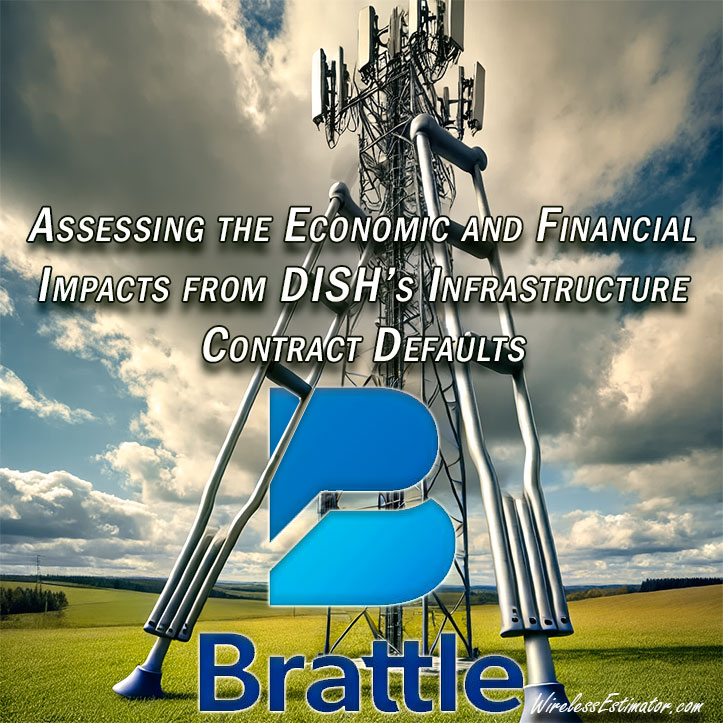
The Wireless Infrastructure Association (WIA) commissioned The Brattle Group to assess the economic fallout from DISH’s contract defaults — and the findings warn of rent hikes up to 10.7%, slower 5G and 6G deployment, and destabilized smaller tower companies, with consequences that ultimately reach every American wireless subscriber.
In late 2025, DISH Wireless LLC declared its long-term master lease agreements with tower companies “excused” — walking away from billions in contracted obligations after EchoStar sold its spectrum holdings to AT&T and SpaceX. A new economic study by The Brattle Group, prepared for WIA, has now quantified exactly what that decision means for every actor in the wireless ecosystem: tower owners large and small, carriers, rural communities, and consumers.
The findings are stark. If the defaults stand without consequence, the ripple effects will be felt for years through higher rents, reduced capital investment, widened rural coverage gaps, and a permanent repricing of counterparty risk that could fundamentally change how tower contracts are written across the United States.
A $9 Billion Shock
Industry observers estimate DISH’s defaults put more than $9 billion in contracted tower revenues at risk. The Brattle Group estimates DISH leases account for 5.1% to 7.0% of annual rental revenues across the major tower companies — American Tower, Crown Castle, and SBA Communications — spread across roughly 25,000 macro sites.
American Tower filed suit in October 2025, disclosing DISH represented ~4% of its U.S. and Canada property revenue, or about $210 million annually. Crown Castle terminated its DISH agreement in January 2026 and is seeking over $3.5 billion in remaining payments. SBA has also filed suit. Meanwhile, DISH has signaled it will receive none of EchoStar’s $42.6 billion in spectrum sale proceeds, an apparent attempt to become judgment-proof, leaving the FCC’s approval of the spectrum transfer as one of the few remaining enforcement levers.
Why This Is Not a Private Dispute
Tower companies invest heavily upfront, in site acquisition, construction, power, fiber, and maintenance, against long-term contracted revenue streams. Without those streams being enforceable, the economic case for tower investment collapses. The Brattle Group draws on contract economics to make a point the industry already knows intuitively: when a major counterparty defaults without bearing appropriate consequences, it doesn’t just harm the parties involved; it degrades the incentive structure for the entire sector.
DISH’s argument that an FCC-pressured spectrum sale “excused” its lease obligations seeks to establish a precedent allowing carriers to exit tower contracts by citing regulatory circumstances. If accepted, it would strip away the contractual enforceability that underpins the tower investment decision. As the report states, this action has “introduced uncertainty into a market that depends heavily on contractual stability.”
Two Costly Paths for Tower Companies
Option 1: Rent Increases
To make themselves whole on a net present value basis — accounting for lost DISH payments and site decommissioning costs — tower companies would need to raise rents on their remaining carrier tenants. The Brattle Group models two scenarios: immediate across-the-board repricing, and a more realistic staggered repricing as contracts renew over 15 years.
The result: a required rent increase of 5.7% to 10.7% above standard annual escalators. Since all three major carriers face the same input cost increase simultaneously, economic research on cost pass-through in concentrated markets suggests these increases would largely flow through to consumers in the form of higher wireless bills.
Option 2: Capex Cuts
If tower companies absorb the loss instead, the result is a contraction in capital expenditure at exactly the wrong moment. The transition to 5G Advanced, edge computing at tower sites, and early 6G readiness all require continuous reinvestment. For some tower companies with high DISH tenancy concentrations, the revenue loss would be nearly double their entire annual capex budget — making cuts unavoidable if the shortfall isn’t recovered elsewhere.
The consequences: slower 5G densification, delayed rural broadband expansion, and a weaker U.S. position in the global 6G race, a priority the White House explicitly identified in its December 2025 presidential memorandum on winning the 6G competition.
Smaller Tower Companies Are Most Exposed
The Big Three tower companies have diversified portfolios, investment-grade credit, and national scale to absorb the shock, painfully, but manageably. Smaller and regional operators do not. Between 5% and 10% of DISH’s sites were with smaller companies, many serving rural markets where each tenant represents a critical share of revenue.
The Brattle Group’s modeling shows that for every 1 percentage point increase in weighted average cost of capital (WACC), a tower company needs to raise rents by approximately 0.3 percentage points to offset DISH’s default. Smaller operators already face WACCs of 12% to 17,%compared with the 6% to 7% range for large public companies. In rural markets with no infrastructure redundancy, the math can push operators toward deferred maintenance, site decommissioning, or insolvency — leaving communities with no wireless coverage alternatives.
Repricing Counterparty Risk Across the Industry
The most durable impact of the DISH default may be structural rather than financial. Tower valuations, credit ratings, and financing terms are all built on the assumption that carrier default on long-term master lease agreements is negligible. If the FCC approves EchoStar’s spectrum transfer without conditions, lenders and investors will be forced to reprice that assumption across the industry.
Barclays didn’t wait. In December 202,5 it downgraded both American Tower and Crown Castle, citing rising uncertainty over DISH rent collection. American Tower stock fell 4% in September when the spectrum sales were announced; Crown Castle and SBA fell 2% and 4% respectively, while the S&P 500 rose 4% in the same period.
Looking forward, new tower contracts may feature shorter terms, higher base rents, stricter financial covenants, and reduced flexibility. New wireless market entrants — the competitors regulators hope will someday challenge the Big Three carriers — will face a tower market permanently more expensive due to the precedent DISH has set.
What the FCC Decides Next
The Commission must rule on whether to approve EchoStar’s spectrum transfer to AT&T and SpaceX — and whether to attach conditions that ensure DISH’s contractual obligations are honored. Conditioning approval is one of the only remaining tools that can prevent EchoStar from collecting tens of billions in spectrum proceeds. At the same time,e its subsidiary walks away from the infrastructure contracts that supported the network on which those licenses were built.
Multiple lawsuits are proceeding in parallel, but DISH’s judgment-proof posture limits what courts alone can deliver. The FCC’s decision is, in practical terms, a judgment on whether the contractual norms underpinning billions of dollars in wireless infrastructure investment will be upheld.
What Tower Owners and Contractors Should Watch
- Lease renewals will get harder. Expect tower companies to push for higher base rents and fewer concessions as DISH-related losses work through the portfolio.
- New entrant economics are under pressure. Smaller carriers will face a tower market repriced for default risk — complicating already-thin business models.
- Rural operators: review your financials now. If DISH was a meaningful tenant and re-tenanting is slow, assess capital reserves, covenant headroom, and debt maturities.
- Contract structures will tighten. Expect shorter auto-renewal windows, stronger financial covenants, security deposit requirements, and parent guarantees for lower-credit tenants.
- Decommissioning clauses need scrutiny. DISH’s departure is creating substantial equipment removal costs for tower owners. Ensure your lease agreements explicitly assign these costs to the defaulting tenant.
- Follow the FCC proceeding closely. Conditions attached to the EchoStar spectrum transfer — or their absence — will set the tone for how regulators view infrastructure contract enforcement for years.
The DISH default is a defining test for the wireless tower industry’s contract ecosystem. The Brattle Group’s analysis makes clear that consequence-free default is not a private matter — it is a systemic event with measurable costs that extend from Wall Street to rural America. How the FCC, the courts, and the industry respond will shape the investment calculus for wireless infrastructure for the decade ahead.

