
















AT&T and Ericsson demonstrated something with real security implications outside AT&T Stadium in Arlington, TX on Friday, July 10: standard 5G cell towers, already blanketing American cities, can detect and continuously track multiple drones in real time using nothing but software layered on equipment that’s already up there. What it does not do is stop one. This was a sensing demonstration, not an interception test.
The event was staged for an audience that included dozens of federal, state, and local law enforcement agencies, and it produced a genuinely live moment: during the demonstration, the system detected a real drone approaching the stadium and tracked its movement in real time, not a scripted flyover.
What it actually showed — and what it didn’t
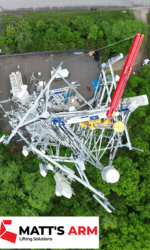
The mechanism is called multistatic sensing. Instead of one radar unit bouncing a signal off a target and reading the echo, Ericsson wired together three synchronized 5G tower sites near the stadium — one roughly a quarter mile away, two others about 1.6 miles out — so they work as a coordinated network. One node transmits while the others listen for reflections bouncing off objects in the air, and because there’s no single point of failure, accuracy improves as more towers contribute overlapping views of the same airspace.
The tracked drones don’t need to carry any electronic device or transmitter. The system detects passive objects — a drone with its radio off, a vehicle, a person on foot — and coverage is determined by where the towers already sit, not by whether the target is cooperating. That’s a meaningfully different capability than existing cell-based drone-location services, which only work if the drone itself is broadcasting.
But everything the system produces is data: location, velocity, elevation, an AI-generated classification with a confidence score. AT&T’s own framing is that the network’s role is delivering that fused sensing data to third parties who can act on it — combining it with their own radar, camera feeds, and other sources. Turning a detected drone into a grounded one is left entirely to whoever receives that data, and under current federal law, that’s a very short list.
The confiscations and arrests that give this context
The reason AT&T and Ericsson could stage this demo in front of law enforcement audiences at all is that the underlying problem is not hypothetical at that specific stadium. FBI Dallas told NBC 5 that its agents have seized 53 drones during the eight World Cup matches played at AT&T Stadium so far. Federal authorities separately charged two men for allegedly flying unregistered drones inside the stadium’s temporary flight restriction. Nationally, the White House’s FIFA World Cup Task Force reported nearly 1,500 drone detections and more than 700 mitigations across the tournament as of the demo date.
Arlington police, for their part, said they already run their own drone detection during major events in the city’s entertainment district, can trace a drone’s radio signal back to its pilot, and are working to expand their mitigation capability — meaning the actual disabling of a drone, not just spotting one. That’s the gap AT&T and Ericsson’s pitch is aimed at filling from the sensing side: even a police department that can already detect a drone often can’t act on that detection at scale or from range, and a distributed, tower-based sensing net could feed better, earlier data into whatever mitigation system a city or federal task force is running.
The legal gap that no demo touches
Detection and mitigation are governed by entirely different rules, and that’s where the real bottleneck sits. Under the SAFER SKIES Act, signed into law in December 2025, trained and certified state and local law enforcement can now support counter-UAS operations at major public events — before that, only federal agencies could legally intercept or neutralize a drone at all. Even so, broader DOJ and DHS mitigation authorities actually lapsed at the end of September 2025 when Congress failed to renew them during a government shutdown, leaving those departments without clear standing legal authority to disable a drone outside the specific carve-outs written for the World Cup. A pending bill, the DEFENSE Act, would extend counter-drone authority to state and local law enforcement for regular-season games and other events that don’t get the marquee-event federal security detail a Super Bowl or World Cup match gets.
AT&T and Ericsson proved that: cell towers can now see a drone as well as, or better than, dedicated radar, without a city or venue having to buy and install any new hardware. Whether anyone is legally allowed to do anything about what those towers see once flagged — jam it, force it down, physically intercept it — remains a fight playing out in Congress, not in Arlington airspace.

