
















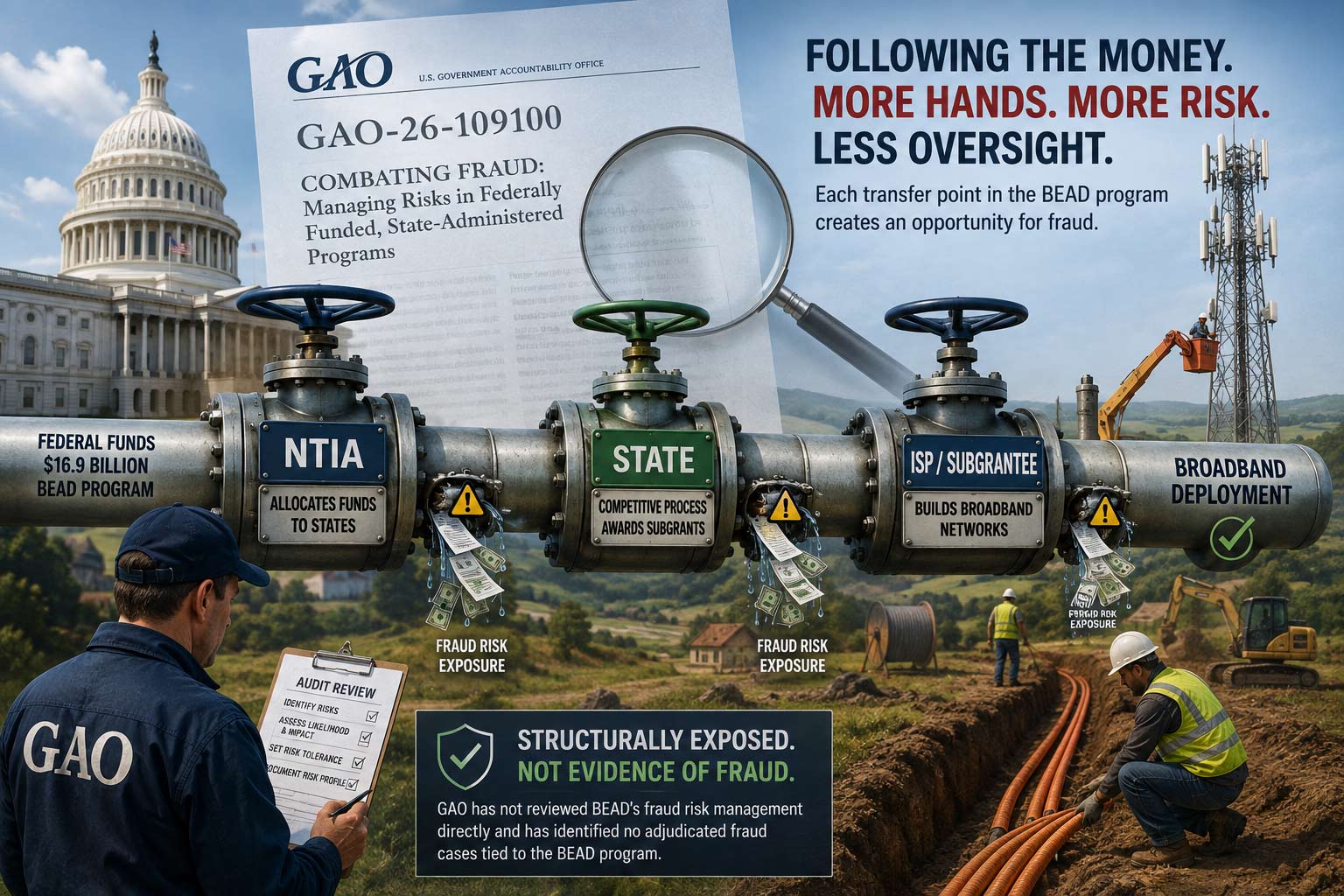
A new Government Accountability Office report has BEAD sitting in some uncomfortable company: the $16.9 billion broadband grant program made GAO’s list of federal initiatives most structurally exposed to fraud, alongside Medicaid, SNAP, and disaster assistance funding. The report, “Combating Fraud: Managing Risks in Federally Funded, State-Administered Programs” (GAO-26-109100), published July 23, reviewed 20 of the largest federally funded, state-administered programs and found the same underlying vulnerability running through all of them: money passes from Washington to states, then to subgrantees, and every hop adds an entry point fraud can exploit while diluting who’s actually watching the funds.
BEAD fits that structural description. NTIA allocates funds to states and territories, which run competitive processes to award subgrants to internet service providers. As of May, NTIA had approved 54 of 56 state and territorial final proposals, clearing the way for those states to start disbursing funds to ISPs for network construction.
What the audit actually found — and didn’t
GAO is explicit that it has not reviewed BEAD’s fraud risk management directly, because the program only started sending money to states in fiscal year 2023. It has no adjudicated fraud cases tied to BEAD to point to. The one case it does cite — a grant manager sentenced to 28 months and ordered to pay $828,152 in restitution for fraudulent invoices and expense reports — happened in a different NTIA broadband program entirely, not BEAD.
Buried further down, in a footnote: among the 18 programs GAO could meaningfully compare on single-audit findings, BEAD posted zero audits with severe and persistent problems, out of ten completed. The Supplemental Nutrition Assistance Program, by contrast, came in at over 19 percent. That’s a data point that cuts against the “vulnerable to fraud” framing running through most of this week’s coverage, and it deserves at least as much daylight as the risk-category placement.
Where the real evidence lives: a 2023 review of NTIA’s other broadband grants
The substance behind GAO’s concern isn’t a fresh finding about BEAD. It’s a callback to GAO-23-105426, “Broadband Funding: Stronger Management of Performance and Fraud Risk Needed for Tribal and Public-Private Partnership Grants,” published in January 2023. That review examined two separate, smaller NTIA broadband programs — the $2.98 billion Tribal Broadband Connectivity Program and the $288 million Broadband Infrastructure Program — and concluded NTIA’s fraud risk management didn’t align with leading practices at the time. No office within the Department of Commerce had been designated to lead the effort, and NTIA hadn’t conducted a fraud risk assessment consistent with GAO’s own framework: identifying risks, assessing their likelihood and impact, setting risk tolerance, and documenting a fraud risk profile.
GAO made 15 recommendations across performance measurement and fraud risk management in that report. NTIA agreed with all of them and, according to the new audit, has since fully implemented them, including standing up what the agency has described as a Risk Management Council to govern risk — fraud among it — across its grant portfolio. NTIA maintains those same controls now extend to BEAD.
An NTIA spokesperson told Broadband Breakfast that BEAD “must be managed with discipline and careful oversight,” and that the agency will continue monitoring the program to guard against fraud, waste, and abuse.
The harder question sitting next to this one
Worth noting for context: a separate, more recent GAO inquiry has flagged unresolved questions around NTIA’s internal review of $47.7 billion in broadband awards — a live thread that speaks more directly to BEAD’s current administration than a three-year-old audit of a different program does. Anyone covering this ought to treat that inquiry, not the 2023 TBCP/BIP review, as the more relevant BEAD-specific oversight question going forward.
The takeaway for carriers and contractors in the subgrant pipeline
None of this means BEAD money is being mishandled. It means BEAD has the same generic structural exposure as every large pass-through federal grant program, that GAO hasn’t yet independently tested whether NTIA’s controls are actually working inside BEAD itself, and that the strongest evidence GAO can currently offer comes from a different program under the same agency. ISPs and subcontractors drawing down BEAD subgrants should expect state administrators and NTIA to lean harder on documentation, invoicing, and eligibility verification in the months ahead — that’s the direct, practical consequence of a “top five” fraud-risk placement, regardless of whether an actual case ever materializes.

