











The FCC has updated its Covered List to add two new categories of foreign-produced equipment: advanced robotic devices — defined as mobile robots including humanoids and quadrupeds — and connected power inverters. The action follows determinations by a White House-convened Executive Branch interagency body with national security expertise, which found both categories “pose unacceptable risks to the national security of the United States or the safety and security of United States persons,” regardless of country of origin.
The stated risks
For power inverters, the national security determination cites the absence of a secure U.S. supply chain combined with continuous inflows of foreign-produced inverters and components. The determination flags remote connectivity as a compounding vulnerability as inverter-based resources proliferate on the U.S. grid, warning that foreign firms could potentially disable inverters remotely, exfiltrate data, or facilitate surveillance and cyberattacks by foreign government actors.
For advanced robotic devices, the determination points to networked capabilities that create vectors for attacks capable of manipulating a device’s data and physical operation, along with the risk that data these devices collect could be leveraged to surveil Americans, aid foreign intelligence services, or allow remote commandeering of the robots themselves.
What counts as an “advanced robotic device”
The fact sheet itself doesn’t spell out a technical definition beyond “mobile robots, such as humanoids and quadrupeds,” but the regulatory scope, per reporting on the determination, is broader: any mobile ground robot capable of locomotion, obstacle avoidance, navigation, or ground movement; that operates at a distance from a human operator; weighs more than 4.4 pounds; and carries sensors, connectivity, and software enabling autonomous operation. That sweeps in wheeled and tracked autonomous mobile robots alongside humanoids and quadrupeds, while excluding fixed industrial arms, drones (already covered separately), road and rail vehicles, underwater vehicles, and mobility aids.
The FCC named no company, but the designation lands squarely on Chinese manufacturers who dominate this hardware category — Hangzhou-based Unitree Robotics chief among them, alongside AgiBot and UBTech. Unitree became the first Chinese-made humanoid to reach Western commercial markets with a European launch on July 22, with a North American push reportedly planned. Reporting on the underlying determination also points to two documented vulnerabilities in Unitree hardware: CVE-2025-2894, a March 2025-disclosed firmware backdoor in the Go1 quadruped that connected to a China-based cloud tunnel and was later found running on networks at MIT, Princeton, Carnegie Mellon, and the University of Waterloo; and “UniPwn,” a Bluetooth Low Energy exploit granting root access to the Go2, B2, G1, and H1 platforms that is wormable between nearby units. The designation extends the same Covered List mechanism already applied to Huawei, ZTE, Hikvision, Dahua, DJI drones, and foreign-made routers.
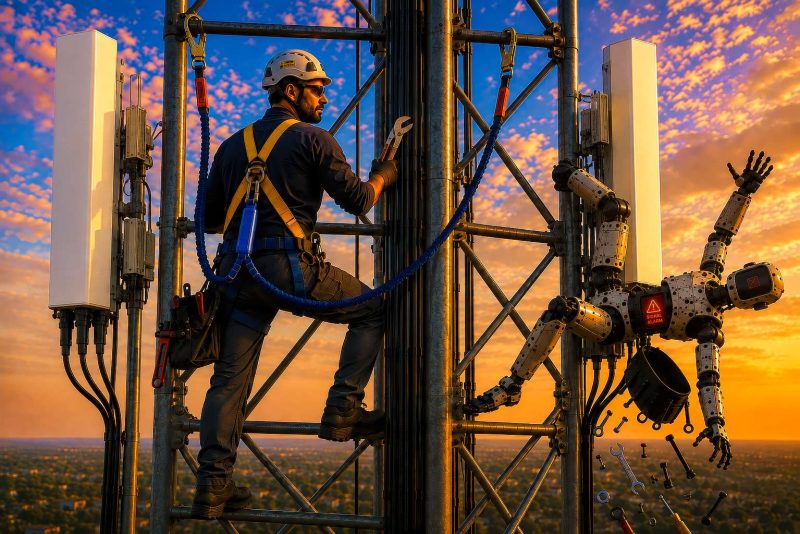
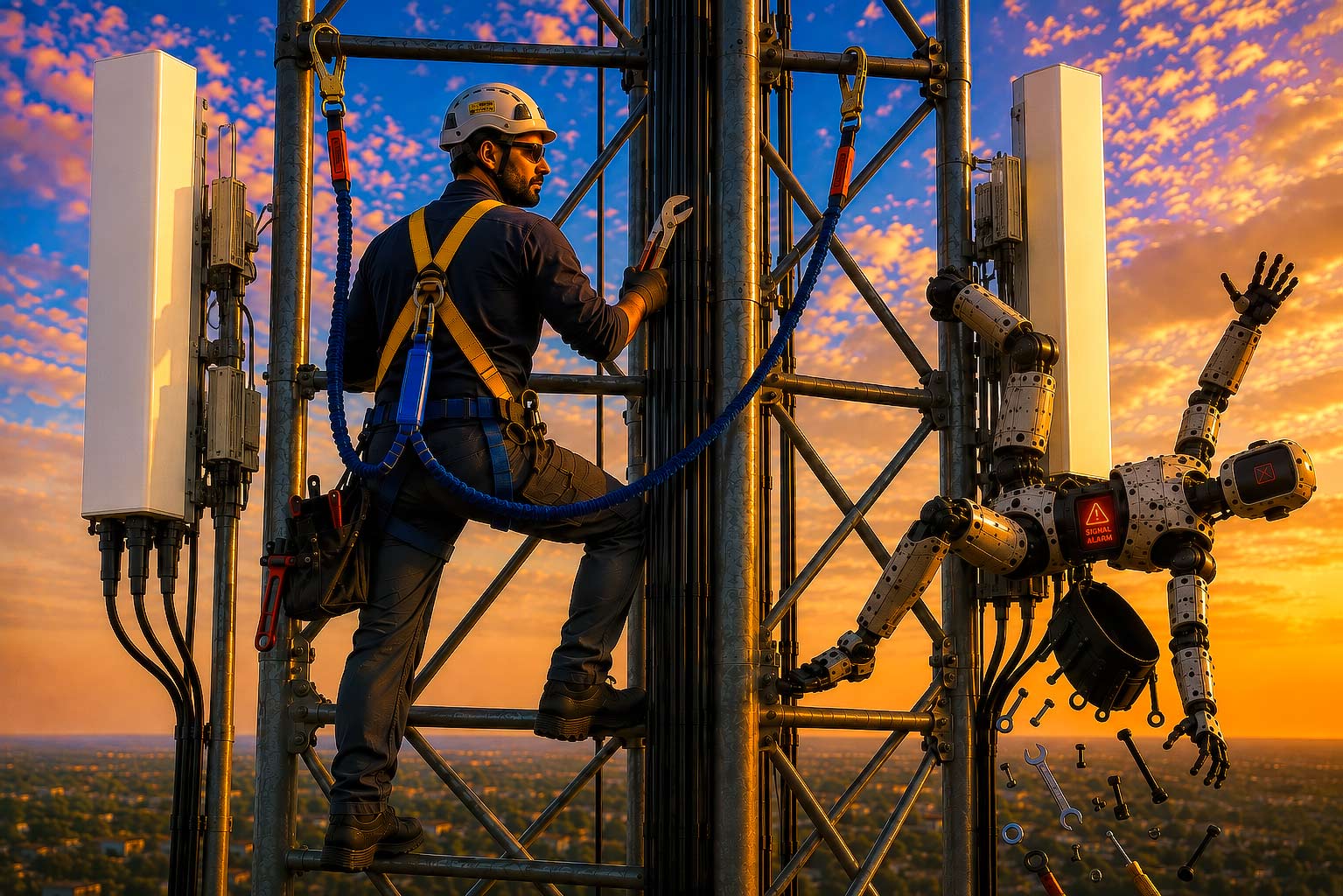
Could these robots climb a tower? Not now, and not on the roadmap shown so far
For an industry that lives on towers and rooftops, the obvious question is whether humanoid or quadruped platforms are anywhere close to doing tower work. They aren’t. Current commercial platforms — Unitree’s own lineup included — are built and marketed for walking on stairs, flat or moderately uneven terrain, warehouse floors, and factory cells; none is demonstrated or sold for the kind of high-angle rope access, structural rigging, or sustained load-bearing climb that tower technicians perform on lattice and monopole structures.
The limitations are well documented industry-wide, not specific to any one manufacturer: most humanoid platforms run 30 minutes to 4 hours per charge before needing a recharge or swap, which rules out the kind of extended, unsupervised climb-and-work cycle a tower job requires. Reliability remains the biggest cited barrier — industrial buyers want 95-99% uptime, and current platforms fall well short in unstructured environments. And the underlying AI still struggles with edge cases and the long tail of physical tasks, meaning today’s deployments run under heavy human supervision even for comparatively simple, repetitive warehouse or factory work. None of that adds up to a platform ready to free-climb a monopole, let alone one certified for it — climbing stairs or crossing a factory floor is a different physical problem than sustained vertical ascent, wind loading, and fall protection on a communications structure.
How the Covered List mechanism works
Under the Secure and Trusted Communications Networks Act, the FCC can only update the Covered List at the direction of national security authorities — it cannot add categories unilaterally. Equipment on the list is barred from receiving new FCC equipment authorization, generally required before electronic devices can be imported, marketed, or sold in the U.S., which blocks new models in the newly covered categories from entering the market going forward.
What’s exempt, and what isn’t affected
The determination carves out a Conditional Approval pathway: the Department of War can grant Conditional Approval for advanced robotic devices, and the Department of Homeland Security can do the same for power inverters, in either case after finding a specific device or class of devices doesn’t pose the identified unacceptable risks.
The FCC was explicit about the limits of its action: it does not affect a consumer’s continued use of devices already acquired; it does not prevent retailers from continuing to sell, import, or market previously authorized models; restrictions apply only to new device models going forward; and it does not affect purchase or use by the federal government or federal agencies.
Official reaction
FCC Chairman Brendan Carr said: “I welcome these Executive Branch national security determinations, and I am pleased that the FCC has now added foreign produced advanced robotics and power inverters to the FCC’s Covered List. Following President Trump’s leadership, the FCC will continue to do our part to secure America’s critical supply chains and, with today’s action, the FCC is acting in lock step with our national security agencies to do just that.”

