
















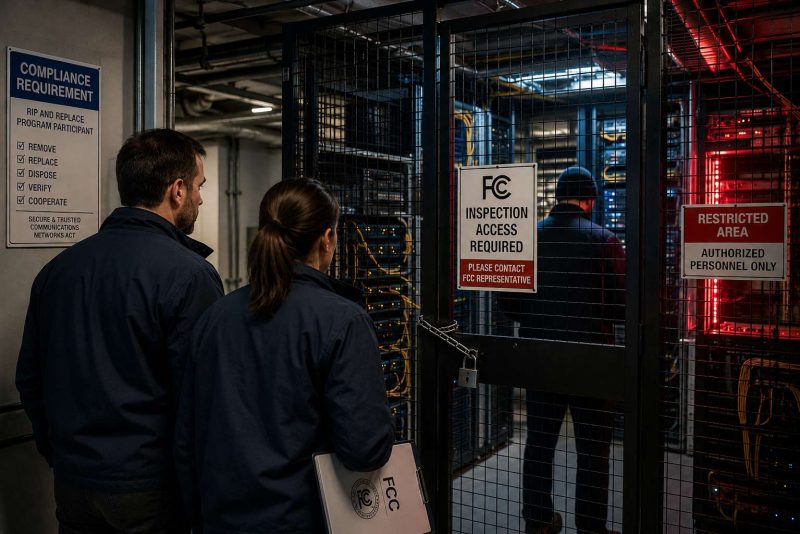
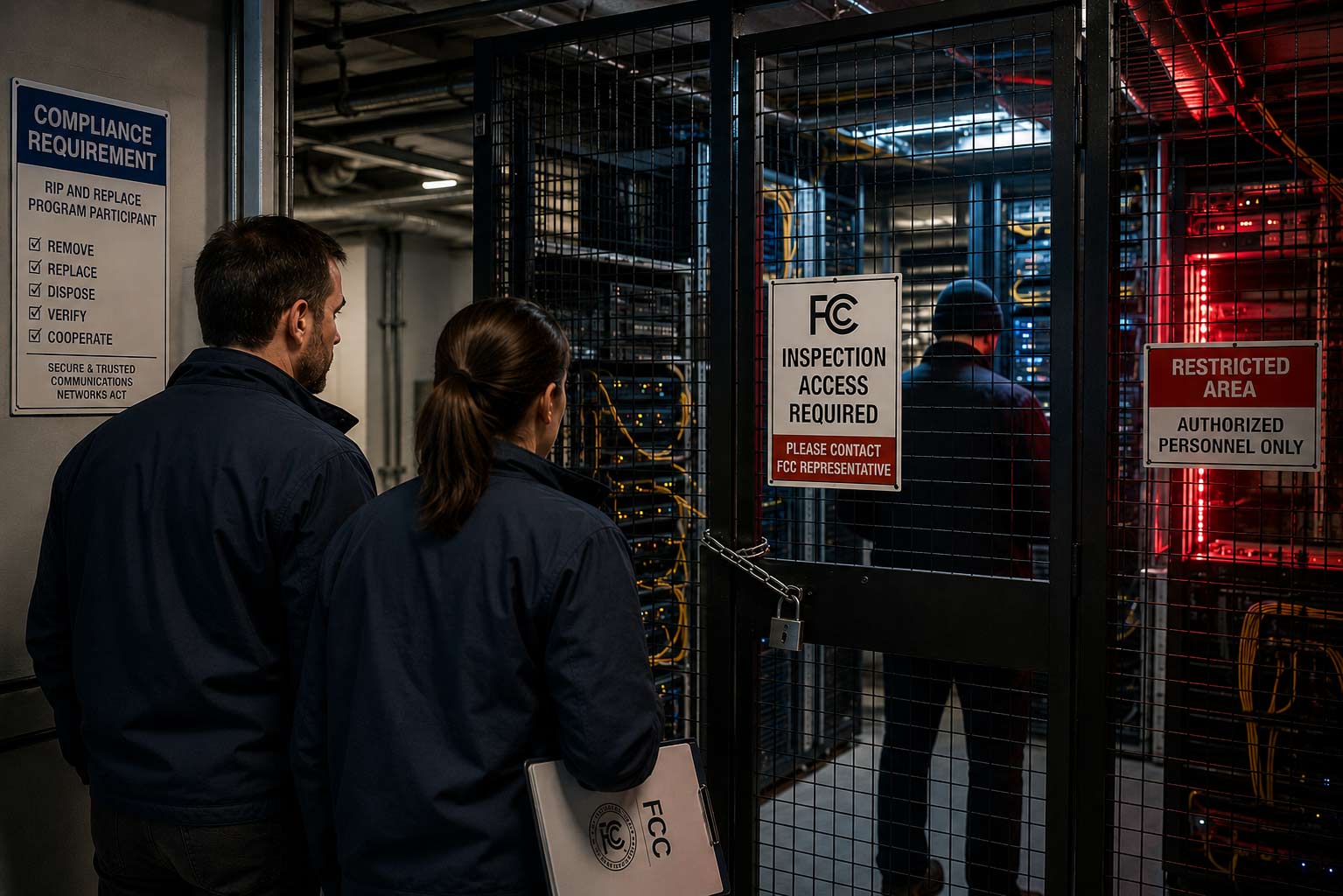
The Federal Communications Commission’s Enforcement Bureau has proposed a $14,000 fine against Stealth Communications Services, LLC, a New York-based fiber broadband provider, for allegedly blocking two compliance inspections related to its participation in the federal “Rip and Replace” program, which aims to eliminate Chinese-made telecommunications equipment from American networks.
The Alleged Violations
The FCC’s Enforcement Bureau announced Thursday that Stealth Communications apparently failed to permit two compliance inspections required under the Secure and Trusted Communications Networks Reimbursement Program — the federal initiative commonly known as “Rip and Replace.” The inspections were intended to verify the company’s progress in removing equipment from its network as a condition of receiving federal reimbursement funds.
Under the program’s rules, participating carriers are required to cooperate fully with FCC compliance monitoring, including permitting on-site inspections of their facilities. Blocking or impeding such inspections is a direct violation of the program’s requirements and can expose participants to fines, cancellation of funding commitments, or recoupment of funds already disbursed.
Who Is Stealth Communications?
Founded in 1995, Stealth Communications Services is a private fiber-based Internet service provider headquartered in New York City. The company installs and maintains its own fiber optic network throughout New York City, providing gigabit internet services primarily to businesses in Manhattan. In 2013, the City of New York authorized Stealth to construct its own fiber network, and by 2015 the city entered into a $5.3 million public-private partnership with the company to expand fiber broadband into Brooklyn and Queens Industrial Business Zones. As of 2019, Stealth reported connecting hundreds of commercial properties with over 100 fiber route miles.
Stealth has a prior history with the Rip and Replace program. In September 2023, the FCC’s Wireline Competition Bureau granted Stealth a six-month extension of its removal, replacement, and disposal deadline — from September 29, 2023 to March 29, 2024 — citing supply chain issues beyond the company’s control. That extension made Stealth the first recipient of such a deadline extension under the program.
The Rip and Replace Program
The Secure and Trusted Communications Networks Reimbursement Program was established under the Secure and Trusted Communications Networks Act of 2019 and formally stood up in 2022. The program reimburses small providers of advanced communications services — those with 10 million or fewer customers — for the costs of removing, replacing, and disposing of telecommunications equipment from companies deemed national security threats, primarily Huawei Technologies and ZTE Corporation, both of which have ties to the Chinese government and military.
The program faced a significant $3 billion funding shortfall for years, leading to reduced payments to participants and repeated delays until Congress provided the necessary funding in late 2024. As recently as May 1, 2026, the FCC granted 26 companies additional time to complete their work under the program, citing supply chain disruptions and permitting delays.
Consequences of Non-Compliance
The $14,000 proposed fine reflects penalties for two separate instances of blocking inspections. Beyond the fine itself, the stakes for Stealth are considerably higher. Under the program’s rules, non-compliance can result in the denial of future funding, the cancellation of existing funding commitments, and the recoupment of funds already paid out. Participants who signed on to the program also acknowledged that failure to comply could result in civil or criminal prosecution by law enforcement authorities.
The proposed fine is currently a Notice of Apparent Liability, meaning Stealth has the opportunity to respond to the FCC before any final penalty is imposed. The company may contest the findings, present mitigating circumstances, or negotiate a settlement with the Enforcement Bureau.
The FCC filing is available on the Commission’s website under Docket No. 18-89.

