















The timing lines up in a way that’s hard to ignore. Just as a new report commissioned by the Wireless Infrastructure Association — alongside a separate, independent analysis reaching similar conclusions — argues that satellite direct-to-device service can’t replace terrestrial cell towers, the federal government is moving to strip roughly half the broadband locations awarded to satellite providers under the $42.45 billion BEAD program.
States are being asked to remove as many as half the locations they’d awarded to satellite internet providers under BEAD, according to four state officials who spoke to Broadband Breakfast. Satellite had accounted for about 20 percent of the program’s 3.9 million locations, with satellite grantees collectively set to receive more than $1 billion — both figures now headed downward.
The National Telecommunications and Information Administration told states last week that locations no longer qualify because the FCC’s newest broadband coverage map, published earlier this month, shows those spots either don’t need service at all (sheds, barns) or are already served by a terrestrial provider. The removals fell almost entirely on low-Earth-orbit satellite awards — SpaceX and Amazon Leo, the only two LEO providers in the BEAD program, were positioned to split roughly $1.05 billion combined before this reduction.

One Sponsored Report, One Independent
The Mobile Experts Inc. report, “Will Satellites Replace Cell Towers?“, was directly sponsored by WIA, a trade association representing terrestrial tower and infrastructure companies. The second report, TMF Associates’ “Satellite Direct-to-Device: A Supplement for Terrestrial Cell Coverage,” written by longtime independent satellite analyst Tim Farrar, carries no sponsorship, though WIA is hosting and promoting it alongside its own commissioned report. Both reach much the same conclusion.
What the Independent Report Found
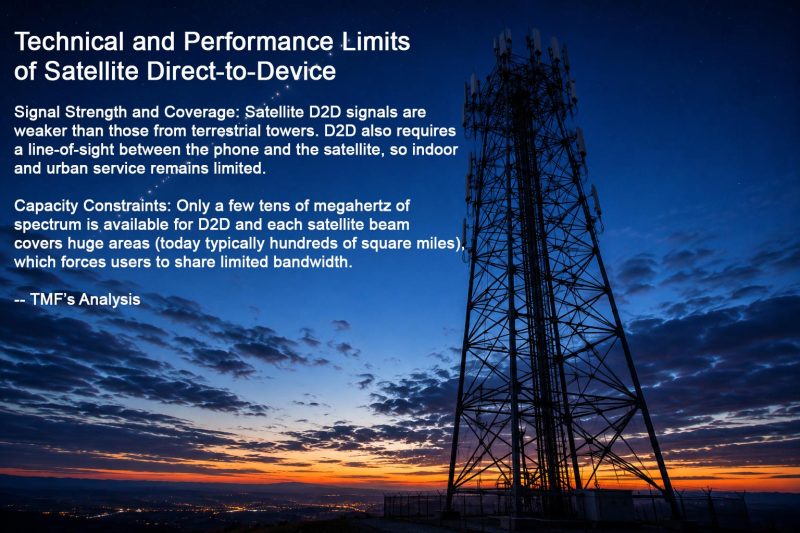
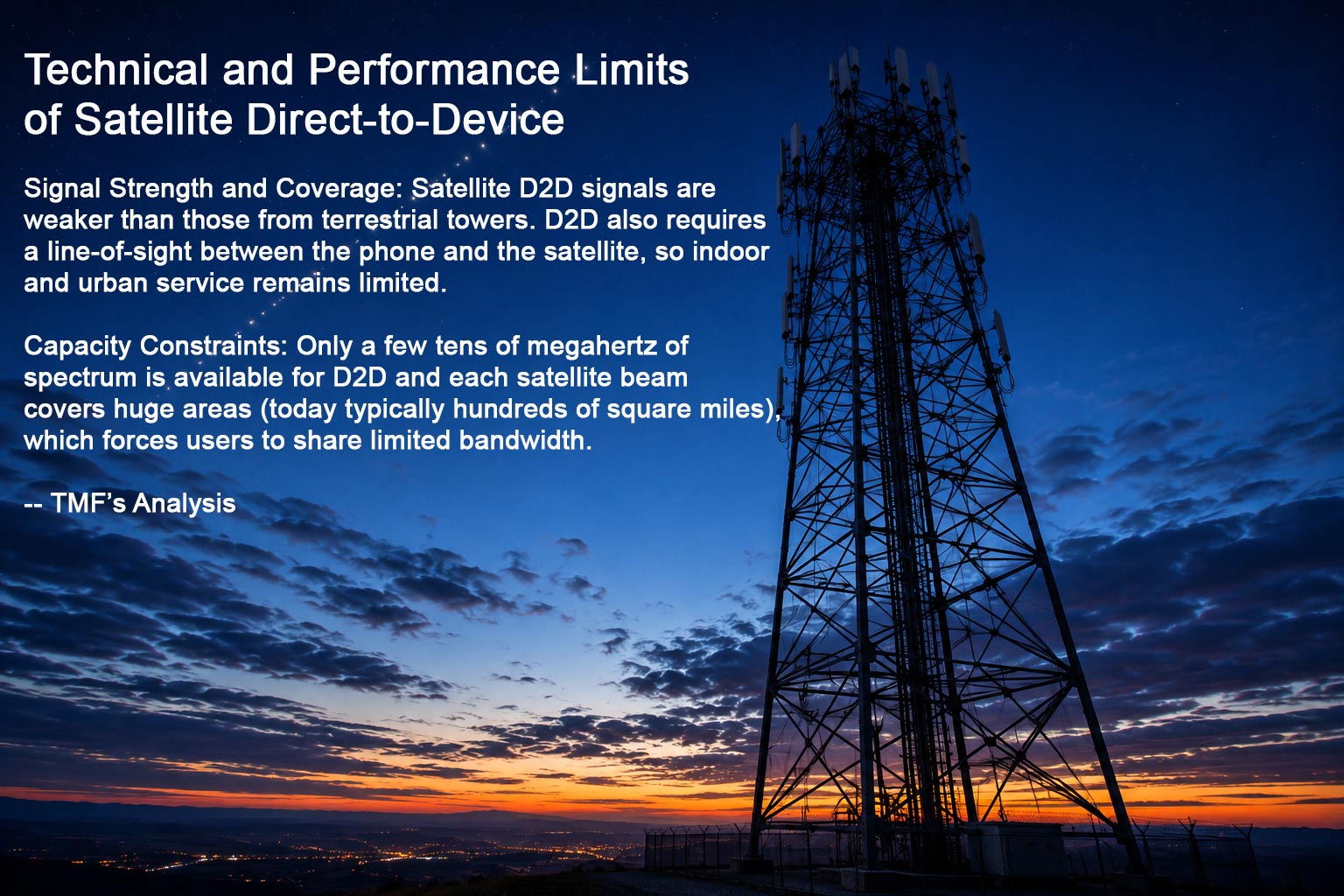
Farrar’s paper is the more data-dense of the two, and it’s blunt about the scale of the gap between hype and current usage. As of May 2026, satellite usage accounted for just 0.0002 percent of T-Mobile’s total network traffic, despite the carrier reporting 150,000 daily users of its Starlink-powered T-Satellite service as of January 2026. Farrar calculates that works out to roughly 10 petabytes of satellite traffic a month, or just over 2 megabytes of data per user per day — compared with an average daily consumption of more than 600 megabytes per connection across the 579 million wireless connections tracked by CTIA in 2024. T-Mobile’s own CEO has described usage as “a lot less than what we were originally thinking,” concentrated mostly in national parks.
The technical constraints Farrar cites are specific: current Starlink D2D speeds generally run below 1 Mbps download, compared with average terrestrial mobile download speeds in the U.S. of 73.8 to 184.7 Mbps as of fall 2025. Starlink’s D2D service uses just a single paired 5 MHz spectrum block in the U.S. today, a sliver compared with the hundreds of megahertz mobile operators deploy terrestrially — and that scarcity carries a real price tag: the FCC valued a similar 5 MHz block at $4.8 billion back in 2004, while SpaceX has now agreed to pay over $20 billion, including interest, to acquire 65 MHz of spectrum from EchoStar for its next-generation system. Even with that massive investment, T-Mobile, AT&T, and Verizon each still hold more than four times as much spectrum for their terrestrial networks.
Farrar is careful to note this is a genuinely fast-moving space, not a static picture: Amazon’s pending acquisition of Globalstar, a T-Mobile/AT&T/Verizon joint venture announced to pool spectrum resources across satellite partners, SpaceX’s $85 billion June 2026 IPO, and Rocket Lab’s roughly $8 billion agreement to acquire Iridium all point to serious capital continuing to flow into the sector. But he frames the physics as durable regardless of the investment: satellites sit hundreds of miles from a handset rather than the few miles typical of a terrestrial tower, and signal power falls off with the square of distance — meaning a satellite 100 times farther away than a cell tower produces a signal roughly 10,000 times weaker. Combined with beam footprints of 100 to 600 square miles versus 3 to 20 square miles for a typical suburban terrestrial site, Farrar’s paper concludes D2D “can never be a true substitute for terrestrial cellular service,” even as SpaceX’s planned Gen2 constellation — not expected before 2028 — promises meaningfully better performance.
What the WIA-Sponsored Report Found
Mobile Experts’ report leans harder on plain-language framing — “satellites can cover Mount Everest, but they don’t cover your kitchen” — while backing it with its own link-budget math. A modern smartphone transmits less than 0.5 watts of radio power in all directions; that signal loses roughly 90 percent of its strength penetrating a typical exterior wall, leaving enough to reach a tower three miles away but not enough to reach a satellite 400 miles up. The report’s own link-budget table shows a positive margin for outdoor Starlink connections but a negative margin both indoors and in-vehicle — meaning, in the report’s terms, that indoor and in-car satellite connections fall below the threshold needed for even a minimal connection.
On usage, Mobile Experts cites Ookla speed-test data showing satellite connections account for only about 0.5 percent of American speed tests run since the T-Mobile/Starlink, Skylo, and Lynk services launched — a figure the report says lines up almost exactly with its own back-of-envelope estimate: since people spend more than 90 percent of their time indoors and roughly 90 percent of Americans already have good 4G/5G coverage, simple logic suggests only about 1 percent of usage should plausibly shift to satellite.
The report’s economic analysis is its most concrete contribution: it estimates 5G data costs mobile network operators roughly $0.27 per gigabyte to deliver in a busy city, rising to about $3.50 per gigabyte in sparsely populated rural areas due to lower utilization — while predicting satellite D2D costs, even once constellations are more heavily utilized, will run between $4 and $8 per gigabyte. Roughly 650 Starlink satellites currently provide D2D coverage globally, with 14,000 more planned, compared with the roughly 80,000 base station sites that make up a typical American terrestrial mobile network. The report’s conclusion: “Satellites are more expensive than terrestrial base stations everywhere that people live: in urban, suburban, and most rural communities. Satellites make sense financially in truly remote areas, where terrestrial networks would be under-utilized.”
Where the Freed-Up BEAD Money Might Land
What happens to the roughly $1 billion or more in freed-up satellite BEAD funding is, for now, an open question — and it’s tangled up with a much larger pot of money NTIA has been sitting on for months. NTIA Administrator Arielle Roth told lawmakers in late June that guidance on more than $21 billion in BEAD “non-deployment” funding — money left over after states meet their basic infrastructure obligations — is targeted for release sometime this summer, after having already slipped past an earlier March deadline. The agency has floated permitting reform, workforce training, public safety communications, and Next Generation 911 upgrades as possible uses; some Republican senators have separately pushed for cybersecurity spending, while a still-unsigned executive order would tie access to those dollars to whether states have “onerous” AI regulations on the books.
Nothing in NTIA’s public statements so far specifically earmarks the satellite-reduction savings for fixed wireless, but the structural setup makes it a plausible landing spot. Under the Trump administration’s technology-neutral restructuring of BEAD, fixed wireless is already one of three approved deployment technologies alongside fiber and satellite, and it’s already carrying real weight in the program — roughly 11 percent of BEAD-eligible locations nationally are slated for fixed wireless under states’ approved final proposals, with fiber taking about 66 percent and satellite the remaining share. Fixed wireless has also already produced some of the program’s only tangible results to date: Roth told Congress in late June that Louisiana and Nebraska are the only two states to have actually connected any residents using BEAD money so far, and both did it with fixed wireless, not fiber. If NTIA’s forthcoming non-deployment guidance treats “cleaning up” locations stripped from satellite awards as a priority, fixed wireless — cheaper and faster to deploy than fiber, and already proven out in two states — is a logical technology for states to lean on to fill the gap, though nothing published to date confirms that’s where NTIA intends to steer it.

