
















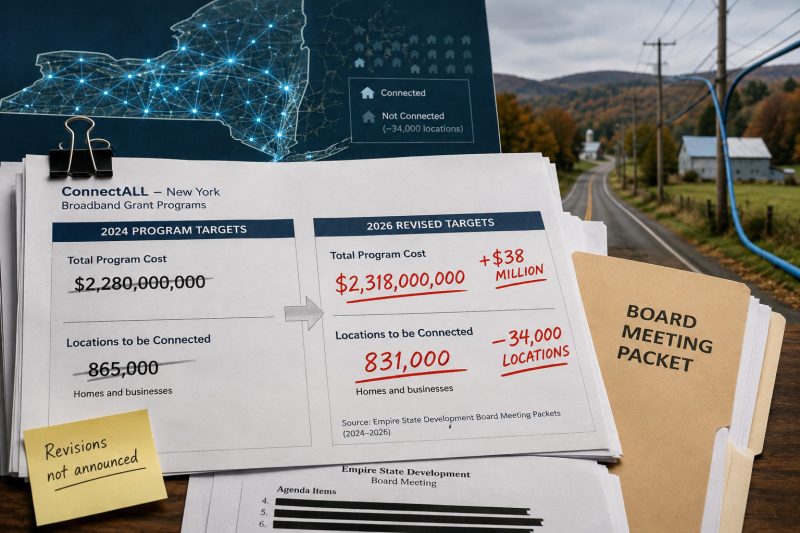
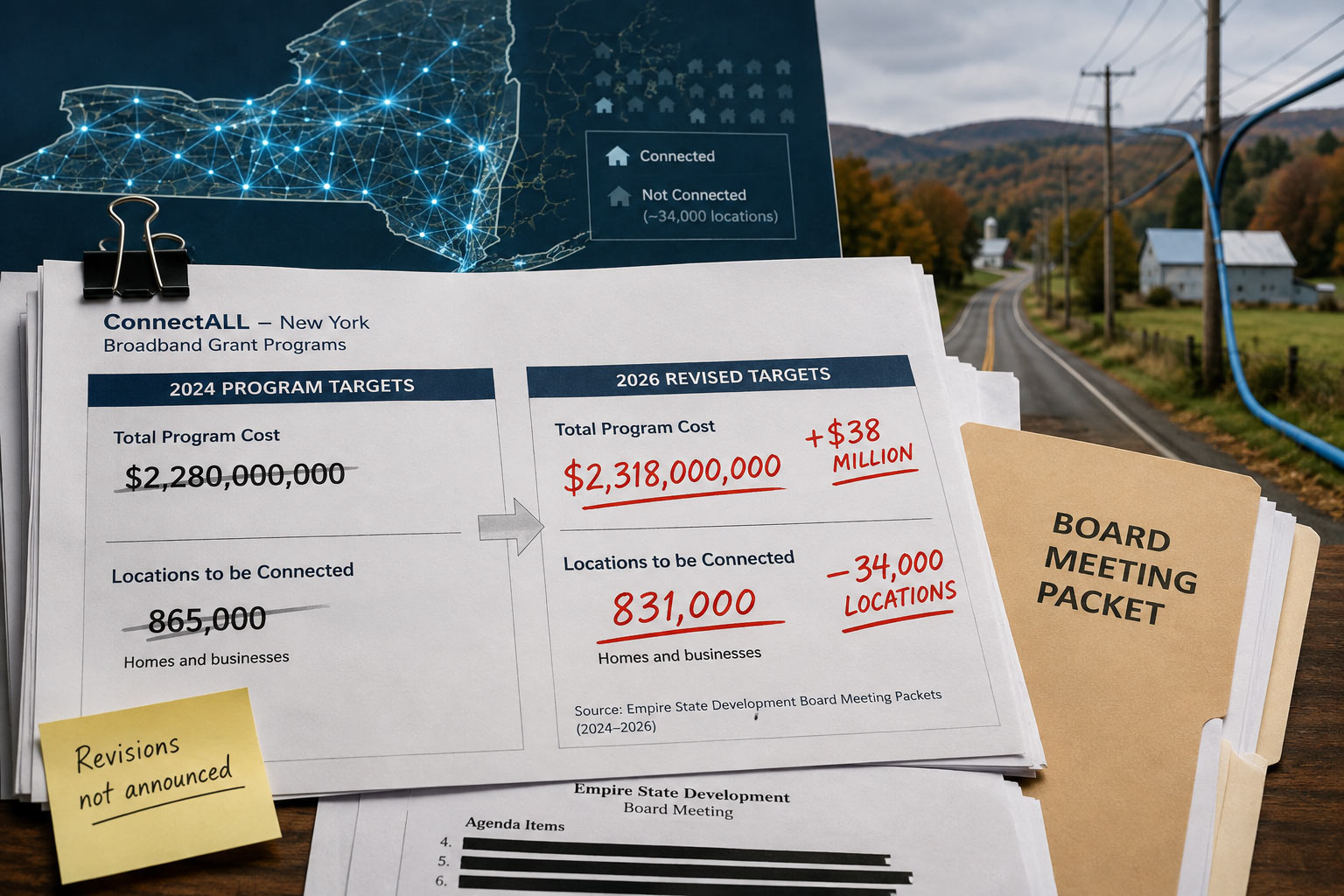
New York quietly widened the price tag on its two flagship broadband grant programs by roughly $38 million over the past two years — while cutting the number of homes and businesses those same programs promise to connect by about 34,000, according to an analysis published August 18 by the Advanced Communications Law & Policy Institute (ACLP) at New York Law School.
ConnectALL, the state broadband office overseeing the money, did not announce any of the revisions. ACLP says it found them buried in Empire State Development board meeting packets.
New York has committed more than $300 million in federal Capital Projects Fund money and state funds to two programs: the Municipal Infrastructure Program (MIP), which funds open-access municipal fiber networks, and the Affordable Housing Connectivity Program (AHCP), which funds connectivity in affordable housing developments. ACLP director Michael Santorelli and researcher Alex Karras tracked all 34 awards issued under the two programs — 22 MIP, 12 AHCP — from July 2024 through July 2026, cross-referencing every dollar figure and location count against its original announcement.
The detail that matters more for this industry than the headline number is where the money and the mileage actually moved: fewer homes passed, higher grants per project, and a scope-cutting pattern that lines up almost exactly with the same rising labor, materials, tariff and right-of-way costs that have been squeezing tower and fiber contractors on private builds for the past two years. This isn’t an abstract state-budget story. It’s a preview of what the publicly funded side of the buildout looks like when those same cost pressures hit a program with no matching-fund requirement and a hard federal deadline.
The paper trail existed — it just wasn’t published anywhere ConnectALL wanted you to look
ACLP’s report is blunt about how it found this: not through a ConnectALL announcement, a press release, or the agency’s project dashboard, but by working through meeting materials prepared for the Empire State Development board, which oversees ConnectALL. “New York does not report these grants consistently,” the report states. “Rather than a standing record per project, cost and scope figures surface piecemeal across board packets, fact sheets, performance reports, and press releases, each stating a project’s status as of that moment. No single source shows how a grant has changed over time.”
One line buried in the state’s own CPF Performance Report, filed with the U.S. Treasury in July, confirms part of the mechanism: New York moved unspent AHCP funds over to cover a shortfall in MIP. That’s the kind of transfer that would ordinarily warrant its own line in a press release. Instead, ACLP found it in a footnote.
Ten grants went up, seven went down — and reach fell almost everywhere
The numbers, aggregated across both programs: 10 projects had their grant amounts revised upward by 5 percent or more, against 7 revised downward, netting about $38 million in additional committed funding. Meanwhile, MIP now plans to pass roughly 19,000 fewer locations than originally announced — a 15 percent cut — and AHCP has fallen further, down about 15,000 households, a 44 percent cut. Fifteen of the 34 projects will now serve fewer connections than the day they were first announced. Run those two lines against each other and the unit economics move in one direction only: the average cost to connect a single MIP location is up 26 percent, from $2,113 to $2,661; the average cost per AHCP household is up 91 percent, from $957 to $1,822.
A handful of individual awards carry most of that weight. Oswego County’s MIP grant — announced in February 2025 as a $26 million award to build 345 miles of fiber and pass 10,792 homes, businesses and community institutions — now shows a $29.5 million grant against 2,319 locations, according to ACLP’s tracking: a 79 percent cut in promised reach paired with a 13 percent increase in cost. That’s the single largest per-project swing in the dataset, pushing Oswego’s cost-per-location up 428 percent. Schoharie County’s grant climbed from $30 million to $42.4 million, a 41 percent jump, while its planned locations grew only 10 percent, from roughly 4,000 to 4,390 — cost outrunning reach by a wide margin even where the project didn’t shrink.
Two AHCP awards in ACLP’s dataset moved in the same direction: a combined Manhattan and Bronx award dropped from 6,080 households to 3,607, a 41 percent cut, and a Buffalo City award fell from 5,033 households to 3,353, down 33 percent.
Two projects didn’t just shrink — they nearly disappeared. The CNY Open Access award, originally $26 million, was cancelled outright. And a Franklin County project with Development Authority of the North Country (DANC) was cut from 1,600 planned locations to two, which ACLP flags separately in its methodology rather than folding into its cost-per-connection averages, on the reasonable grounds that a grant spread over two locations isn’t a meaningful unit-cost figure.
Why the state says this is happening — and why the explanation only partly holds up
ACLP lays out three plausible, overlapping explanations, and doesn’t pretend to have proof of which one dominates. First: CPF-funded projects must be substantially complete by the end of this year, and slashing scope on a project is one way to guarantee it crosses that finish line on time. Second, and complicating that theory: Treasury does allow states to request deadline extensions, and New York appears to have secured them for some AHCP projects, pushing that program’s completion deadline to June 30, 2027.
ConnectALL requested extensions on MIP projects too, but that request was still pending as of the end of July, according to the report — which didn’t stop the state from cutting MIP scope anyway, well before knowing whether it would get more time.
The third explanation is the one that should get a tower and fiber contractor’s attention: rising construction, labor, tariff, and infrastructure-access costs. ACLP notes that ISPs “of all ilk are encountering higher than expected ROW, pole, and related access costs” — the same line items that have been reshaping bid economics on privately funded builds across the country. MIP and AHCP were both structured without a required grantee match, meaning the state — not a private ISP — absorbs the full cost of these overruns directly. When a pole-attachment negotiation runs long or a right-of-way permit costs more than modeled, there’s no private partner sharing that hit. New York eats it alone, which is a fairly direct explanation for why the state might be trimming footprints rather than requesting more money for the same footprint.
ACLP also raises a separate and less flattering possibility: that private ISPs have simply kept building and “edging out” their own networks into some of these areas since the grants were first announced, making portions of the publicly funded build redundant. The institute has flagged this overbuilding concern in earlier reports on the same two programs, and says it applies here too — meaning some of what’s being cut may never have needed public money in the first place.
What it means for the contractors bidding this work
For firms building out fiber and municipal broadband under these grants, the practical takeaway isn’t the $38 million headline number — it’s that the reach these projects were bid and scoped against has been quietly shrinking on the state’s side of the ledger, in some cases by double-digit percentages, without a corresponding public notice to the market watching them. A contractor pricing follow-on work off an original 10,792-location Oswego announcement is pricing against a project that, per ACLP’s tracking, is now a 2,319-location build. That’s not a rounding error in a construction plan; it’s a different project.
ACLP’s closing argument is a transparency argument, not just a budget one: the fact that this pattern could only be reconstructed by hand, from scattered board packets and a buried Treasury footnote, is itself the finding.
The institute is calling for standardized, ongoing public reporting on grant scope and cost changes — not because the underlying cost pressures are unusual, but because contractors, county governments, and taxpayers are currently expected to track $300 million in public infrastructure spending by reading the fine print of unrelated board meetings. New York didn’t build a broadband transparency gap. It just never built the reporting to close one.
