















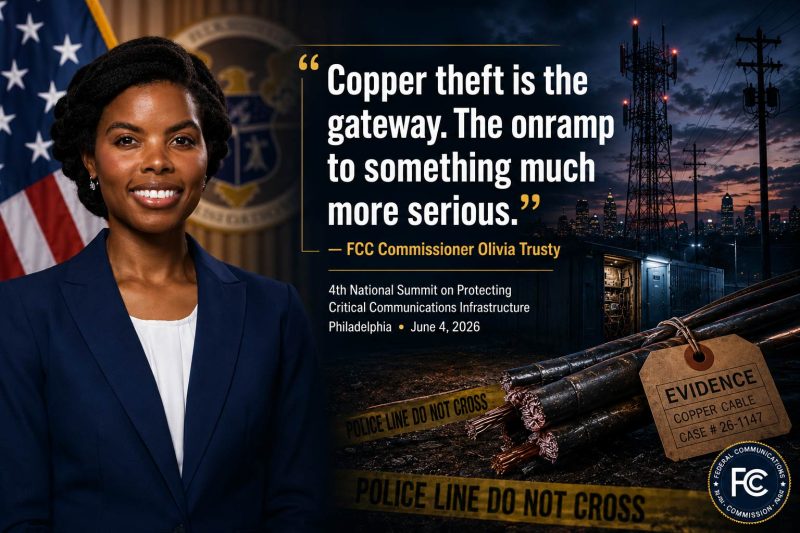
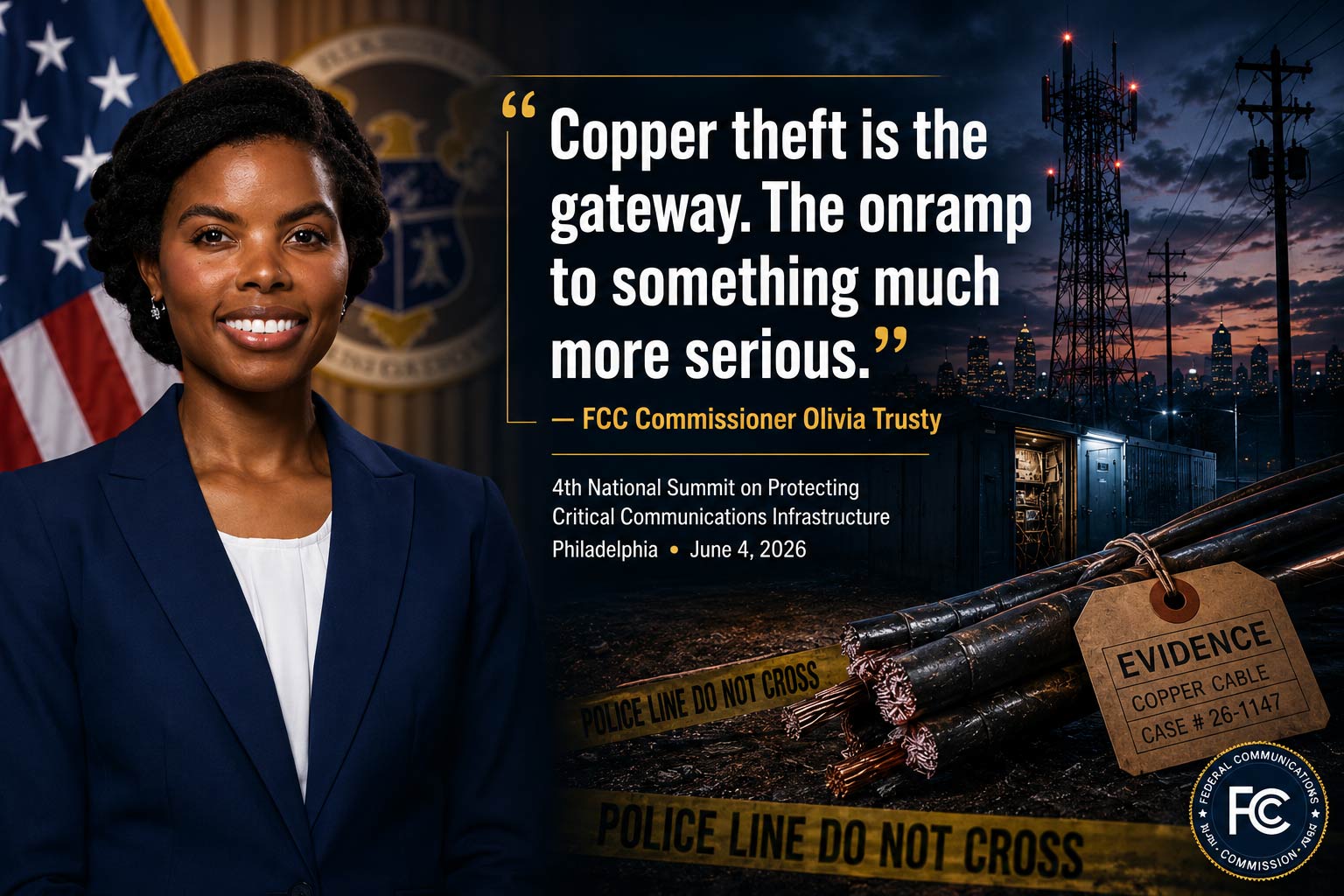
The theft and deliberate destruction of America’s communications infrastructure is no longer a regional nuisance or a simple property crime — it has become a national security emergency, and it is getting worse. That was the urgent message delivered by Federal Communications Commissioner Olivia Trusty at the 4th National Summit on Protecting Critical Communications Infrastructure, held in Philadelphia on June 4.
“Copper theft is the gateway,” Trusty told summit attendees. “The onramp to something much more serious.”
The Numbers Tell a Stark Story
Between June 2024 and June 2025, nearly 16,000 incidents of theft and vandalism targeted U.S. communications infrastructure, disrupting service for approximately 10 million customers. In the first half of 2025 alone, there were 9,770 reported incidents — nearly double the prior six months.
By 2025, the problem had grown even further. New reports released at the summit revealed more than 18,000 incidents in 2025, disrupting service for 11.8 million customers nationwide. An accompanying economic analysis estimated that such disruptions imposed societal costs — mostly borne by consumers — ranging from $294 million to $1.47 billion in 2025 alone.
More than half of copper theft incidents are concentrated in California and Texas, though Trusty pushed back on any purely regional reading of the problem. The threat, she made clear, is national.
AI: A New and Dangerous Multiplier
Perhaps most alarming is what Trusty described as the emerging role of artificial intelligence in targeting infrastructure. Trusty warned that AI tools are being used to mine public FCC filings to identify and specifically target communications infrastructure.
She noted that the combination of AI tools and dark web marketplaces is lowering the barrier to entry for would-be attackers. “We are not seeing widespread, confirmed misuse of AI in domestic infrastructure vandalism cases, yet,” Trusty said, “but the trajectory and potential for harm is clear.”
For rural broadcasters and telecom providers in particular, the warning carries special weight. Trusty urged a faster transition from copper lines to fiber in rural areas, where towers are especially vulnerable.
A Patchwork of Laws Leaves Gaps for Bad Actors
Stronger deterrence, Trusty argued, begins with the law. In 2025, 23 states considered new protections for communications infrastructure and 13 enacted laws strengthening felony penalties for theft and vandalism. In 2026, Colorado, Connecticut, Oregon, and Virginia adopted felony-level protections. Today, 28 states classify such crimes as felonies.
But that still leaves nearly half the country without adequate legal teeth. The remaining states that have not made the same classification create what Trusty called a “patchwork” — one that bad actors are actively exploiting, seeking out jurisdictions where the consequences remain minimal. Trellis
The Federal Fix: A Bill Awaiting Action
Trusty called on Congress to pass H.R. 2784, the Stopping the Theft and Destruction of Broadband Act, which would extend federal criminal protections to private communications networks delivered by wire or radio. The bill would establish clearer penalties for attacks on communications infrastructure and strengthen tools available to law enforcement — a step industry leaders have identified as critical to deterring repeat offenses.
The bipartisan legislation was introduced by Rep. Laurel Lee (R-FL) and Rep. Marc Veasey (D-TX). “When it comes to the intentional theft or damage of communications facilities, weak and ineffective laws often allow perpetrators to escape justice,” Rep. Lee said upon introducing the bill.
The bill has been introduced to close statutory gaps and criminalize attacks on privately owned communications networks nationwide, but it remains pending in the House Judiciary Committee. Trusty’s message in Philadelphia was direct: Congress needs to act now.
More Than a Crime — An Attack on All of Us
Trusty has been sounding this alarm for months, but her tone in Philadelphia carried new urgency. She referenced severed cables in Wyoming caused by suspected vandals, which led to a county-wide 911 outage and tens of thousands of dollars in damage, as well as a radio repeater tower used by firefighters that was deliberately targeted.
“When a hospital can’t connect to its patient records, when 911 callers hear nothing but silence, when an entire small town loses connectivity because someone saw dollar signs in copper wire — that is not a prank. That is not mischief. That is a direct attack on the lifeblood of our economy and our daily life,” Trusty said.
The message from Philadelphia was clear: the window to treat infrastructure vandalism as a manageable inconvenience has closed. What was once dismissed as opportunistic theft has evolved into a sophisticated, coordinated threat with national security implications — and the federal response has yet to keep pace.
