















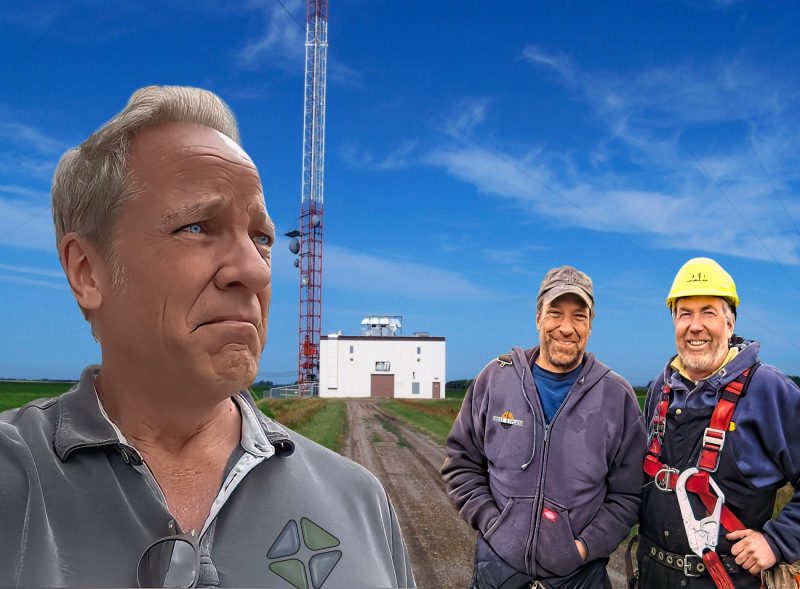
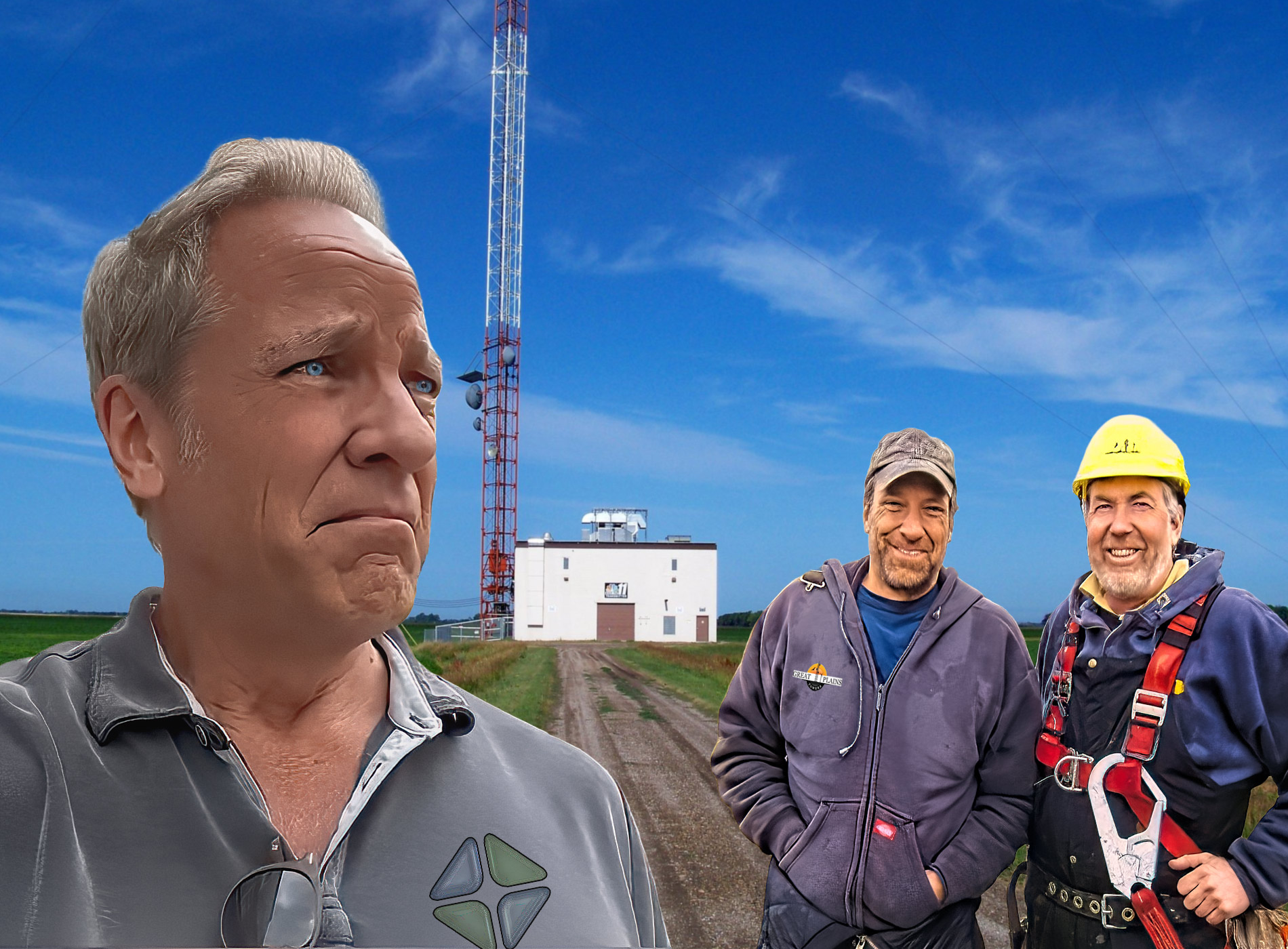
Mike Rowe, the nation’s most recognizable champion of skilled trades and PureTalk’s lead spokesperson, has abruptly terminated his relationship with the mobile carrier after a Reddit post and a chance encounter with a tower crew exposed what he described as “two uncomfortable truths I can’t unknow” — one about the company he represented, and one about the industry that makes it all work.
It started, as many things do now, on Reddit
In late January, a Reddit post caught Rowe’s attention. A user laid out, in the meticulous and mildly infuriated detail only Reddit can produce, exactly what PureTalk was — and was not.
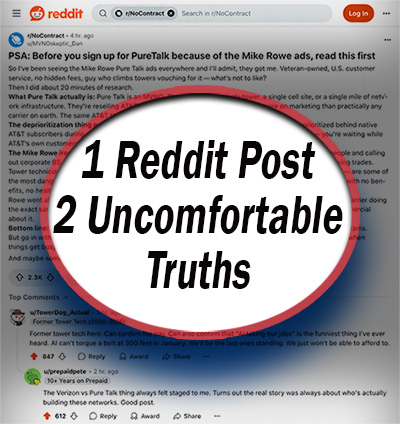
It was not an independent carrier that owned and operated its own network infrastructure, the kind of company employing the skilled American workers Rowe has spent two decades championing. It was an MVNO — a mobile virtual network operator — riding entirely on AT&T’s network.
The same AT&T that outspends Verizon on marketing by an additional hundred million annually.
The same AT&T that prioritizes its native subscribers over PureTalk customers the moment a network gets congested.
What the Reddit post clarified was that PureTalk subscribers were, quietly and contractually, AT&T subscribers, just without the name.
“I read that post three times,” Rowe said. “Then I called someone who could tell me if it was true. It was.”
The parking lot conversation that finished it
Rowe might have survived the Reddit revelation with a revised script and a carefully worded disclaimer.
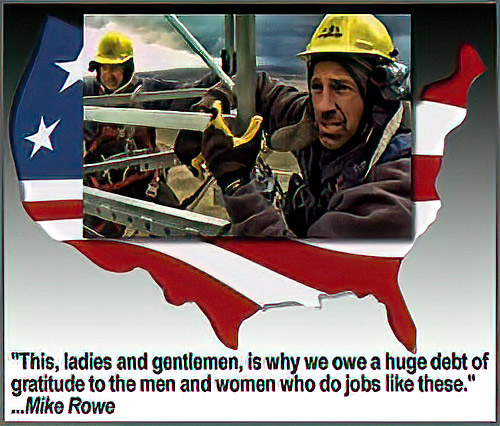
What made it untenable was what happened three weeks later.
During a PureTalk promotional shoot in late February, Rowe fell into a 45-minute conversation with a tower crew contracted to maintain a nearby cell site visible from the parking lot where filming was taking place.
“I was standing there telling a camera how PureTalk gives hardworking Americans a fair deal,” Rowe said, “and I could see guys gearing up to climb a 200-foot tower to swap out AT&T sectors for about what someone makes putting you on hold for three minutes—in an indecipherable accent—and calling it ‘customer support.’”
“I couldn’t finish the take.”
What followed was two weeks of calls to contractors, crew members, and industry insiders.
Rowe found that entry-level tower technicians — working at height, in wind, in ice, in conditions that can kill them if they make one wrong move, frequently earn between $18 and $22 per hour at the bottom of the contractor supply chain.
He also discovered that many are illegally classified as independent contractors, with no benefits, no health insurance, and no paid time off.
“The fatality rate in this industry is staggering,” Rowe said.
He also noted, with considerable edge, that the AI wave eliminating white-collar jobs across the economy has done nothing to threaten the tower technician workforce — and won’t.
“AI can’t climb,” he said.
Rowe said the final decision came when he was reviewing the script for his next PureTalk spot — a commercial that would again position the carrier as the honest, working-person’s alternative to the corporate giants.
“I looked at the script, and I thought: I can’t say these words with a straight face anymore. Not because they’re false. But because the full truth is bigger than what the script contains. And I’ve never been any good at telling half a story.”
“PureTalk is a good company,” Rowe said. “I’ve been pointing my finger at Verizon for years, and they earned it. But AT&T and T-Mobile are no different. They’re all squeezing the same contractors and their tower technicians into the ground. I just didn’t connect those dots when I signed on. I’ve connected them now.”
He paused.
“The dirtiest job in America isn’t the one I filmed in Dickinson. It’s what the carriers have done to the contractors and crews out there doing it,” Rowe said.
“I couldn’t help but wonder how many wireless contractors I pass every day who seem perfectly normal—until you realize they’re standing on a pool of magma, fueled by unpaid change orders and bad pricing, just waiting to erupt and bring a carrier’s build program to a grinding halt.”

If you’re reading this note with a slight sense of having been had, that’s entirely intentional. It’s April 1st, and Mike Rowe has not quit PureTalk. Everything else, unfortunately, is real.
The wages, the supply chain squeeze, and the fatality rates are real. So is the part about PureTalk running on AT&T’s network — and deprioritizing its subscribers during congestion.
Rowe publicly called out Verizon for using its financial muscle to pressure networks into pulling a PureTalk commercial that took direct aim at its pricing, a move he described as textbook bullying by a $185 billion company that buys more media in a week than PureTalk buys all year. Rather than back down, he went straight back to his office and recorded a new one using just his cellphone, and posted the story publicly for his six million Facebook followers to judge for themselves.
Contractors know that move well. The difference is that when the carriers pressure them, there’s no cellphone video, no six million followers, and no second take.
And the deeper irony: the “honest man’s” alternative Rowe championed runs entirely on AT&T’s network, the same carrier whose pricing practices, similar to Verizon and T-Mobile, are grinding the contractor workforce down.
PureTalk has built its brand around supporting veterans.
NATE: The Communications Infrastructure Contractors Association’s Military of NATE ad hoc committee actively recruits veterans transitioning out of military service into tower work to allow them to achieve their full potential and help in the industry.
And non-profit Warriors4Wireless helps veterans get careers as tower techs.
The veterans Pure Talk celebrates in its commercials, and the veterans ascending towers for near-poverty wages are, in many cases, the same people, just photographed from different angles.
Somewhere between the veteran photo shoots, nobody at PureTalk bothered to check what the network they’re selling actually pays the veterans building it.
Mike Rowe has spent his career warning that the skilled trades are in crisis. Tower climbers don’t need that warning — they’re living it.
Contractors are closing their doors and thousands of jobs are disappearing, not because of AI, not because the work has gone away, but because the pay no longer covers the cost of doing it.
Rowe asked America in 2012 to think about these workers the next time they picked up a phone. Fourteen years later, the phone still works. The workforce, building and maintaining it, is quietly falling apart.
One final footnote: the Dickinson episode wasn’t just memorable — it was the shoot that completed Rowe’s Dirty Jobs journey across all 50 states. He saw more of American labor than almost anyone alive. It just turns out the pay stub was never on the itinerary.
Additional April 1 exclusive and investigative Wireless Estimator articles can be found here:
Kiss Cam love story ends the moment Verizon’s terms were unveiled last night
Senator Kennedy says wireless giants are running a ‘Goat Rodeo of Greed’ at contractors’ expense; investigations by DOJ and FCC urged
Alabama contractor’s tower crews to share in an expected $120 million windfall from an unexpected fine art find
Interagency squabble ends with OSHA requiring the nation’s revered raptors to harness up

Nationwide strike of contractors averted after carriers and towercos agree to meaningful concessions
From monopoles to barber poles, NWSA adds a new certification to buoy lack of broadband funding
FCC to unveil breakthrough technology to replace billion-dollar spectrum bids
New structural corset could sound the death knell for tower technicians’ retrofitting work
Huawei CFO’s release requires her to show how she swapped out cell site circuit boards
Giant step back for mankind: Supreme Court scrubs Nokia’s 4G Moon network launch
Ivanka puts in a hostile bid for 3M, wants crown jewel DBI-Sala
Guyed tower collapses on White House lawn hurling lighting debris into President’s office
Anritsu’s global success tagged to God and one misspelled word in 1844
American Tower takes AT&T to court and wins a $132 million judgment
From broadband to a blues harp, PCIA Chief splits his time with Broadway
